Lee Administration Plans to Purchase 36 Trillion Won Worth of Advanced U.S. Weapons During Term... Stealth Fighters to Aid OPCON Transfer
- Input
- 2025-11-05 12:31:47
- Updated
- 2025-11-05 12:31:47
During tariff negotiations, the Donald Trump administration demanded that the Korean government spend 5% of its GDP (93 trillion won) on defense. In response, the Korean government has only considered defense spending up to 3% of GDP (55 trillion won).
According to government diplomatic sources on the 5th, the South Korea–United States summit Joint Fact Sheet (JFS), which is in its final stages of coordination, is expected to include a provision stating that South Korea will purchase U.S. weapons worth $25 billion (about 36 trillion won). The Korean side has already presented the U.S. with a list of American weapons that have been decided for purchase or are planned for acquisition, stating that the purchase volume will reach $25 billion by 2030. The scale of projects reflected in the Medium-Term National Defense Plan (2025–2029) that involve the purchase of U.S. weapons is also estimated at around $25 billion.
A significant portion of the advanced weapons to be acquired will be those necessary for the transfer of Wartime Operational Control (OPCON). The Lee Jae-myung administration aims to achieve OPCON transfer within its term. This requires the introduction of high-priced U.S. reconnaissance equipment and similar assets.
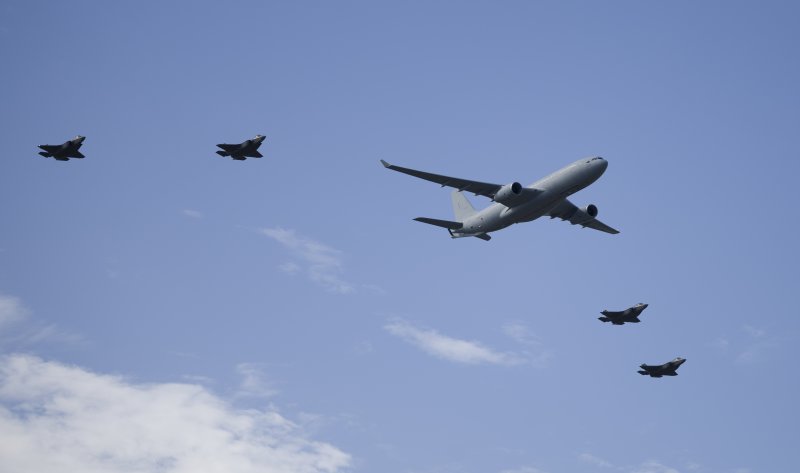
The list of U.S. advanced weapons to be purchased includes the following: the second phase of the F-35A project (about 4.5 trillion won), the second phase of the Airborne Command and Control Aircraft project (about 3 trillion won), the Large Special Operations Transport Helicopter project (about 3.3 trillion won), maritime operational helicopters (over 3 trillion won), the Command Helicopter-II project (about 870 billion won), and the Ship-launched Ballistic Missile Interceptor project (about 800 billion won).
The Command Helicopter-II project is essential for strengthening the command and control capabilities of the Korean military and its ability to conduct combined operations. The Ship-launched Ballistic Missile Interceptor project is also a key initiative to bolster the response to North Korea's nuclear weapons and ballistic missile threats, forming a core part of the national missile defense system.
The most expensive projects—the second phase of the F-35A and Airborne Command and Control Aircraft—are closely linked to the transfer of OPCON. The second phase of the Airborne Command and Control Aircraft project will significantly enhance the Korean military’s ability to command and control air and fighter jet operations. This will play a crucial role in ensuring that the Korean military can independently command and control operations after OPCON transfer.
In particular, the F-35A stealth fighter acquisition project is regarded as a core initiative for preparing for OPCON transfer by strengthening the Air Force’s advanced combat capabilities and enhancing independent operational capacity.
South Korea already introduced the F-35A stealth fighter a decade ago. In 2014, the government signed a contract with Lockheed Martin Corporation to purchase a total of 40 units, some of which have been deployed and are in operation with the Air Force. The government is considering expanding the fleet to 60 units through additional purchases. Starting in 2027, South Korea is expected to have the capability to independently conduct depot-level maintenance (disassembly, assembly, life extension, and upgrades) of the F-35A domestically.
While South Korea is also developing its next-generation indigenous fighter, the KAI KF-21 Boramae, the introduction of the F-35A remains crucial for securing fifth-generation stealth air power for the Air Force.
The list of purchases submitted to the U.S. is largely composed of weapons systems to be acquired through government-to-government Foreign Military Sales (FMS) contracts. South Korea and the U.S. are in the final stages of coordinating the announcement of a fact sheet summarizing agreements in security and trade reached through two summits. The trade section has already been finalized, but the final documentation of the security section is experiencing some delays. The two countries are also negotiating details regarding the introduction of a nuclear-powered submarine, revisions to the Nuclear Cooperation Agreement, and the purchase of U.S. weapons. A government official stated, “Final coordination among relevant ministries is underway regarding the wording of the fact sheet.”