Taerim Oh, CEO of Gluwa: "Becoming the Bitcoin of Communication Networks" [Video]
- Input
- 2025-11-06 09:19:02
- Updated
- 2025-11-06 09:19:02
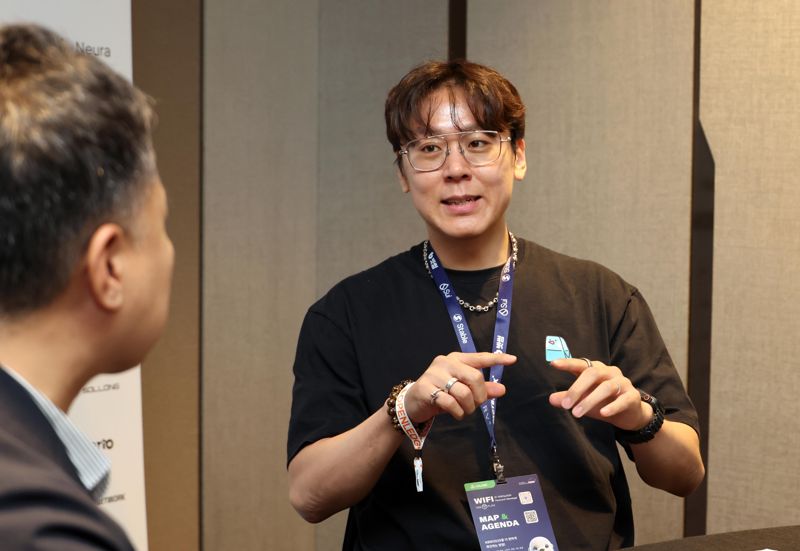

"In the medium term, our goal is to complete the design at the communication satellite level and provide technological proof. In the long run, as various companies and governments begin to use this decentralized network, we aim to become the company that is like Bitcoin (BTC) for communication networks."
Taerim Oh, CEO of Gluwa, recently sat down for an interview with The Financial News YouTube channel. Gluwa is the developer behind Spacecoin and Creditcoin (CTC), and is a well-known figure in the blockchain industry who needs little introduction. He has drawn significant attention for launching a ‘space project’ that connects the space industry with blockchain. This year, after completing technology verification, the company plans to launch its first satellite cluster as early as next year. We discussed with CEO Oh the company’s mid- to long-term business plans.
— We heard you became interested in blockchain during your university years. Was there a particular reason?
▲ I graduated from university in December 2010, and at that time, Bitcoin (BTC) was a hot topic on campus. As a young student, I realized that Bitcoin was not just a digital currency, but an innovative technology that enabled ‘objective facts’ in the digital world. Previously, digital data could be controlled and manipulated, making it inherently subjective. Blockchain, however, was the first technology to create ‘digital objectivity’ that could not be tampered with. I was convinced that this would lead to a massive innovation.
— Did you decide to start a business right away?
▲ I originally planned to go to graduate school, but after seeing the emergence of Bitcoin, I felt, “This is something I have to start now.” So, I postponed graduate school and founded Gluwa in 2012.
— How did the ‘space project’ leading to Spacecoin begin?
▲ After starting the blockchain business, we launched a project called ‘Creditcoin (CTC)’ in 2017. The goal was to provide lending opportunities to the financially underserved outside the banking system and to record loan data on the blockchain to create an objective credit profile. In fact, we provided loans totaling about $100 million to more than two million people.
However, as we ran the business, we realized that a significant number of the financially underserved didn’t even have internet access. Without internet, fintech and blockchain are meaningless. That’s when I started thinking, “Is there a way to solve internet access itself?”
— Is that when you turned your attention to satellite internet?
▲ That’s right. At first, we considered Starlink, but the cost was too high. It was $150 per month, with a satellite dish costing about $600. The regions we wanted to support had a per capita GDP of just over $2,000. So, we needed our own solution.
At the time, we had a development team in Florida, where many engineers were former National Aeronautics and Space Administration (NASA) and United States Space Force (USSF) personnel. Through conversations with them, I learned that even small and medium-sized companies could now launch satellites. After some research, I found it was indeed possible. That’s when we began developing communication satellite technology, which led to the birth of the Spacecoin project.
— Why did you decide to combine blockchain with satellites?
▲ There were two major changes. First, the commercialization of the space industry has drastically reduced the cost of launching satellites. Second, blockchain technology has matured enough to handle large-scale transactions reliably.
Combining these two factors, I realized we could build a ‘decentralized communication network.’ Traditional networks are centralized and cost tens of billions of dollars to build. We wanted to design a decentralized structure from the start, creating a global network with complete net neutrality that anyone could join.
— Is your primary target market overseas rather than in Korea?
▲ That’s correct. Korea already has world-class communication infrastructure. In contrast, we are focusing on emerging markets where internet access is limited. For example, in the Federal Republic of Nigeria, the government has built a digital identity network used by banks and fintech companies, enabling online credit lending. This environment was well-suited for our services.
— What is the roadmap for Spacecoin?
▲ Spacecoin consists of three roadmaps.
First, the token roadmap. We are currently conducting the second airdrop, which is intended to connect existing Creditcoin (CTC) holders and community participants to the Spacecoin ecosystem.
Second, the communications technology roadmap. Together with engineers from Samsung Networks, we are designing a decentralized communication network and securing patents.
Third, the space technology roadmap. We have already successfully launched and tested our first satellite, and plan to launch three additional satellites. Through these, we will verify inter-satellite communication, handover (automatic connection switching between satellites), and location proof technology.
— When do you expect commercialization to begin?
▲ We expect to complete technology verification in 2025, and to launch the first satellite cluster and begin services in 2026–2027. On the ground, we are preparing for users to experience the Spacecoin ecosystem in advance through a virtual network project called ‘StarMesh’.
— Why did you choose Low Earth Orbit satellites (LEO satellites)?
▲ Launch costs are much lower, and signal latency is shorter. High Earth orbit satellites have slower signal speeds due to the longer distance light must travel. LEO satellites are the optimal choice to minimize this.
— You also unveiled the USC Testnet. What does it mean?
▲ The USC Testnet is a blockchain technology development project aimed at improving scalability and security. While the original Creditcoin (CTC) was a chain for specific lending scenarios, it is now evolving into a general-purpose Layer 1 chain supporting a variety of financial services.
— What are your mid- and long-term goals?
▲ In the medium term, our goal is to complete the design at the communication satellite level and provide technological proof. In the long run, we hope that various governments and companies will use our decentralized network, and that we will become known as the ‘Bitcoin of communication networks.’
— Lastly, is there a message you’d like to share with investors or readers?
▲ Our company has two main characteristics. First, we are highly ambitious. Second, we are a company that has endured for a long time. The longer a company has been in business, the less likely it is to close its doors. You will continue to see us next year and beyond.
kjw@fnnews.com Kang Jae-woong Reporter