[fn Editorial] Next Year’s 728 Trillion Won Budget: ‘Selection and Focus’ for a Technological Powerhouse
- Input
- 2025-11-03 18:05:50
- Updated
- 2025-11-03 18:05:50
The budget proposal for next year was drafted amid ongoing U.S.-China trade conflict and intensifying global technological competition. Although the recent U.S.-China summit eased some concerns over tariffs and the supply of rare-earth elements (REE), geopolitical competition surrounding the semiconductor supply chain remains fierce. In particular, as Big Tech rapidly expands investment in AI infrastructure, the race for technological supremacy is accelerating.
In times of such technological upheaval, a nation’s strategic response directly determines the competitiveness of its companies. It is crucial to allocate public funds effectively to support businesses at the forefront of trade and technology battles.
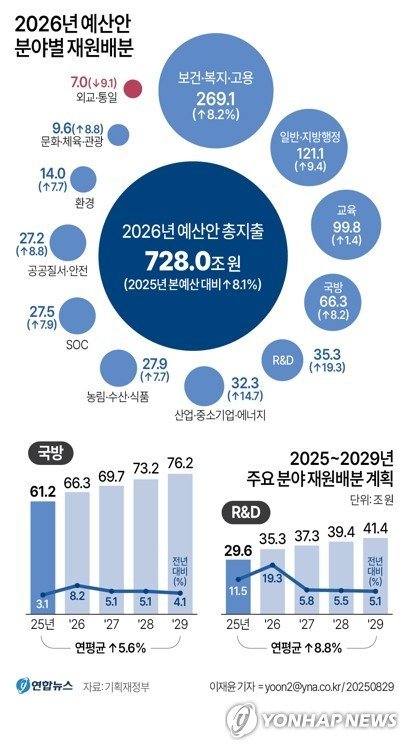
Among next year’s budget proposal, the most notable area is investment in Research and Development (R&D). The allocation is about 35.3 trillion won, nearly a 20% increase from this year. This investment aims to strengthen independent AI capabilities and foster strategic technologies that will drive future growth.
The R&D budget should not merely restore the cuts made by the previous administration. Instead, it must be executed to further elevate Korea’s technological prowess and create a virtuous cycle that boosts the nation’s potential growth rate.
Ultimately, the core of technological competitiveness is people. Without talent, technology-driven growth is impossible. The problem is that Korea is currently caught in a vicious cycle where highly skilled professionals are leaving the country for opportunities abroad.
According to a survey by the Bank of Korea (BOK), the number of Korean science and engineering PhDs working in the United States reached 18,000 in 2021, doubling over the past decade. Ten years after earning their degrees, domestic professionals earn only a quarter of what their overseas counterparts make. As long as these conditions persist, brain drain will inevitably continue.
It is no longer an era where patriotism alone can retain top talent. Without bold improvements to salaries and working conditions, efforts to attract world-class technological talent will remain empty slogans.
Although 1.3 trillion won has been allocated for workforce development next year, it is necessary to critically assess whether this is sufficient to secure the talent needed to lead in hyper-competitive fields.
Next year’s budget must serve as a catalyst for Korea to become a top-three AI powerhouse. Maximizing fiscal efficiency through selection and focus is essential. The fiscal deficit is expected to exceed 4% of Gross Domestic Product (GDP) next year. Considering the annual $20 billion investment in the United States agreed upon at the South Korea–United States summit, Korea’s financial burden will only increase. In such circumstances, both ruling and opposition parties must cooperate beyond partisan interests to set strategic budget priorities.
However, it appears that the political sphere is currently preoccupied with next year’s local elections. There are even predictions that the legal deadline of December 2 will be missed, as attention is focused solely on populist projects and regional development budgets. If the nation’s finances are once again left in disarray due to fruitless political strife at a time when fiscal policy is more important than ever, public sentiment will inevitably turn against the government.