[fn Editorial] "The Future of AI Depends on Infrastructure Investment"—Attention on Chey Tae-won's Remarks
- Input
- 2025-11-03 18:05:47
- Updated
- 2025-11-03 18:05:47
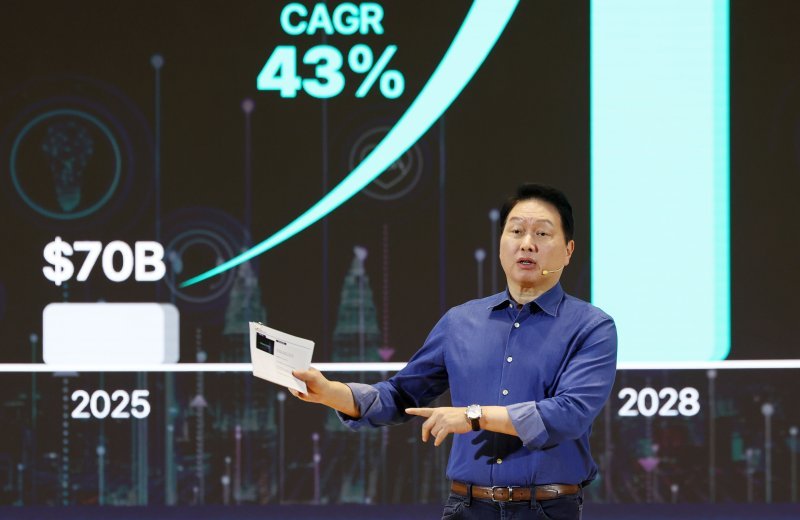
While the importance of AI is widely recognized, a sense of urgency is now more palpable. Due to fierce competition among global big tech companies, this year's global Data Center investment is expected to exceed $600 billion (approximately 800 trillion KRW), a figure that far surpasses the average annual growth rate of 25% recorded over the past five years.
Currently, the supply of AI chips supporting AI computing is unable to keep up with demand. Chey Tae-won noted, "We are entering an era where supply is becoming a bottleneck." He added, "We will increase production capacity and resolve memory bottlenecks through technological improvements." He revealed plans to expand output based on the recently opened Cheongju M15X Plant and the Yongin Semiconductor Cluster, scheduled for completion in 2027. He also expressed his intention to break through by developing innovative ultra-high-capacity memory chips.
Chey Tae-won's remarks also reflect strong confidence in AI-related technologies, as SK Group leads the market for High Bandwidth Memory (HBM), a core component for AI chips.
On this day, SK Group unveiled its next-generation HBM roadmap. Noh-Jung Kwak, CEO of SK hynix, announced plans to sequentially launch High Bandwidth Memory 4 (HBM4) 16-layer, High Bandwidth Memory 4E (HBM4E) 8-layer, 12-layer, and 16-layer, as well as custom HBM4E, starting next year. HBM5 and HBM5E are scheduled for release between 2029 and 2031. Ambitious plans like these require robust policy support from the government to proceed smoothly.
In order not to fall behind the United States of America (USA) and the People's Republic of China (PRC) in the race for AI development, both the government and private sector in Korea are making every effort. Jensen Huang, CEO of Nvidia Corporation, who recently visited Korea, brought a gift of 260,000 advanced NVIDIA Blackwell GPUs, recognizing Korea's AI potential. Sam Altman, CEO of OpenAI, who delivered a video message at the SK Summit, stated, "The partnership with SK goes beyond simple business cooperation," and added, "Korea is already a global leader in AI adoption and utilization." Andy Jassy, CEO of Amazon.com, Inc., expressed a similar view.
However, the challenge is not so simple. As Chey Tae-won pointed out, Korea can only become a powerhouse in AI if infrastructure expansion and talent development keep pace. Among these, the most critical facility is power generation.
Chey Tae-won stated, "We will provide everything from semiconductors to power and energy solutions to build a Korean-style AI ecosystem." He emphasized that laying the foundation for an AI transformation cannot be achieved by companies alone—the primary responsibility lies with the government. In particular, a mid- to long-term power supply plan is essential. Low-cost electricity production is unthinkable without nuclear power plants (NPPs). The government must also provide solutions for semiconductor water supply. Strong commitment and support for nurturing STEM talent are urgently needed. If the government fulfills its role, joining the global top three in AI is well within reach.