Ruling Party to Legislate Extension of Retirement Age by Year-End... Variable Remains Business Community Opposition
- Input
- 2025-11-03 13:27:52
- Updated
- 2025-11-03 13:27:52
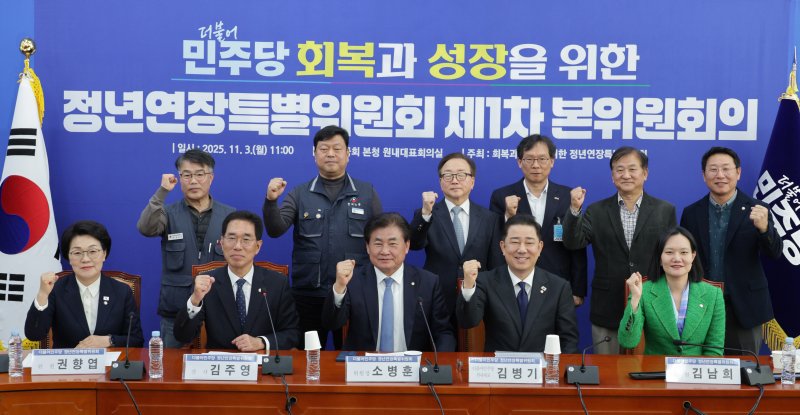
[Financial News] On the 3rd, the Democratic Party of Korea (DPK) announced its intention to legislate the extension of the statutory retirement age to 65 by the end of this year.
The Special Committee on Extension of Retirement Age of the DPK held its first plenary meeting at the National Assembly of the Republic of Korea on the same day and made this decision.
Kim Joo-young, the committee's secretary, told reporters after the meeting, "Although we have not reached a consensus on the extension of retirement age, reemployment, and wage system reform, there were areas where opinions converged," adding, "We will produce an agreement by the end of the year, no matter what."
Previously, the committee had set a goal to legislate the extension of retirement age within the year. The government also announced in June that it would gradually raise the current retirement age of 60 to 65 by 2033.
The National Assembly of the Republic of Korea is also taking an active role. The labor-management social dialogue led by Speaker Woo Won-shik has gained momentum as the Korean Confederation of Trade Unions (KCTU) joined for the first time in 26 years. Leveraging this atmosphere, the DPK is determined to complete the legislative process by the end of the year.
The main issues are the timing of the phased extension and concerns over reduced youth employment. The challenge is to effectively bridge the five-year income gap between the current retirement age of 60 and the National Pension Service (NPS) eligibility at 65, while ensuring youth employment is not adversely affected. The direction appears to be toward extending the retirement age, reemployment after retirement, and a major overhaul of the wage system. While the People Power Party also supports these goals, disagreements are expected over specifying 65 as the statutory retirement age. The People Power Party maintains that such matters should be left to labor-management autonomy.
At the meeting, Kim Byung-kee stated, "Since last year, the proportion of the population aged 65 and over has exceeded 20%, marking our entry into a super-aged society. Considering labor shortages and pension fund instability, extending the retirement age is a positive measure. However, we must also consider the potential impact on youth employment and increased corporate burdens. From a pro-and-con perspective, both sides stand to lose, so an early resolution is essential."
The variable in the 'early resolution' mentioned by Kim Byung-kee is opposition from the business community. Kim Joo-young also remarked, "It felt as though the business community's opinions had returned to square one." The Special Committee on Extension of Retirement Age had previously held several working-level meetings, but as labor and management failed to find common ground, a public plenary session was convened.
Even at the meeting, the business community did not hide its concerns. Lee Dong-geun, Vice Chairman of the Korea Enterprises Federation (KEF), emphasized, "The extension of the retirement age is not simply a matter of income and labor security for the elderly, but is also closely related to jobs for future generations and thus requires a cautious approach." Myeong-ro Lee, Director of Human Resources Policy at the Korea Federation of SMEs (KBIZ), noted, "If the statutory retirement age is extended, it could increase instability rather than promote job security, so wage system reform must come first."
[email protected] Kim Yun-ho Reporter