[fn Editorial] Successful Korea-China Summit Ushers in a New Era for Both Nations
- Input
- 2025-11-02 19:12:52
- Updated
- 2025-11-02 19:12:52
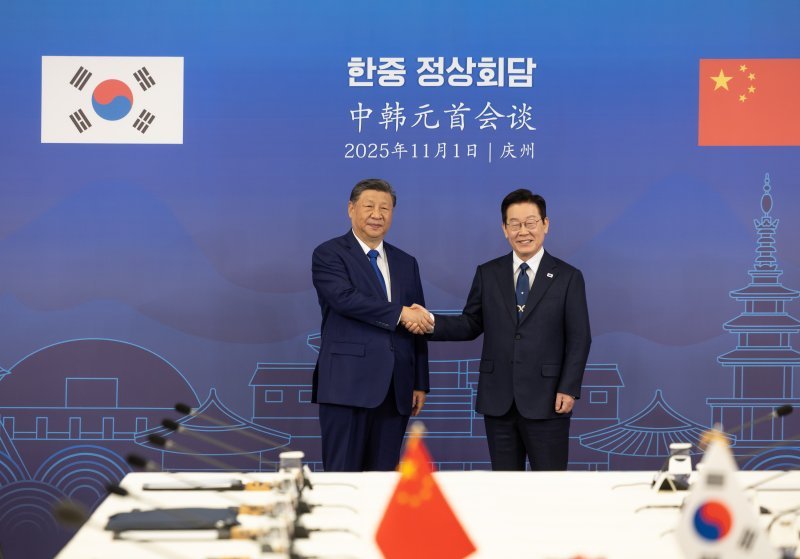
Since the Terminal High Altitude Area Defense (THAAD) dispute in 2014, the so-called 'ban on Korean content in China' was imposed, leading to an almost complete severance of cultural and tourism exchanges. Confrontation with China, whose influence continues to grow, inevitably impacts our economy. The suspension of group tours from China has significantly contracted the travel industry and related businesses.
At the summit, the two sides signed memoranda of understanding in areas such as currency swap, joint promotion of the Innovation Startup Partnership Program, strengthening cooperation in service trade, and joint response to online fraud crimes. These visible outcomes mark a new beginning for Korea-China relations. By agreeing to enhance exchanges and cooperation in the fields of economy, culture, and criminal investigation, the two countries have laid the foundation for redefining their relationship in a more amicable direction.
Korea faces a difficult diplomatic balancing act between the two major powers, the United States and China. Security is undoubtedly more important than the economy if forced to choose between the two. However, as seen in the THAAD dispute, security issues are directly linked to economic matters. Korea must pursue a wise diplomatic policy that avoids becoming too close or too distant from either side, much like walking a tightrope. This is what is referred to as pragmatic diplomacy.
While pragmatic diplomacy is easy to talk about, it is extremely challenging in practice. Fundamentally, Korea must align with its ally, the United States, on security issues, but should be cautious not to provoke China openly. Of course, Korea must never submit unconditionally to Chinese pressure. Ultimately, it is important to remember that countries like Russia and China have fundamentally different systems from ours. Pragmatic diplomacy means maintaining principles, gaining what can be gained, and minimizing losses.
Regardless, China, like Japan, is a neighboring country with which Korea cannot avoid economic cooperation. China's economic growth remains robust, and its achievements in technological innovation are remarkable, even surpassing those of the United States in some areas. Korea should accelerate the Korea-China Free Trade Agreement (FTA) and restore cultural exchanges.
It is also significant that the two countries agreed to strengthen economic and trade cooperation, such as continuing collaboration at the ministerial level on the Regional Comprehensive Economic Partnership (RCEP). There is hope that performances by Korean entertainers in China may resume, which would be another outcome of the summit. Nevertheless, China should not be underestimated. Many contentious issues remain, such as the installation of structures in the West Sea. Korea must employ both hard and soft diplomatic strategies and never back down in verbal disputes.
The most important issue for Korea is North Korea's nuclear weapons, and only China, as a close neighbor with influence over North Korea, can help. During the APEC period, North Korea even rejected a meeting request from the United States. Thus, Korea has no choice but to cooperate with and utilize China for security reasons. Between the United States and China, Korea must pursue a practical strategy that prioritizes national interests over alignment with either side.