‘Gyeongju Declaration’ Omits Multilateral Free Trade Language... First Inclusion of AI and Demographic Issues [Gyeongju APEC Wrap-up]
- Input
- 2025-11-02 18:23:29
- Updated
- 2025-11-02 18:23:29
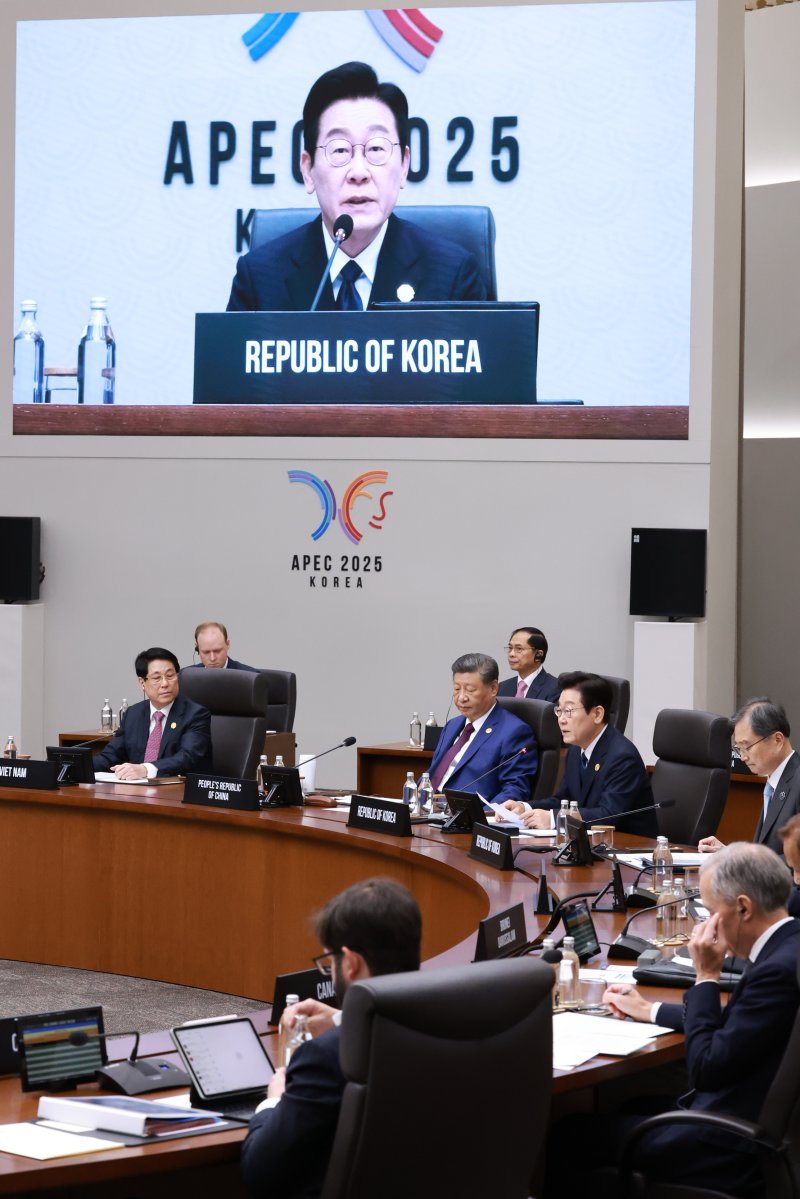
According to diplomatic sources on the 2nd, the Gyeongju Joint Declaration omitted direct references to supporting the World Trade Organization (WTO) and the multilateral trading system. Instead, the declaration reflected these principles through the outcomes of the ministerial meeting of foreign and trade ministers, finding a compromise.
At the pre-summit ministerial meeting of the 21 APEC member economies, discussions focused on the need for WTO reform and the importance of a predictable multilateral trading order.
There was a difficult process of reconciling differing views between major countries such as the United States and China. The final joint declaration was only completed six hours before Lee Jae-myung announced it on the 1st.
When asked by foreign reporters about difficulties in drafting the Gyeongju Declaration, President Lee Jae-myung replied, “The final text was completed only on the morning of the announcement.” He explained that there were disagreements over the wording, which required adjustments. While trade and investment were major points of contention, he stated that an amicable agreement was ultimately reached.
Additionally, President Lee suggested that tariff policies should be advanced through consultation and coordination among countries. He emphasized that international relations are not dominated by any single country and that no nation can secure outcomes solely in its own favor, highlighting the need for time and communication.
The drafting of the joint declaration faced difficulties from the outset due to the absence of US President Donald Trump, who has maintained tariff policies instead of the WTO’s free trade principles. With Trump’s early departure, US Treasury Secretary Scott Bessent participated in the adoption of the Gyeongju Joint Declaration as his representative. Chinese President Xi Jinping, meanwhile, stressed the importance of implementing free trade and multilateralism in relation to the Gyeongju Declaration.
President Xi opposed protectionism and unilateral pressure, calling for the removal of trade barriers to ensure the stability of global industrial and supply chains, which raised concerns about potential conflict. However, the US-China summit held on the 30th of last month yielded a positive outcome, helping to avert a clash over the Gyeongju Joint Declaration.
President Lee highlighted as a key achievement the adoption of an agreement for the first time in APEC history that includes joint responses to bridging the AI gap and addressing demographic decline among member economies.
In addition, the APEC AI Initiative was adopted alongside the declaration to promote AI cooperation. This initiative sets out a shared vision and concrete action plans to ensure all member economies participate in the AI transformation and share the benefits of technological progress. It includes measures to promote economic growth through AI innovation, strengthen capabilities, and expand private investment in resilient AI infrastructure. The significance lies in it being the first APEC-level AI agreement with participation from both the US and China.
To address demographic changes, the APEC Joint Framework on Demographic Change was also adopted, recognizing low birth rates and population aging as common regional challenges and outlining plans for joint action.
This framework presents policy directions and cooperation strategies in five key areas: enhancing social system resilience, modernizing human resource development, strengthening health and care services, boosting economic capacity, and promoting regional dialogue and cooperation.
Additionally, this is the first APEC leaders’ declaration to explicitly recognize the cultural and creative industries as new growth engines for the Asia-Pacific region and to call for related cooperation. Cultural industries such as K-Culture are expected to play a significant role in the region’s economic growth.
rainman@fnnews.com Kim Kyung-soo Reporter