CBRE Korea: Cumulative Commercial Real Estate Investment Surpasses 25 Trillion Won in Q3
- Input
- 2025-10-30 11:35:51
- Updated
- 2025-10-30 11:35:51
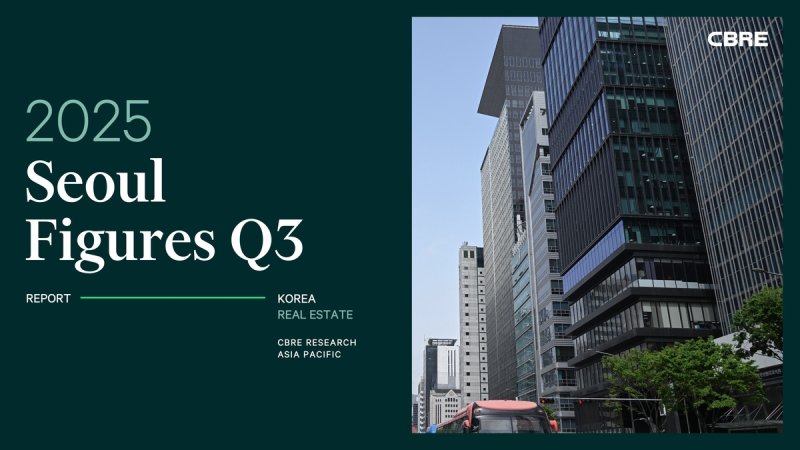
On the 30th, CBRE Korea, the world's largest integrated real estate services company, announced these findings in its '2025 Q3 and Q4 Domestic Commercial Real Estate Market Report.' This figure surpasses the annual performance of approximately 22 trillion won in 2024, and with several large-scale transactions expected to close in Q4, annual investment is projected to exceed 30 trillion won.
According to the report, if mega-asset transactions in the Bundang Business District (BBD) are included, the total market size for Q3 reached about 10 trillion won. Office assets accounted for 7.6587 trillion won, or roughly 77% of all transactions. Major deals such as Pangyo Tech One Tower (about 1.9 trillion won) and Tower 730 (about 870 billion won) led the market. Logistics asset transactions totaled 1.2576 trillion won, a 2.6-fold increase from the previous quarter. As concerns about oversupply in the logistics sector eased, both domestic and international investors showed increased interest and activity.
The average vacancy rate for Grade A office space in Seoul was 3.1%, up 0.5 percentage points from the previous quarter. By region, Kangnam maintained strong demand with a vacancy rate of 1.5%, down 0.3 percentage points. In contrast, Downtown Seoul (4.1%) and Yeouido (3.6%) saw vacancy rates rise by 0.9 and 0.8 percentage points, respectively. Effective rents increased by 1.0% to 37,624 won per square meter, while nominal rents rose by 0.9% to 39,964 won per square meter, continuing a stable upward trend.
This quarter, a significant number of new leasing activities were observed, especially in Kangnam and Yeouido. In Kangnam, expansion demand from finance and IT-based companies remained strong, with Toss Bank's move to OPUS 459 serving as a notable example. In Yeouido, the Korea Fire Protection Association (KFPA) and NH Capital signed relocation contracts for ONE CENTINEL. Meanwhile, the Magok District attracted new tenants mainly from the aviation and construction sectors, further solidifying its status as an emerging business district.
The retail market saw continued improvement in vacancy rates across major commercial districts, driven by a recovery in domestic consumption and an increase in foreign visitors. Myeong-dong experienced its fourth consecutive quarter of declining vacancies, reaching the 7% range in Q2 2025—the lowest level since 2018. In Kangnam and Seongsu-dong, active leasing by fashion, beauty, and medical brands continued, while Chinese brands such as Xiaomi Corporation and Chazi expanded their presence in various districts.
Supply of Grade A logistics centers in the Seoul metropolitan area decreased by about 68% year-on-year, but leasing demand, led by electronic commerce (e-commerce) and Third-Party Logistics (3PL) companies, remained robust, bringing the market closer to stabilization.
Claire Soohye Choi, Head of Research at CBRE Korea, stated, "In the third quarter, the commercial real estate market demonstrated both growth and selective dynamism, with leasing activities and strategic investment transactions focused on high-quality office and logistics assets." She added, "Despite macroeconomic uncertainties, more investors are proactively executing asset strategies centered on large-scale deals, and this, combined with the potential for further interest rate cuts, is raising expectations for gradual market growth."
[email protected] Jeon Min-kyung Reporter