Police to Block Hate Speech Rallies Against Foreigners... Proposal to Amend Criminal Code Also Submitted
- Input
- 2025-10-30 10:00:00
- Updated
- 2025-10-30 10:00:00
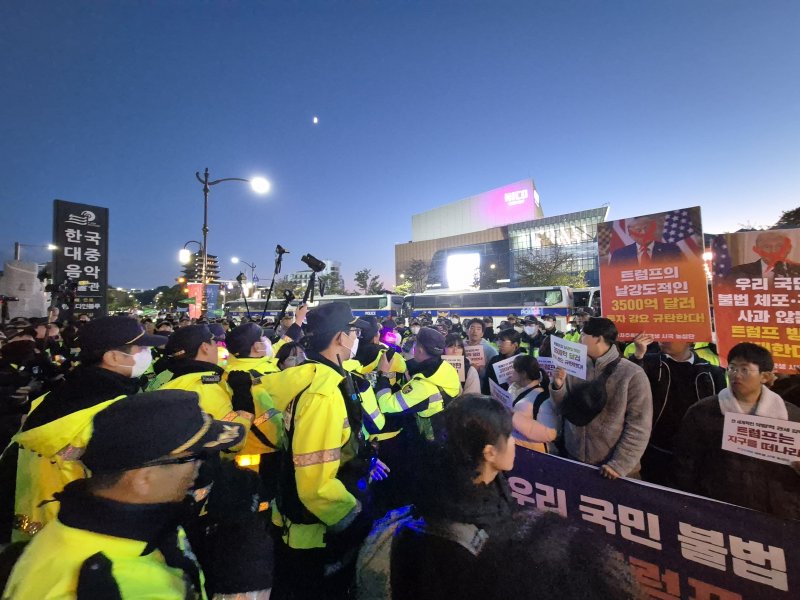
The Korean National Police Agency (KNPA) announced on the 30th that it finalized countermeasures after discussing this agenda at the 574th regular meeting of the Korean National Police Committee on the 20th.
The police will respond in stages, from the rally reporting phase to follow-up actions.
At the reporting stage, the police will strengthen management of hate speech that could incite group clashes and restrict rallies and marches in areas where such clashes are likely. If a rally poses a direct and clear threat to public safety and order, the remaining rallies will be banned. After assessing the risks in the rally report and promotional materials, the police have established proportional standards for action under the Assembly and Demonstration Act.
During on-site response, the police will gradually increase the scale of police force and the level of measures.
If a rally poses a direct and explicit danger, the police will take steps such as dispersal or relocation in accordance with the Assembly and Demonstration Act and the principle of proportionality.
If clashes occur with foreigners, merchants, or citizens, or if the march deviates from the designated route, the police will use sufficient personnel and equipment to prevent and block illegal acts and maintain order. For rallies with only hate speech, dialogue police and broadcasting vehicles will be deployed, and warning broadcasts will be issued repeatedly to suppress such behavior as much as possible.
In the follow-up stage, the police will focus on collecting evidence of illegal acts and conduct swift investigations to ensure strict legal action.
If organizers create threats or anxiety through hate speech, incite group clashes, or violate restrictions such as marching to distant locations, any actions outside the reported scope will be prosecuted as 'violation of organizer compliance requirements' under the Assembly and Demonstration Act.
The police will also actively investigate insults against foreign tourists and obstruction of business for small and medium-sized merchants. Malicious distortion of facts and the creation or distribution of false information will be regarded as acts exceeding freedom of expression, and the 'Task Force for Crackdown on the Distribution of False Information' will apply the Act on Promotion of Information and Communications Network Utilization and Information Protection (ICNA) and the Framework Act on Telecommunications.
The police will also actively participate in legislative discussions on hate speech.
According to the police, most advanced countries, including the United States, Germany, and France, have criminal provisions for hate speech, such as aggravated punishment for insults based on nationality, race, or religion. The Committee on the Elimination of Racial Discrimination (CERD) recommended in May that South Korea amend its criminal code to increase penalties for racially motivated crimes. In response, the police plan to submit their opinions on amending the criminal code to the Ministry of Justice and other relevant agencies.
In addition, the police will work to raise awareness, referencing the Constitutional Court of Korea's decision that 'hate speech, in itself, violates human dignity and denies the value of certain groups, making its prohibition and restriction inevitable.'
Previously, Yun Ho-jung, Minister of the Interior and Safety (MOIS), submitted the 'Active Law Enforcement Measures by Police' as an agenda item to the Korean National Police Committee on the 10th, following a series of anti-Chinese protests in Myeong-dong, Seoul, stating, "The police must actively respond to hate rallies and demonstrations." This is the second time the Minister of the Interior and Safety has submitted an agenda to the police committee, following Kim Boo-kyum in 2018.
A KNPA official stated, "We will ensure that these measures are implemented without fail at the front lines of public security, and we will deploy police forces nationwide to ensure the safety and security of the APEC Summit."
[email protected] Kang Myung-yeon Reporter