[Editorial Office News Analysis] 'Hangang River Ferry Era'... Will Launching Boats Alone Attract Crowds?
- Input
- 2025-10-29 18:07:47
- Updated
- 2025-10-29 18:07:47
If you walk from Yeouinaru Station on the Seoul subway down to the banks of the Hangang River, you'll notice several new docks that weren't there before. The Seoul Metropolitan Government is building dedicated docks for Hangang Bus, and E-Land Cruise, a private company, has constructed a large new dock as well.
Including the existing operator ELAND CRUISE, three companies will be competing to run ferries on the Hangang River around October.
The issue is that the Hangang Bus project by the Seoul Metropolitan Government has sparked heated debate in political circles. Nevertheless, Hangang Bus will officially begin operations on the 1st of next month, ushering in a new era for Hangang River ferries.
The real question is whether the competition among the three ferry operators will ensure stability and profitability, making the business sustainable. This is directly tied to whether citizens will have real choices when enjoying cruises on the Hangang River.
Setting aside political controversies, it is necessary to examine the future of the Hangang River ferry market through an analysis of business competitiveness.
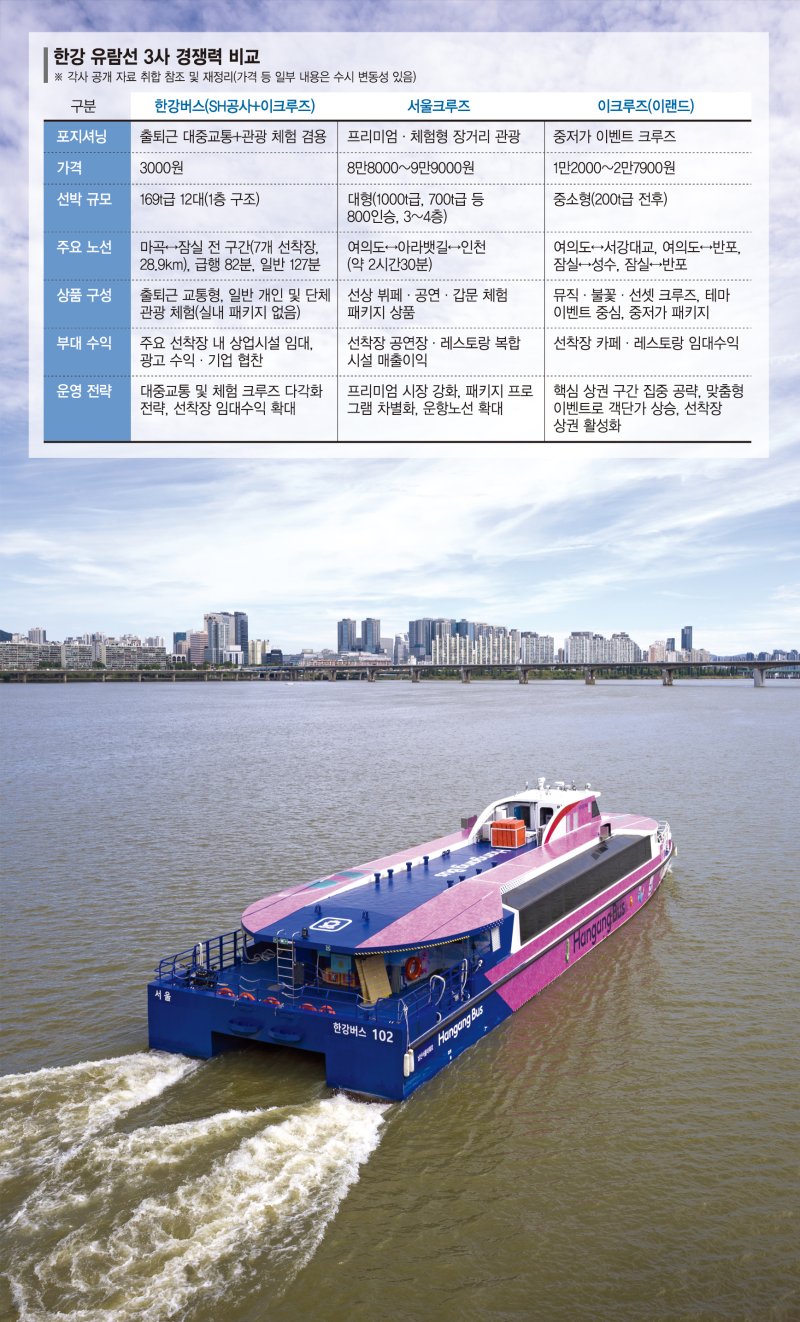
■ 3,000 won vs. 100,000 won: Clear differences in price and customer base
The positioning of the three operators is clear.
Hangang Bus is a public, low-cost cruise experience. The fare is just 3,000 won, reflecting its aim to serve as a mass transit option for commuters. However, the key to its revenue structure is filling the long off-peak hours outside of commuting times. As a result, it functions both as public transportation and as a sightseeing experience, allowing passengers to enjoy the scenic beauty of the Hangang River. On board, the seating is arranged in rows facing forward to maximize capacity during rush hours. Wide glass windows on both sides offer panoramic views, and each seat is equipped with a tray for laptop use. Bicycle racks are installed at the bow and stern for cyclists. The design accommodates both commuters and tourists.
In contrast, 'ELAND CRUISE' under E-Land Group is a low- to mid-priced event cruise. Fares range from 12,000 to 27,900 won. Themed cruises such as music, fireworks, and sunset attract specific customer groups. The operation focuses on maximizing turnover by running short routes multiple times, such as round trips between Yeouido and Sogang Bridge or between Jamsil and Seongsu, targeting only the most popular boarding points.
E-Land Cruise positions itself as a premium, experiential long-distance tour. Package fares per person range from 88,000 to 99,000 won, including a buffet, performances, and a lock experience. The round trip between Gimpo Ara Waterway and Yeouido takes about two and a half hours. The main targets are foreign tourist groups and corporate events, and the large vessels can accommodate up to 800 passengers at a time.
Overall, the three operators' price ranges do not overlap—low, mid, and high. Customers and markets are segmented into simple experiences and package tours.
■ Vessel structure reflects business strategy
Each operator's vessels are uniquely designed for their business models.
Hangang Bus connects seven docks over 28.9 km from Magok to Jamsil. Since one vessel accesses all docks, efficiency is high. However, the vessel's structure poses challenges. The Hangang River narrows upstream, and the gap between the water and bridges decreases. To safely pass under bridges, Hangang Bus is built low with a single deck, limiting capacity to under 200 passengers. Unlike typical cruise ships, there is no spacious performance area inside; the focus is on seating, making it difficult to add package programs with indoor events. The speed is kept at 12 knots for safety, which may seem slow for commuters but is reasonable for sightseeing. Hangang Bus aims to serve both commuters and tourists, offering versatility but lacking a clear target market.
E-Land Cruise, on the other hand, operates large cruise ships as tall as three or four-story buildings, with a capacity of up to 800 passengers. Since reservations are for groups, revenue is stable for the operator. Kim, an office worker in Seoul, recently took his parents on an E-Land Cruise.
Kim said, "The package price per person was over 100,000 won, which was a bit much, but with the variety of performances and a decent buffet, it was worth it."
ELAND CRUISE, with its mid-sized vessels, finds a niche between the two. By offering mid-priced package services, it targets the gap in the market.
However, as all three operators expand their business domains, overlaps and conflicts may arise. Hangang Bus is broadening its scope from commuting to tourism. While ELAND CRUISE focuses on mid-priced packages, it also offers low-cost tourism products, leading to potential overlap. Similarly, E-Land Cruise's new mega dock in Yeouido, opened on the 24th, could intensify competition with ELAND CRUISE.
■ Can Hangang Bus become the 'catfish' of the market?
A key point is whether Hangang Bus will play the role of a 'catfish' in the new ferry era.
The main concern is the sustainability of Hangang Bus. Two challenges must be addressed. First is improving profitability. Like other operators, Hangang Bus cannot be self-sustaining with cruise revenue alone. Additional income sources are needed, such as utilizing convenience stores, restaurants, and cafes at the docks. E-Land Cruise's Yeouido Ferry Terminal is equipped with performance halls and restaurants. ELAND CRUISE is profitable thanks to ancillary facilities at its docks.
Hangang Bus faces even greater urgency. With a fare of just 3,000 won, turning a profit is difficult. Even with subsidies due to its public nature, it must eventually become self-sustaining. The plan is to increase indirect revenue through sales at the docks and corporate advertising.
Jin-young Park, head of the Future Hangang Headquarters at the Seoul Metropolitan Government, stated, "To ensure public accessibility, we set the fare at 3,000 won, and subsidies will be provided for the time being. However, if the ratio of cruise to ancillary revenue is maintained at 1:3, we expect to turn a profit from the third year onward."
The second challenge is the governance structure of Hangang Bus. It is a joint venture with 92.6 billion won invested by Seoul Housing and Communities Corporation (SH) and 4.9 billion won from ELAND CRUISE. For the Seoul Metropolitan Government, which lacks experience in waterway operations, partnering with ELAND CRUISE is a wise choice, as it brings cruise business expertise and facilitates smooth market entry. By joining as a co-operator, ELAND CRUISE can also diversify its business portfolio. However, ELAND CRUISE has only partially contributed its investment and is holding off on additional funding.
Recently, Oh Se-hoon, the mayor, addressed this issue during a parliamentary audit, saying, "I will check whether the relationship is completely severed." Both sides are renegotiating the existing investment agreement to stabilize the corporation.
■ Selling Hangang culture, not just boats
Ultimately, for the Hangang River ferry era to thrive, large crowds are needed. Is the Hangang River a big enough market? The answer is yes. With Seoul's population of 9.5 million and 20 million foreign tourists annually, the potential customer base is vast. In major cities like Bangkok, Sydney, and New York, tens of millions use water facilities each year. In contrast, Hangang River sees fewer than one million. However, with the Korean Wave, that number could reach five million in a few years.
As more people visit the Hangang River, ferry ridership will also increase. The key to business success is boosting the boarding rate. Service quality must be high enough to encourage repeat customers. If people only ride once out of curiosity, the business may fail. Hangang Bus exceeded expectations during trial runs, but it remains to be seen if the positive response will continue after operations resume. An ELAND CRUISE official commented, "The more people visit the Hangang River, the higher the sales at restaurants and other facilities at the docks, and naturally, some will board the ferries as well."
High-quality ferries will enhance the value of the Hangang River. As a world-class natural resource, the river should be preserved and developed as an attractive public asset to usher in a 'Hangang Renaissance.' Accessibility should be improved so anyone can easily enjoy coffee or sunsets along the riverbank. Adding ferry tours will be the icing on the cake. For both Koreans and foreign tourists, Hangang culture should be created and promoted. For example, cycling routes could be developed in conjunction with Hangang Bus. By linking cultural events in riverside spaces with Hangang Bus, regardless of weather, operators can overcome profitability challenges.
With its potential, major capital is being invested in the Hangang River. If profitability remains low, these investments could become sunk costs, resulting in national losses. The true value of the Hangang River will rise and investment will be revitalized only when the entire river is developed as a vast cultural platform that blends public interest and business viability—not just as a ferry service.
Jinman Kim, CEO of E-Land Cruise, stated, "While more people are enjoying the Hangang River, there is growing demand for diverse activities beyond just eating ramen on the grass, such as performances and sports. If more cultural and sports facilities are added along the waterfront, this will naturally link to the ferry business and guarantee profitability."
[email protected] Chang-won Cho