Voice Phishing Losses Near 1 Trillion Won... Overseas Bases Fuel the Rise of 'Shadow Financial Networks'
- Input
- 2025-10-29 15:39:47
- Updated
- 2025-10-29 15:39:47

According to The Financial News, annual losses from voice phishing (vishing) are approaching 1 trillion won, as the crime has evolved beyond simple phone scams. Organizations based overseas, such as in the Kingdom of Cambodia, have established integrated call centers, money laundering, and remittance networks, effectively creating a 'shadow financial ecosystem.' While authorities have launched full-scale investigations, the speed and scale of overseas network expansion outpace government responses.
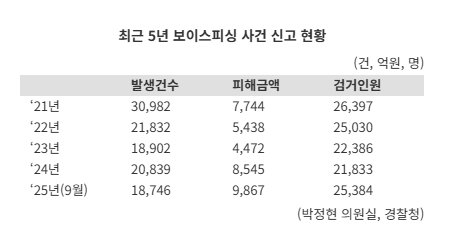
On the 29th, The Financial News obtained 'Recent Five-Year Vishing Incident Report Statistics' from the Korean National Police Agency (KNPA) via the office of Park Jung-hyun, a member of the Security and Public Administration Committee from the Democratic Party of Korea (DPK). The data show that from January to September this year, vishing losses reached 986.7 billion won, already surpassing last year's total of 854.5 billion won. Compared to 2021 (774.4 billion won), this marks an increase of about 27%.
Notably, while the number of incidents has decreased, the total losses have increased. This year, there were 18,746 vishing cases, down from 30,982 four years ago. As a result, the average loss per case this year is approximately 52.64 million won, nearly double the 25 million won average in 2021.
Experts note that, whereas indiscriminate targeting of the general public was common in the past, recent schemes have evolved to selectively target vulnerable individuals with assets.
The expansion of vishing crime organizations is cited as a key factor. A notable example is the mass arrest and extradition of 55 vishing operatives from the Kingdom of Cambodia. According to police investigations, these groups operated under the command of Chinese leaders, with two Korean ringleaders and one manager overseeing the organization, which was divided into five teams with a clear chain of command.
A total of 110 Korean victims suffered losses amounting to more than 9.3 billion won. The criminals extracted money under the guise of membership or verification fees in social networking service (SNS) chat rooms for paid dating or cryptocurrency investments. They also impersonated delivery workers or prosecutors.
However, until the government launched a comprehensive response following the death of a university student, the true scale of these organizations remained hidden. Establishing bases overseas, such as in the Kingdom of Cambodia, was a deliberate tactic to evade detection by Korean law enforcement.
Another factor in the spread of these crimes is that many participants knowingly joined the operations, rather than being kidnapped or forced through false job ads.
If individuals participated for criminal profits rather than out of coercion or threats, they were likely more actively involved. This is seen as a direct cause of the sharp increase in both the number of victims and the total losses.
Experts emphasize that simply arresting lower-level operatives in Korea is insufficient to dismantle overseas-based criminal organizations. These groups have developed self-sustaining international networks that can quickly regenerate even if some members are caught.
Yeom Gun-woong, a professor at U1 University’s Department of Police and Fire Administration, stated, "Most vishing organizations are funded by Chinese capital, making cooperation with China crucial." He suggested, "Given the international nature of these crimes, it is necessary to strengthen police foreign affairs personnel and establish a permanent, integrated government control tower—under the Prime Minister of South Korea or the President of South Korea—that encompasses investigation, finance, intelligence, and diplomacy."
Some experts also call for a 'two-track response' that combines prevention and suppression. They recommend that public institutions develop and distribute vishing-blocking apps to protect vulnerable groups such as the elderly and middle-aged women, and that penalties be strengthened. Experts also advise establishing systems that enable financial institutions to promptly freeze funds when losses occur.
[email protected] Kim Ye-ji Reporter