[fn Editorial] Welcome Rebound in Growth Rate—Uninterrupted Innovation Must Follow
- Input
- 2025-10-28 18:33:32
- Updated
- 2025-10-28 18:33:32
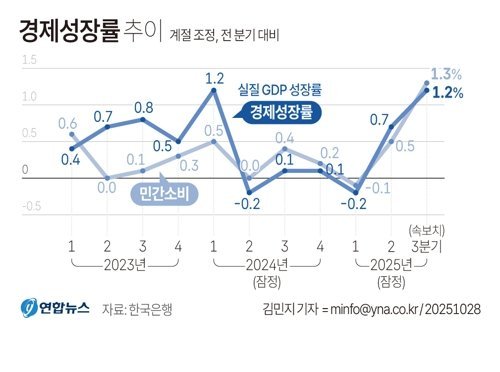
The rebound in growth was largely driven by private consumption. Purchases of goods such as passenger cars and communication devices, as well as spending on restaurants and medical services, all increased. Overall, private consumption rose by 1.3%, marking the largest increase since the third quarter of 2022. Government consumption also grew by 1.2% due to expansionary fiscal policy, and facility investment increased by 2.4%. These factors have brought a modest warmth to the previously sluggish domestic market.
The boom in semiconductors also played a significant role. Soaring demand for semiconductors from overseas factories revived exports, which had been declining. Automakers, facing high tariffs in the United States of America (U.S.A.), found alternative markets in Europe and the Middle East, maintaining strong export performance. Contrary to concerns, semiconductors and automobiles have continued to lead exports, supporting overall growth.
The government has expressed strong confidence in achieving growth in the 1% range. On this day, the Ministry of Economy and Finance (MOEF) diagnosed that the economy has entered a typical recovery phase and hinted at the possibility of raising its annual growth outlook from the previous 0.9% to the 1% range. The MOEF even described the third quarter as the new administration’s first full economic report card.
While it is encouraging to have avoided growth in the 0% range, overestimating this achievement could be detrimental. The increase in consumption was largely due to public support funds and government-issued vouchers. The first round of vouchers, reflected up to the third quarter, amounted to 9.2 trillion won. The second round, distributed since the end of September, totals 4.5 trillion won and will be reflected in fourth-quarter growth.
The key question is whether private consumption can be sustained after the voucher programs end. Prices are rising across the board, with food, groceries, and dining costs soaring. Household debt, which has ballooned, shows no sign of decreasing. For households and small business owners burdened by high interest rates, rate cuts are desperately needed, but the reality is far from favorable. Financial authorities are unable to lower rates due to concerns about housing prices. Meanwhile, the government’s real estate policies remain inconsistent. To maintain momentum in consumption, the government must continue to implement sophisticated measures to stimulate domestic demand.
The export outlook is also far from optimistic. Although demand for semiconductors used in Artificial Intelligence Servers has surged, bringing prosperity to semiconductor companies, significant challenges remain. In particular, Korean firms specializing in Memory Semiconductors must remain vigilant as China is rapidly advancing its technology and production capacity. Excluding semiconductors, export performance remains stagnant. Additionally, segments of the manufacturing sector, such as the Petrochemical industry, are struggling.
Rigid labor laws and employment systems, as well as superficial regulatory reforms, continue to hinder businesses. Expecting a sustained rebound in growth without addressing these institutional issues is unrealistic. The government must also properly conclude tariff negotiations with the U.S.A. to prevent further harm to domestic companies. While rushing negotiations under time pressure is unwise, a prolonged standoff is not the answer either. Only by strengthening the overall economy and maintaining innovation can meaningful growth be achieved.