Will the ‘Tears of Ten Years’ at the Kaesong Industrial Complex Finally End?... Rising Hopes Among SMEs
- Input
- 2025-10-28 17:29:10
- Updated
- 2025-10-28 17:29:10
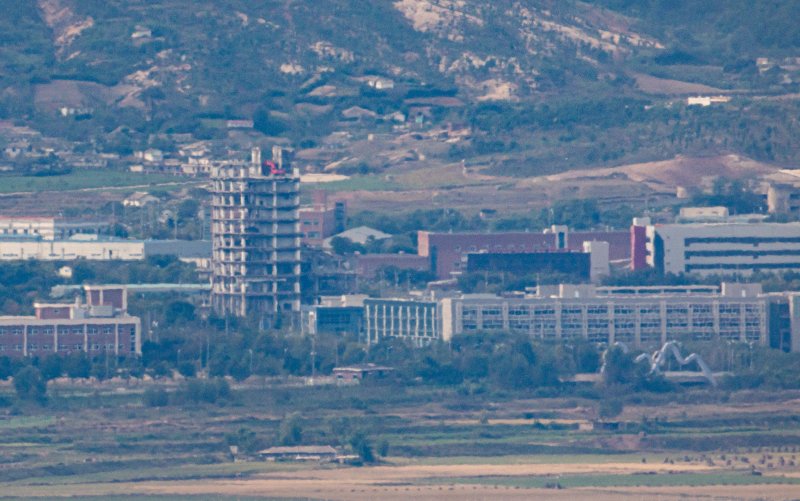
[Financial News] There is growing optimism that spring may return to the Kaesong Industrial Complex, which has been at a standstill for over a decade. This sentiment is fueled by U.S. President Donald Trump’s repeated statements of willingness to meet with North Korean leader Kim Jong Un on the occasion of the Asia-Pacific Economic Cooperation (APEC) summit.
The small and medium-sized business sector is determined to overcome challenging times by revitalizing inter-Korean economic cooperation, starting with renewed dialogue between North Korea and the United States. However, analysts note that significant hurdles remain, such as United Nations Security Council (UNSC) sanctions on North Korea, making the path to reopening a long one.
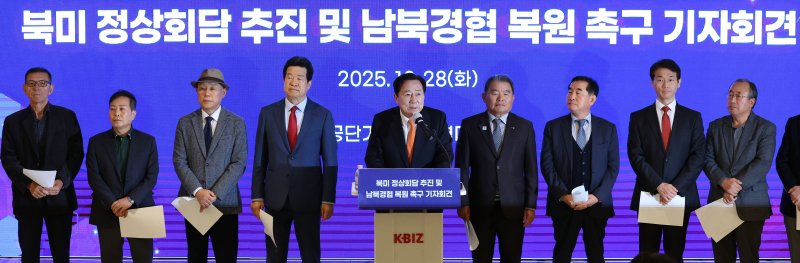
On the 28th, the Kaesong Industrial Complex Enterprises Association held an emergency press conference at the Korea Federation of SMEs (KBIZ) in Yeongdeungpo-gu, Seoul, urging the resumption of the North Korea-U.S. summit and the restoration of inter-Korean economic cooperation. The association stated, "We hope that the North Korea-U.S. summit will be realized, leading to renewed inter-Korean dialogue and the reopening of the Kaesong Industrial Complex, a symbol of inter-Korean economic cooperation."
Tenant companies at the Kaesong Industrial Complex are calling for its reopening, which they believe would revitalize struggling small and medium-sized enterprises. According to the Ministry of Unification (MOU) statistics from October 2014, the complex’s annual production reached $390 million, with annual exports totaling $13 million. There were approximately 54,000 North Korean workers at the complex, earning an average monthly wage of $146.70.
One advantage of the Kaesong Industrial Complex is that North Korea is a tariff-free zone. Yu Dong-ok, CEO of Daewha Fuel Pump Ind., Ltd., explained, "According to our Constitution, the territory of the Republic of Korea includes the Korean Peninsula and its adjacent islands, so there are no tariffs between the North and South."
The government is also taking proactive steps to restart the Kaesong Industrial Complex. According to a recently announced amendment to the 'Enforcement Decree on the Organization of the Ministry of Unification and Its Affiliated Agencies,' the Ministry of Unification (MOU) will restore the Peace Cooperation District Promotion Team, which is responsible for matters related to the complex.
Former presidents of the Kaesong Industrial Complex Enterprises Association met with Minister Chung Dong-young of the Ministry of Unification the previous day to discuss the opinions and response strategies of the SME sector regarding the reopening of the complex.
Tenant companies are already preparing operational plans for the potential reopening. At the press conference, Ki-Moon Kim, the founding chairman of the Kaesong Industrial Complex Enterprises Association and current chairman of KBIZ, stated, "If the complex reopens, we plan to transform it into an international complex involving companies from the United States, China, Japan, and other countries to shield it from political disruptions and ensure its continued operation."
However, there are many obstacles to restarting the complex, such as the need to restore the Gaesung Industrial District Foundation. In particular, resuming operations could violate UN Security Council Resolution 2094, which prohibits large-scale cash transfers to North Korea.
The Kaesong Industrial Complex broke ground on August 22, 2000, after the inter-Korean summit between the late President Kim Dae-jung and the late North Korean leader Kim Jong Il on June 15, and the signing of a development agreement between Hyundai Asan and the North.
The late Chung Ju-yung, honorary chairman of Hyundai, is credited as a key figure who met with Kim Jong Il and played a pivotal role in negotiating and reaching substantial agreements on the construction of the complex.
The story of Choco Pie at the Kaesong Industrial Complex also drew significant attention. Orion Corporation’s Choco Pie, distributed as snacks to North Korean workers at the complex, became so popular that it was traded at a premium in North Korean markets, eventually leading to the suspension of its distribution.
Once a symbol of peace, the Kaesong Industrial Complex faced turbulence after the launch of the Lee Myung-bak administration in 2008, particularly following the shooting death of Park Wang-ja, a tourist at Mount Kumgang.
In March 2010, following the ROKS Cheonan incident, the government imposed the May 24 Measures, which banned new investments in the complex and reduced the number of personnel allowed to stay there by more than half. Later that November, after the shelling of Yeonpyeong Island, the South Korean government restricted border crossings, further freezing inter-Korean relations.
After repeated suspensions due to North Korea’s nuclear provocations, the Kaesong Industrial Complex was completely shut down on February 10, 2016, during the Park Geun-hye administration.
[email protected] Kim Hyun-chul, Seo Ji-yoon Reporter