[fn Editorial] KOSPI 4000: A New Milestone, Sustaining the Rally Through Structural Reform
- Input
- 2025-10-27 19:05:45
- Updated
- 2025-10-27 19:05:45
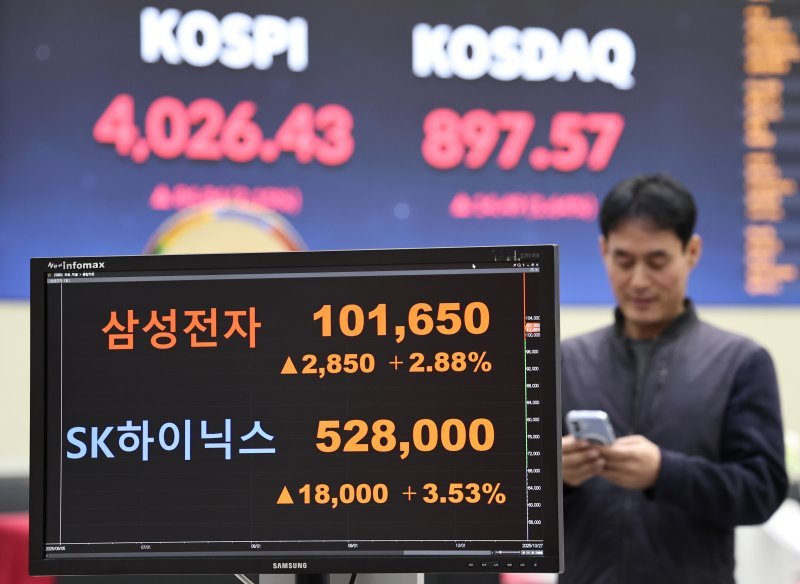
It is also noteworthy that foreign investors and semiconductors have been the main drivers behind the relentless rally. According to the Korea Exchange (KRX), from the beginning of this month through the 24th, foreign investors made net purchases exceeding 5.2 trillion won in the KOSPI market. During the same period, institutions net bought over 2.4 trillion won, while individuals net sold more than 8 trillion won. The return of foreign investors, who had previously shunned the domestic market for various reasons, is attributed to expectations of further gains in major domestic semiconductor stocks. Riding the artificial intelligence (AI) wave, global big tech companies and semiconductor firms have posted unprecedented gains. In contrast, domestic tech companies have not experienced a similar surge, which has fueled ongoing discussions about the so-called Korea discount.
The stocks most heavily purchased by foreign investors have been these undervalued semiconductor companies. From the start of the month through the 24th, foreign net purchases of Samsung Electronics Co., Ltd. reached 4.328 trillion won. Buoyed by this, Samsung Electronics broke through the 100,000 won per share mark for the first time ever. Positive news such as supplying to Nvidia Corporation and expanding its market share in High Bandwidth Memory (HBM) have also contributed to the stock’s rally. SK hynix also climbed on the same day, once again hitting a record high.
Some market participants now expect the semiconductor boom cycle to be in full swing, driven by explosive demand for Artificial Intelligence Servers, and anticipate further gains. The Lee Jae-myung administration’s stock market revitalization policies and proactive support have also played a role in attracting foreign investors. The continued record highs in the U.S. stock market and the increasing likelihood of a dramatic resolution to the China–United States trade war are positive external factors that could further boost investor sentiment.
However, investors should not be swept up by market liquidity and sentiment and rush blindly into the stock market. There are concerns that the fear of being left behind, which previously fueled a surge in real estate and now in equities, could reignite a wave of debt-financed investment. On this day, the KOSPI 200 Volatility Index (VKOSPI), often called Korea’s fear index, soared by 57% compared to the end of last month. The core issue is the solid competitiveness of our companies and economy. Many point out that the current rally is not necessarily linked to improvements in overall corporate productivity or fundamentals.
To achieve a sustained upward trend, thorough structural reform and strengthening corporate fundamentals are essential. The Korean economy is expected to grow by only 0% this year and, at best, by 1% next year. This is insufficient to support a sustainable bull market. Companies are walking a tightrope amid the China–United States trade war and sluggish domestic demand. With the exception of semiconductors, most industries are at a critical crossroads. The government must strive to protect national interests while minimizing corporate losses through successful negotiations. Ultimately, boosting corporate performance and technological competitiveness is the best way to support the stock market. Government backing is crucial in this regard.