President Lee Receives Green Light for Adoption of Gyeongju Declaration... U.S.-China Trade Agreement Remains Key
- Input
- 2025-10-27 16:16:39
- Updated
- 2025-10-27 16:16:39
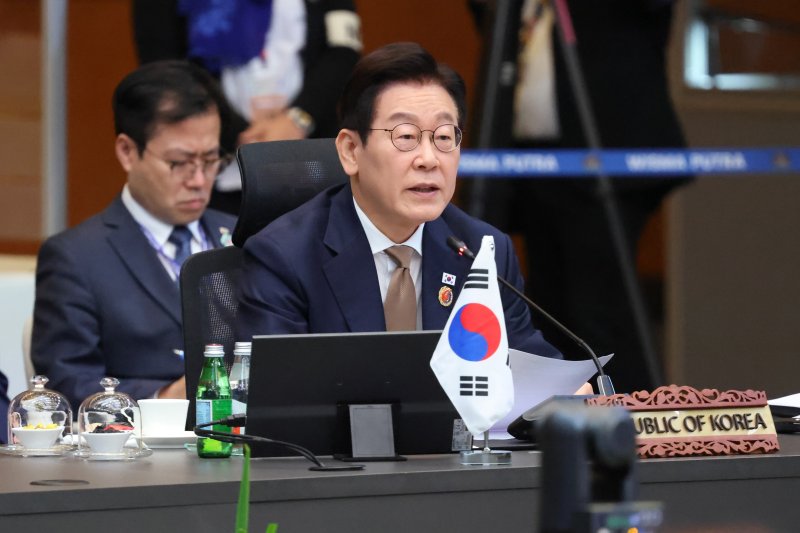
There were particular concerns about a possible boycott of the joint declaration by the U.S. and Chinese leaders. During the first Trump administration in 2018, the APEC Summit failed to produce a joint declaration for the first time ever, as the U.S.-China trade conflict escalated. At that time, U.S. President Donald Trump did not attend the summit in person, sending the Vice President instead, and the U.S.-China conflict over the failed declaration was openly displayed. This year, as President Trump is scheduled to attend only the 'APEC CEO Summit' in Gyeongju on the 29th and skip the main summit, concerns have resurfaced about a repeat of the joint declaration boycott.
According to diplomatic sources on the 27th, the prospects for reaching the Gyeongju Joint Declaration at this week's APEC Summit have improved after contentious issues between the U.S. and China were resolved at the ASEAN Summit in Malaysia. This follows a broad agreement reached during high-level trade talks between delegations led by U.S. Treasury Secretary Scott Bessent and Chinese Vice Premier He Lifeng, held in Kuala Lumpur, Malaysia, on the 25th and 26th. Secretary Bessent stated, "We believe China's export controls on rare earths will be suspended for a year, and the U.S. is not expected to impose an additional 100% tariff on China."
It is expected that U.S. President Donald Trump and Chinese President Xi Jinping will meet on the 30th during the Gyeongju APEC Summit to announce the finalization of negotiations. Following the U.S.-China summit, the Gyeongju Joint Declaration will be adopted immediately at the APEC Summit, which will be held in Gyeongju over two days starting on the 31st.
The drafting of the Gyeongju Joint Declaration also began on this day. The declaration will be refined through the APEC Concluding Senior Officials' Meeting (CSOM) on the 27th and 28th, and the APEC Ministerial Meeting (AMM) on the 29th and 30th.
These meetings to draft the Gyeongju Joint Declaration are attended by representatives from 21 member economies and major international organizations such as the Association of Southeast Asian Nations (ASEAN), the Organization for Economic Cooperation and Development (OECD), and the World Trade Organization (WTO). There is also keen interest in whether the draft will include phrases such as 'free trade' and 'fair competition' among APEC member economies.
In addition to the Gyeongju Joint Declaration, a separate declaration addressing digital divide reduction and responses to demographic changes is also being prepared. The digital divide encompasses not only the wealth gap between countries resulting from AI-driven economic growth, but also disparities in AI accessibility among individuals within a single country.
[email protected] Kim Kyung-soo Reporter