'Three MICHELIN Star' Molecular Gastronomy Chef Enchanted by 'Kimchi Magic' [On Site]
- Input
- 2025-10-27 15:48:50
- Updated
- 2025-10-27 15:48:50
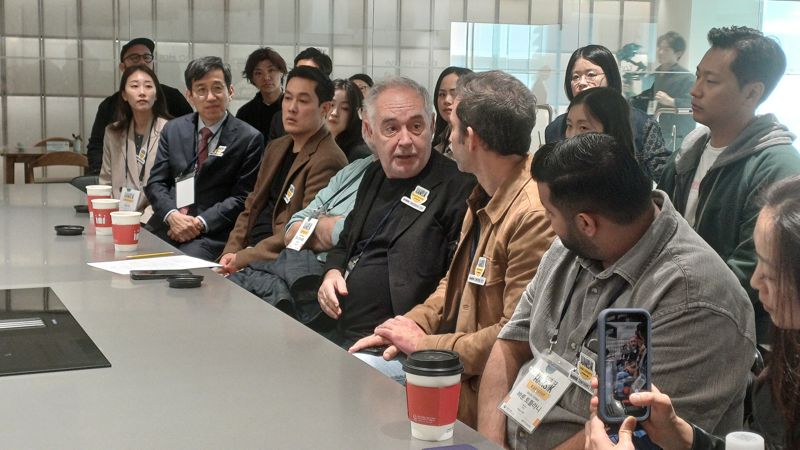
[Financial News] "Are all Korean fermented vegetables like Kimchi always served cold? What is the difference between Kimchi and pickles?"
Ferran Adrià, a world-renowned figure in molecular gastronomy, asked a flurry of questions with the curiosity of someone new to cooking. This took place at a workshop themed 'The History and Value of Korean Vegetable Fermentation,' hosted by the Korean Food Promotion Institute at Korea House in Toegye-ro, Seoul, on the 27th. In the first part of the event, Chae-Rin Park, principal researcher at the World Institute of Kimchi, explained Korean fermented foods, focusing on Kimchi. Following this, Chef Cho Hee-sook—known as the 'chef of chefs' and the 'godmother of Korean cuisine'—demonstrated how to make Dongchimi and Soy Sauce Kimchi.
Throughout the lectures and Kimchi-making demonstrations, Ferran Adrià nodded enthusiastically, took notes on recipes, asked numerous questions, and even requested additional lecture materials after the session.
Ferran Adrià, originally from Catalonia, Spain, began his culinary career at the renowned Spanish restaurant El Bulli. From 1997 until its closure in 2011, he maintained Three MICHELIN Stars for 14 consecutive years. He now serves as the founder of the nonprofit research foundation elBullifoundation. Adrià is celebrated as a pioneer of molecular gastronomy, having invented the technique of Spherification—encapsulating intensely flavored liquids in alginate and calcium to create bead-like spheres.
At the event, Chae-Rin Park presented the characteristics of the Full Korean Table Setting, the structure of traditional Korean kitchens, the history of fermented vegetable development, and both the strengths and limitations of Kimchi, making the information accessible for international attendees.
Park explained, "In a Full Korean Table Setting, all dishes are served at once, allowing diners to freely combine rice and side dishes in countless ways. This means that even with the same table, the meal experience can vary greatly depending on the person. In particular, because the traditional Korean kitchen had limited space for fire (agungi), Korean food culture evolved to focus on fermented vegetables like Kimchi, which could be prepared in advance."
Apart from rice and soup, a Korean table is centered around pre-made vegetable side dishes such as Kimchi, namul, and pickled vegetables. This developed in line with the Korean dining custom of serving multiple side dishes at once. When Chae-Rin Park explained, "Korean Kimchi is an upgraded form of Korean pickles, made tastier by reducing salt and adding fermented seafood and complex seasonings," Ferran Adrià nodded in agreement.
Park added, "While Chinese Paocai is cooked again by the chef after pickling, Kimchi is eaten immediately without any additional cooking. The microorganisms present in fermented seafood and various vegetables compete with each other during fermentation, resulting in rich flavors and nutrients."
hwlee@fnnews.com Lee Hwan-joo Reporter