'AI Scholar' Yann LeCun: “Current AI Understands the Physical World Less Than a Cat... The Next AI Revolution Is the ‘World Model’”
- Input
- 2025-10-27 13:10:43
- Updated
- 2025-10-27 13:10:43
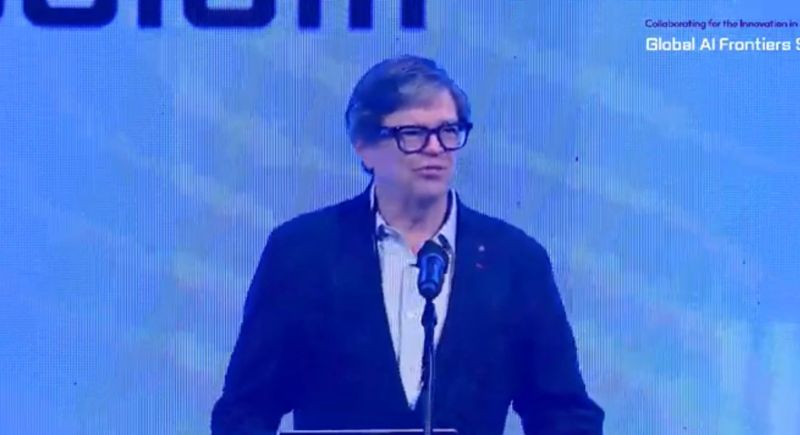
[The Financial News] “Text alone cannot achieve human-level AI. We need AI systems that understand the physical world and learn autonomously through sensory inputs such as video.”
Yann LeCun, professor at the Courant Institute of Mathematical Sciences (CIMS) at New York University and Chief Scientist at Meta Platforms Inc., stated during his keynote at the 'AI Frontier International Symposium 2025' in Seoul Dragon City on the 27th, “LLMs will become obsolete within five years.”
He predicts that within a few years, World Models—AI systems capable of understanding the real world and controlling robots—will emerge as the dominant technology, replacing Large Language Models (LLMs). LeCun emphasized that text-based learning alone cannot achieve human-level AI, and that understanding the world through sensory inputs such as vision and hearing is essential.
LeCun explained, “AI is on the verge of another revolution. Over the past 15 years, there have been major technological leaps with Deep learning and LLMs, but the journey of AI innovation is far from over. The next generation of AI revolution will center around the World Model.”
He further noted, “To truly achieve intelligent machines, several more revolutions are needed, and the core lies in the concept of the World Model. AI must understand the operating principles of the physical world and be able to think and plan autonomously like humans.” LeCun added, “In the near future, everyone will wear wearable devices equipped with AI assistants. For this technology to seamlessly integrate into daily life, AI must possess human-level understanding and intelligence.”
LeCun particularly pointed out that the capabilities shown by current generative AI represent only a small fraction of human intelligence. He remarked, “Humans and animals possess a ‘mental model’ of the world, set goals, make plans, and act accordingly. AI must also evolve to understand the physical world, learn autonomously, and predict actions.” He identified the core of this structural shift as the World Model and Joint Embedding Predictive Architecture (JEPA).
A World Model is a system in which AI abstracts the state of the external world and predicts how the world will change when it performs certain actions. The JEPA concept proposed by LeCun enables higher-level reasoning and planning by making predictions in the 'representation space' rather than simply generating at the pixel level. In other words, LeCun defined it as AI that understands the physical world and can plan and reason autonomously.
LeCun stated, “Current AI is not yet as intelligent as a cat when it comes to understanding the physical world. AI must learn the operating principles of the world by autonomously interpreting visual and sensory data to approach human-level reasoning.”
He advised, “If AI researchers aim for human-level AI, they should focus on areas that LLMs currently cannot handle—such as world understanding, persistent memory, and complex planning and reasoning.”
LeCun predicted that within the next few years, and at most within five years, JEPA-based architectures will become mainstream, and that real-time vision and hardware memory innovation will be at the core of the next AI competition.
yjjoe@fnnews.com Jo Yoon-joo Reporter