"Significant User Welfare Effects from Search and Map Services... Annual Economic Value Estimated at 20.77 Million KRW"
- Input
- 2025-10-27 10:49:34
- Updated
- 2025-10-27 10:49:34
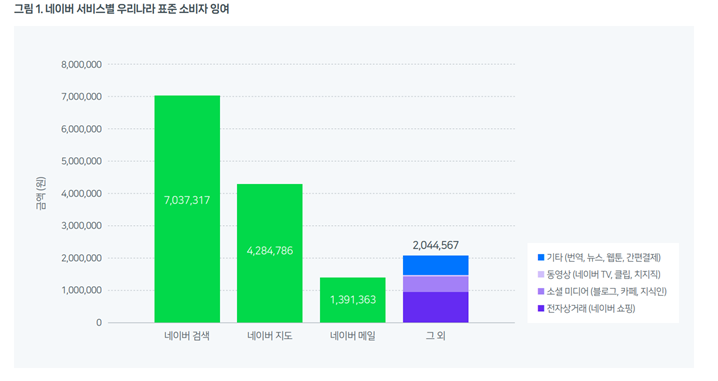
[Financial News] A recent study has found that various free digital platform services in Korea, such as search and map services, deliver significant user welfare benefits. The annual economic value of digital services commonly used by domestic users—including search, map, and email—has been estimated at approximately 20 million KRW.
According to the Digital Economy Report 2025, published on the 27th by the KAIST Center for Digital Innovation, Korean users experience the highest welfare value from search and online map services among more than ten domestic digital services. When converted to economic value, this amounts to at least 20.77 million KRW per year. In the United States, using the same methodology, the annual user surplus was estimated at $17,530 for search engines and $3,648 for map services (as of 2017), with search and map services providing the greatest user benefits.
This report is the first in Korea to quantify consumer welfare from the perspective of 'how much value do free digital goods and services actually bring to our lives.' It marks the initial attempt to measure the welfare value of Korea's digital economy.
Within the Naver Corporation ecosystem, the user welfare value of search and online map services was also the highest. These two services accounted for 72% of the total value among ten services. In economic terms, the search service generated an annual value of 7.04 million KRW, while the online map service contributed 4.28 million KRW. Researchers explained that this is because search and map services serve as core infrastructure and essential tools in the digital ecosystem, providing significant value to users.
Researchers noted that search and map services function as foundational infrastructure and key service tools in the digital ecosystem, delivering substantial value to users.
The report also applied the traditional input-output analysis method to the Naver Corporation ecosystem. According to the report, in the previous year, Naver Corporation's production inducement effect was estimated at 60.21 trillion KRW, value-added inducement effect at 29.31 trillion KRW, and employment inducement effect at approximately 201,629 jobs.
Based on these findings, the researchers emphasized the need to shift the perspective on the value of the digital economy from production to consumption. While input-output analysis, widely used in the industry for economic value assessments, treats digital companies like traditional manufacturing firms, the true value of the digital economy lies not in production methods but in the substantial increase in consumer welfare.
Jae Hyun Ahn, director of the KAIST Center for Digital Innovation and lead author of the study, stated, "Policies regarding digital platforms should be designed to enhance overall social welfare by considering their potential impact on users." He added, "In particular, policies for essential digital goods with significant social ramifications, such as search and map services, must be approached with even greater caution, keeping social welfare in mind."
yjjoe@fnnews.com Jo Yoon-joo Reporter