Chey Tae-won: "Unconditional Protection of SMEs Is an Outdated Approach... Economic Cooperation with Japan Is Essential"
- Input
- 2025-10-26 13:32:15
- Updated
- 2025-10-26 13:32:15
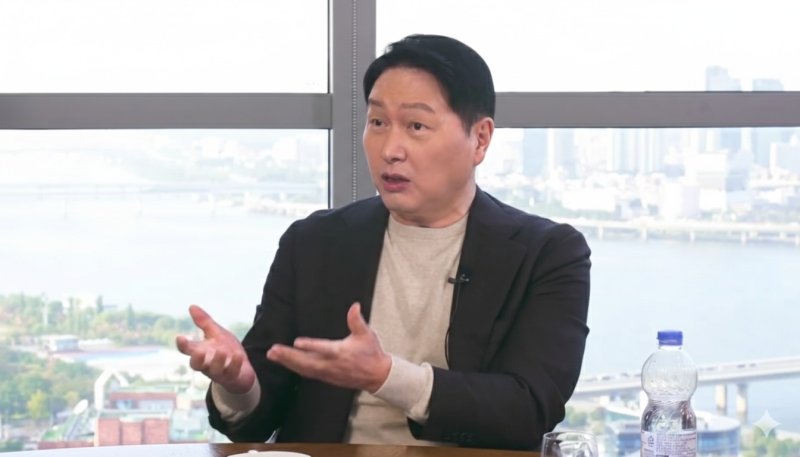
On the 26th, Chey Tae-won, Chairman of SK Group and KCCI, appeared on a YouTube channel and reiterated his Korea-Japan Economic Integration Theory. He emphasized that the export-driven growth model, which has continued since the 1960s, is no longer effective due to tariffs. Chey also argued that it is unlikely for free trade under the World Trade Organization (WTO) system to be restored as it was in the past. According to Chey, the global economic rules are set by the United States (U.S.), China, and the European Union (EU), and Korea is in a position to accept those rules. He stressed that Korea lacks the power to change international order or rules on its own, making it necessary to find partners for solidarity. He suggested that Korea should build an EU-style economic bloc to respond to U.S. tariff policies and changes in the global order.
In addition to Korea-Japan economic cooperation, Chey proposed growth-oriented regulatory reforms, investment in Artificial Intelligence (AI), attracting overseas talent, and establishing Mega Sandboxes as solutions for Korea’s economic growth. He also highlighted the need to change support policies for businesses of all sizes. Chey described unconditional protection of small and medium-sized enterprises (SMEs) as an outdated approach and called for a shift to policies that support growing companies. He added that policies should be designed to strengthen key supply chains by industry, focusing on strategic sectors such as semiconductors.
Chey predicted that AI would present new opportunities for the Korean economy. Drawing a parallel between the current U.S.-China rivalry and the arms race between the U.S. and the Soviet Union during the Cold War, he anticipated that both countries would continue their AI investment race. Chey emphasized that, despite ongoing geopolitical uncertainties, necessary investments must be made. He warned that falling behind in AI would pose significant risks and stated his intention to continue investing in the field.
Chey suggested that establishing Mega Sandboxes in various regions to create AI laboratories and test beds would have a significant impact. He also recommended introducing systems such as the Permanent Resident Card (Green Card) to allow foreign talent to stay in Korea for a certain period and create added value.
Chey also shared why he continues to contemplate the Korean economy as a business leader. He recalled, "My late father, Choi Jong-hyun, always emphasized the importance of contributing to the national economy." Chey believes that companies are not merely entities that grow through competition, but should work together with the community and contribute to society.
Regarding the Asia-Pacific Economic Cooperation (APEC) summit taking place this week, Chey noted that leaders from APEC member countries, including U.S. President Donald Trump and Chinese President Xi Jinping, will gather for extensive discussions. He described the summit as an event that will provide insight into how U.S.-China relations may unfold in the coming years. Chey is serving as chair of the official APEC CEO Summit, a side event of the APEC summit in Gyeongju.
[email protected] Cho Eun-hyo Reporter