Police Officers Search for Missing Persons Like Tracking Violent Criminals...“Staff Shortages Are a Limitation” [Number 112]
- Input
- 2025-10-23 15:46:33
- Updated
- 2025-10-23 15:46:33
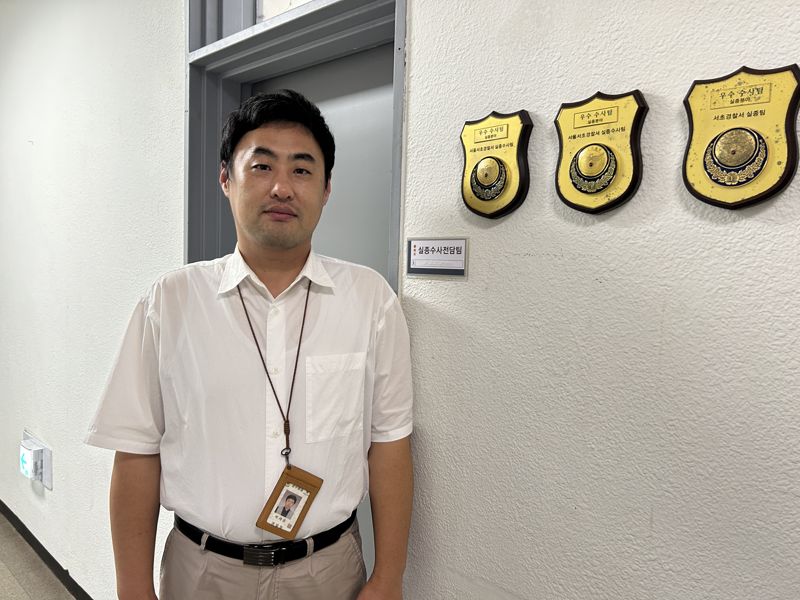
[Financial News] “The workload of the Missing Persons Investigation Team is no less than that of the Violent Crime Unit. Because we cannot exclude the possibility of criminal involvement, we must stay alert at all times.”
Inspector Jae Eung Park of the Missing Persons Investigation Team at Seoul Seocho Police Station is a veteran investigator who has handled missing persons cases since 2015. He has devoted two-thirds of his 15-year police career to this field. Park emphasized that searching for missing persons is not much different from tracking down criminals. When necessary, they obtain financial or telecommunications warrants to trace leads. While most cases are simple disappearances, some escalate into violent crimes.
The creation of the Missing Persons Investigation Team is also tied to violent incidents. In late 2007, after two elementary school students went missing in Anyang, Gyeonggi Province and were found dead three months later, police assigned dedicated missing persons personnel to detective divisions nationwide for the first time. In the early 2010s, the responsibility shifted to the newly established Department of Women and Youth, which weakened the focus. However, after the notorious 'Molar Daddy' (Lee Young-hak) case in 2017, where a middle school girl’s friend was sexually assaulted and murdered, the team was formally institutionalized. Both incidents left a stain on the police due to inadequate investigations and poor initial responses.
Recently, however, attention to the Missing Persons Investigation Team has waned again. Staffing is the clearest indicator of a unit’s priority within the police. At Seoul Seocho Police Station, the team grew from four to eight members after the Lee Young-hak case, but was reduced by two earlier this year. After the cuts, the number of officers on night duty from 6 p.m. to 9 a.m. had to be reduced from two to one. With no time for breaks, officers often work through the night, and the rotation comes around more quickly, further increasing the workload.
Inspector Park explained, “When a report comes in via the 112 Police Emergency Number, both local officers and the Missing Persons Investigation Team respond, but police precincts often have to attend to other incidents. As a result, we spend nights reviewing CCTV footage and canvassing buildings. The recent tragic death of a Korea Coast Guard (KCG) officer made me reflect on our own working conditions, where we barely get any rest.”
Due to staff shortages, it has become even more difficult to investigate long-term missing persons cases. Cases involving children under 18, individuals with intellectual disabilities, and elderly people with dementia are handled by the Long-term Missing Persons Task Force under the Criminal Investigation Mobile Unit at each provincial police agency. The Missing Persons Investigation Team at the police station is responsible for long-term cases involving adults. At Seoul Seocho Police Station, there are currently 19 unresolved long-term cases. Park noted, “At the very least, we need to separate those handling new cases from those responsible for long-term cases. Right now, we are so busy processing new reports each day that we have no time to revisit old cases. Even organizing a mountain search is difficult with fewer staff.” The station receives about 3,000 missing persons reports annually, averaging more than 10 per day.
Nevertheless, Inspector Park said he cannot let go of long-term cases. He checks for 'signs of life,' such as new phone activations or changes in credit information, which can indicate that the missing person is still alive. This is why he continues to track long-term missing persons whenever he has time. Several years ago, he was able to reunite a family by identifying a missing child through the shape of their ear. However, because missing persons investigations are considered extremely demanding within the police, few young officers stay in the unit for long.
He added, “Even though there is a professional investigator system, there are not many incentives. I have persuaded some juniors with five and four years of experience to work with me, but most leave quickly. Still, the sense of accomplishment I feel when dramatically rescuing a suspected suicide victim or receiving thank-you letters from families keeps me here.”
[email protected] Kang Myung-yeon Reporter