Government: 'Seoul Halloween crowd crush caused by poor crowd control... Relocation of the Office of the President to Yongsan had an impact'
- Input
- 2025-10-23 11:19:59
- Updated
- 2025-10-23 11:19:59
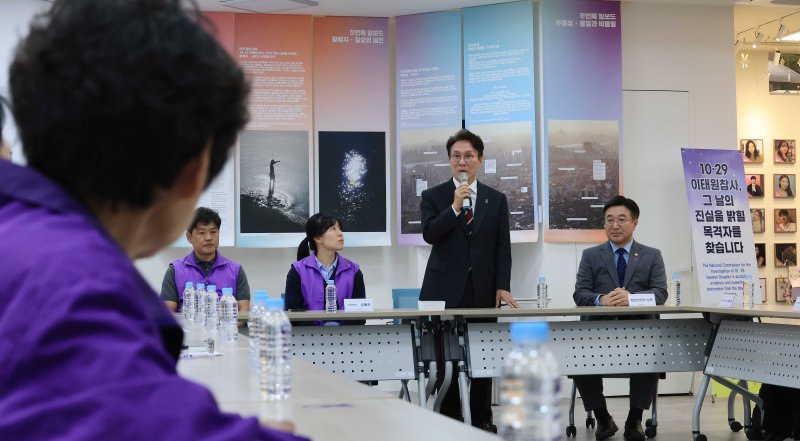
The government announced on the 23rd that the results of the Joint Audit on the Seoul Halloween crowd crush found that the tragedy stemmed from the failure of both the police and the local government to prepare in advance and respond promptly, despite the anticipated large crowds. On the day of the disaster, not a single security personnel was deployed in the Itaewon area, and the Yongsan-gu Office, which served as the disaster response control tower, was found to have its reporting and command systems virtually paralyzed.
This audit was conducted by the Joint Audit Task Force on the Itaewon Disaster, which included the Office for Government Policy Coordination, the Ministry of the Interior and Safety (MOIS), and the Korean National Police Agency (KNPA), starting from July 23. It was launched at the request of the bereaved families, who argued that the government’s investigation remained insufficient even after the Investigation of State Administration and criminal investigations.
Police failed to establish a crowd control plan and neglected 112 Police Emergency Number reports
According to the Task Force, the police did not establish a crowd control plan during the 2022 Halloween period. Instead, they concentrated personnel on managing rallies near the Office of the President of South Korea, leaving the Itaewon area virtually unattended.
The audit by the Korean National Police Agency (KNPA) revealed that Yongsan Police Station had prepared an 'Itaewon crowd management plan' every year from 2020 to 2021, but discontinued it after the Office of the President of South Korea relocated to Yongsan and security demands surged.
On the day of the disaster (October 29, 2022), security personnel were concentrated at rallies in the Samgakji area, leaving no officers present at the Itaewon site. Eleven reports warning of the risk of crowd crush were received via the 112 Police Emergency Number, but only one resulted in an on-site response, while the rest were falsely marked as 'action completed.'
The heads of Yongsan Police Station and the Seoul Metropolitan Police Agency (SMPA) did not arrive at the scene until more than an hour after the disaster occurred, resulting in a critical gap in initial command.
A special inspection by the Korean National Police Agency (KNPA) conducted from November 2022 to January 2023 was also merely procedural. It ended without an official report, and due to a lack of proper handover between departments, some responsible officials retired without facing disciplinary action.
Government demands discipline for 62 officials
According to the Ministry of the Interior and Safety (MOIS) audit, the Yongsan-gu Office situation room was essentially nonfunctional at the time of the disaster.
Of the five staff members in the situation room, two were removing posters near The War Memorial of Korea at the time of the disaster, and the remaining staff only reported the incident belatedly after being notified by the Seoul Metropolitan Government.
The head of the district office was unofficially informed of the accident through a merchant association representative and delayed key decisions, such as establishing the Disaster and Safety Countermeasures Headquarters, for over two hours, according to the Task Force.
The Deputy Mayor of District and the responsible director, who should have overseen disaster response, failed to initiate emergency assembly or provide on-site command. Even the timing of activating the Integrated Support Headquarters was unclear.
The audit also found that Yongsan-gu Office delayed or handled disciplinary actions against related officials in a perfunctory manner even after the disaster. The Seoul Metropolitan Government put the disciplinary requests from Yongsan-gu on hold after only internal review.
Based on the audit results, the Task Force decided to demand disciplinary action or equivalent measures for a total of 62 individuals, including 51 police officers and 11 officials from the Seoul Metropolitan Government and Yongsan-gu Office. However, those who had already retired or been disciplined were excluded.
The Joint Audit Task Force on the Itaewon Disaster stated, 'Despite the clear anticipation of large crowds, the police’s prior preparations were severely lacking, and the relocation of the Office of the President of South Korea contributed to the security vacuum.' The Task Force added, 'We will hold public officials accountable to the end and fundamentally re-examine the disaster response system.'
spring@fnnews.com Lee Bo-mi Reporter