China Discusses Trilateral Currency Swap with South Korea and Japan
- Input
- 2025-10-22 12:52:04
- Updated
- 2025-10-22 12:52:04
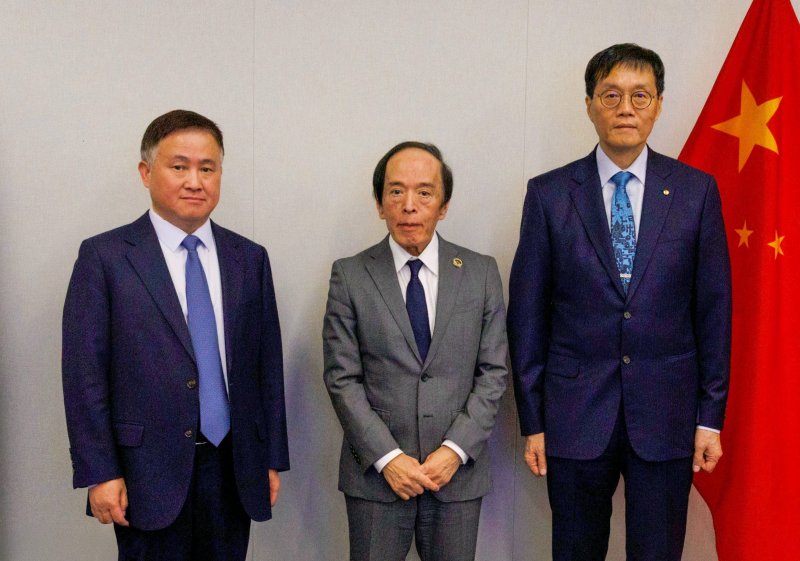
According to the South China Morning Post (SCMP) on the 22nd, Pan Gongsheng, Governor of the People's Bank of China (PBC), attended the International Monetary Fund (IMF)-World Bank Annual Meetings in Washington, D.C. last week. There, he discussed this issue with Rhee Chang-yong, Governor of the Bank of Korea (BOK), and Kazuo Ueda, Governor of the Bank of Japan (BOJ).
SCMP reported, "Such policy discussions are part of China's long-standing efforts to counter the United States dollar (USD) and to promote the use of the Renminbi (RMB) overseas, as well as to facilitate a free trade agreement among the three East Asian countries." Currently, the combined economies of these three nations account for a quarter of the global economy. As of 2024, South Korea and Japan are China's fourth- and sixth-largest trading partners, respectively.
Bilateral currency swap agreements are already in place among the three countries. Since the first currency swap between China and South Korea in 2002, both the duration and scale have gradually increased. The current agreement is for five years and totals 400 billion RMB (approximately 80.3 trillion KRW). China and Japan also signed a three-year currency swap agreement worth 200 billion RMB (about 40.146 trillion KRW) in October last year. The Korea-Japan currency swap was reinstated in December 2023 with a three-year term and a value of 10 billion USD (about 14.301 trillion KRW).
It remains unclear how a trilateral currency agreement among the three countries would be structured. It is also uncertain whether it would fall under the Chiang Mai Initiative (CMI), a multilateral currency swap arrangement launched in May 2000 that includes ten Southeast Asian nations. SCMP noted, "The Chinese central bank did not provide details in its recent online statement, only mentioning that the three governors exchanged views on the latest economic and financial conditions."
Meanwhile, as of the end of September, China had signed currency swap agreements totaling 4.5 trillion RMB (about 903.015 trillion KRW) with 32 central banks worldwide. Of this, 350 billion RMB (about 70.2345 trillion KRW) was signed with the European Central Bank (ECB) and renewed in September. Last week in Washington, China also renewed a five-year currency swap agreement with Iceland worth 3.5 billion RMB (about 702.3 billion KRW).
[email protected] Hong Chae-wan Reporter