Development of Personalized Artificial Skin Technology Using a Patient’s Own Cells
- Input
- 2025-10-22 10:10:04
- Updated
- 2025-10-22 10:10:04
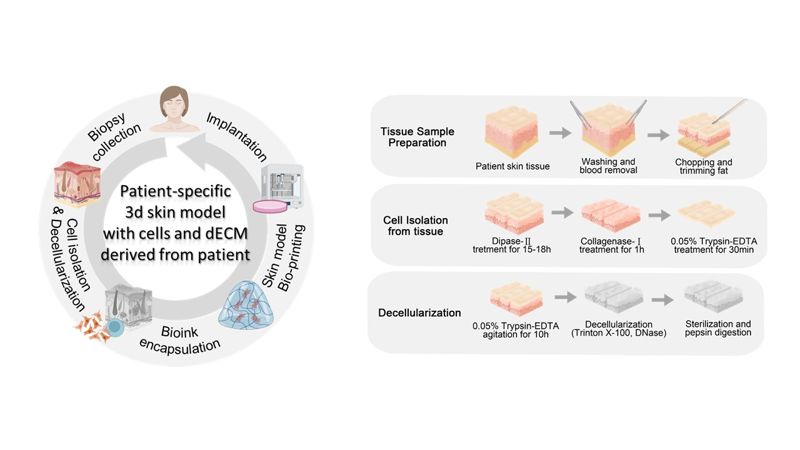
For those who have lost skin due to severe burns or chronic wounds, treatment has traditionally relied on donor skin or artificial materials. Recently, however, a new technology has emerged that grows 'personalized new skin' using materials remembered by the patient's own body.
A research team led by Professor Lee Junmin from the Department of Materials Science and Engineering and Graduate School of Convergence Science and Technology at Pohang University of Science and Technology (POSTECH), along with Kang Raehee, a graduate student in the Department of Systems Biotechnology, collaborated with Professor Park Bo-young of Ewha Womans University (Ewha) and Professor Hanjun Kim of Korea University (KU) to develop an innovative technique for creating customized artificial skin grafts using a patient’s own cells and tissues. The findings were recently published online in the international journal Advanced Science.
Autologous skin grafting, commonly used for treating burns and chronic wounds, is limited by a lack of healthy donor skin and the risk of scarring after surgery. Alternatives such as Acellular Dermal Matrix (ADM) and cell injection therapies have been explored, but artificial materials often fail to reflect individual patient characteristics, and cell injections suffer from low survival rates, limiting their effectiveness.
The research team found a solution in materials that the body can naturally recognize. They created decellularized extracellular matrix from a patient’s skin and recombined it with keratinocytes and fibroblasts derived from the same patient using 3D bioprinting technology. This approach preserves the patient’s unique protein composition and microstructure, allowing their own tissue to be used for skin regeneration.
The team’s personalized graft successfully replicated the complex protein environment of real skin. Collagen production by dermal fibroblasts increased by 2.45 times compared to previous methods, while the formation of vascular junctions and vascular networks rose by 1.27 and 1.4 times, respectively, leading to robust growth of new blood vessels for oxygen supply.
Animal experiments also demonstrated significant reductions in inflammation and complete skin regeneration within two weeks. The length of epidermal migration was approximately 3.9 times greater than before, and dermal thickness showed marked improvement. Unlike control groups or those treated with standard gelatin-based Hydrogel, the grafts established themselves stably without bleeding or congestion.
Most importantly, because the body recognized the graft as its own, rapid and stable healing occurred without immune rejection or scar formation. This technology is expected to offer a new treatment alternative for challenging conditions such as diabetic foot and chronic inflammatory wounds.
[email protected] Yeon Ji-an Reporter