APEC Finance Ministers Adopt Five-Year ‘Incheon Plan’ Roadmap... Korea Leads First-Ever AI Agenda
- Input
- 2025-10-22 00:08:00
- Updated
- 2025-10-22 00:08:00
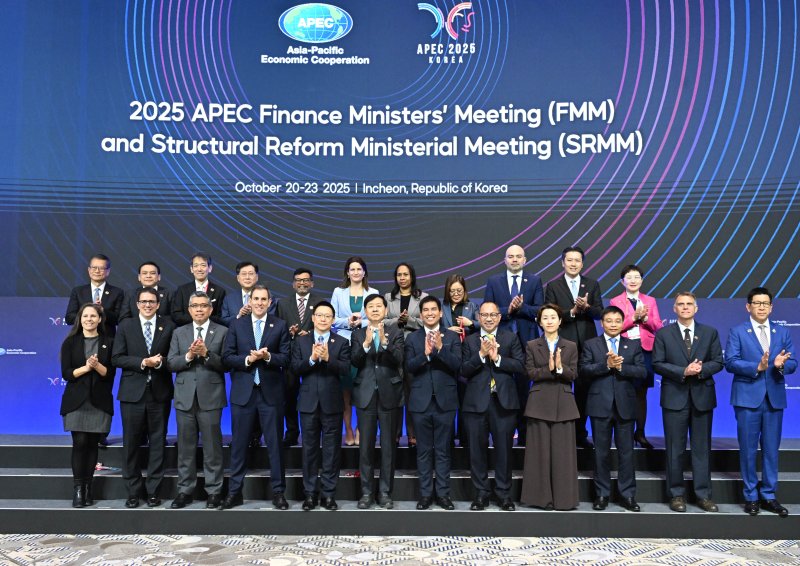
[Financial News] At the 32nd APEC Finance Ministers' Meeting (APEC FMM), all 21 member economies unanimously adopted a joint statement and a five-year mid- to long-term roadmap, the ‘Incheon Plan,’ on the 21st. Following the 2015 Cebu Action Plan (CAP) from the Philippines, this new roadmap sets a fresh direction for regional economic cooperation, focusing on four pillars: innovation, finance, fiscal policy, and inclusiveness. Notably, Korea led the way by introducing artificial intelligence (AI) as an official agenda item for the first time in APEC FMM history, establishing a new milestone for digital cooperation during this era of transformation.
This meeting, held in Songdo International Business District (Songdo IBD), Incheon, was the first APEC FMM hosted by Korea in 20 years since 2005. Finance ministers from major economies such as Thailand, Australia, New Zealand, Vietnam, Hong Kong, and Taiwan attended, along with vice ministers from China, Japan, and Brunei. Representatives from international organizations including the International Monetary Fund (IMF), Organisation for Economic Co-operation and Development (OECD), World Bank, Asian Development Bank (ADB), and Inter-American Development Bank (IDB) also participated.
In his opening remarks on the 21st, Deputy Prime Minister Koo Yun-cheol emphasized, “In times of increasing uncertainty and transition, the spirit of solidarity and unity is more important than ever.” He added, “APEC must work together to ensure that AI and digital innovation become driving forces for economic growth.”
The Incheon Plan includes expanding AI infrastructure, nurturing AI talent, strengthening public-private partnerships, and promoting data-driven innovative finance. The plan is significant in that productivity gains and the spread of innovative ecosystems through AI have become central to fiscal and financial policy. Korea took the lead in adopting AI-related agendas, aligning its national policies—such as expanding research and development (R&D), supporting small business financing, and advancing capital markets—with APEC’s discussion framework. Furthermore, the concept of ‘Financial Inclusion’ was broadened to establish ‘Accessibility and Opportunity for All’ as an independent agenda item, expanding the discussion from growth-centric to a greater focus on inclusion and equity.
This agreement comes just ahead of the APEC Leaders’ Meeting in Gyeongju, which begins on the 31st. Despite ongoing US-China technological rivalry and growing trade uncertainties, member economies reaffirmed their commitment to policy coordination and cooperation. During the meeting, Deputy Prime Minister Koo held bilateral talks with Australia’s Jim Chalmers, New Zealand’s Nicola Willis, Vietnam’s Nguyen Van Thang, and Hong Kong’s Paul Chan to discuss supply chain stability, AI-driven structural reforms, and support for business expansion.
Meanwhile, an AI and digital transformation exhibition was held near the conference venue, featuring participation from domestic companies and institutions. Highlights included AI semiconductors from the National IT Industry Promotion Agency (NIPA), Naver Corporation’s ‘AI Care Call’ service for seniors, and business finance platforms such as Business Analytics System on AI (BASA) and WonBiz Plaza.
Additionally, the Ministry of Economy and Finance will hold a joint session for finance and structural reform ministers on the 22nd, continuing discussions under the theme of ‘Innovation and Digitalization.’ The agenda includes a joint luncheon with the APEC Business Advisory Council (ABAC) and the main session of the structural reform ministers’ meeting, with follow-up discussions focused on improving market and business environments and strengthening regional connectivity.
[email protected] Lee Bo-mi Reporter