'Japan's Export Star' Samgye-tang Faces Uncertainty... Drops 26% in One Year
- Input
- 2025-10-21 15:41:13
- Updated
- 2025-10-21 15:41:13
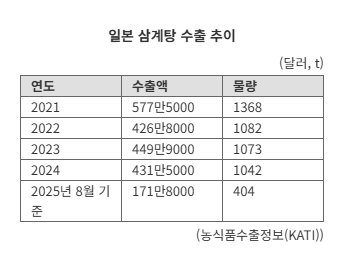
[Financial News] The export outlook for Samgye-tang, a traditional dish that once led the K-food wave, is turning red in Japan. As Japanese-made Samgye-tang products become more widespread and other K-food items like Yangnyeom chicken gain popularity, exports of Samgye-tang to Japan have fallen by 26% in just one year, signaling a rapid decline in demand for Korean Samgye-tang.
According to statistics from KATI Agro-Fisheries Trade Information (KATI), Samgye-tang exports to Japan from January to August this year totaled 24.45 billion won, with a volume of 404 tons. Compared to the same period last year, these figures represent decreases of 26.3% and 26.2%, respectively. Both the export value and volume of Samgye-tang to Japan have been declining since peaking in 2021.
A major factor is the increasing prevalence of small-portion Japanese Samgye-tang products, as opposed to the large-portion Korean versions. Additionally, the popularity of alternative K-foods such as Yangnyeom chicken has contributed to the decrease in Samgye-tang consumption.
The number of Japanese Samgye-tang imitation products rose from 29 in 2022 to 50 in 2023, and 71 in 2024. In contrast, the number of Korean Samgye-tang products increased from 7 in 2022 to 8 in 2024, with only one new product introduced over three years.
By product type, Korean Samgye-tang is mainly offered as Retort Samgyetang (89%) and porridge (11%). Japanese imitation Samgye-tang products, however, are available in a wide range of categories, including Retort Samgyetang, porridge, soup, hot pot broth, and instant foods such as cup noodles and instant rice soup.
The popularity of small-portion, low-priced Japanese Samgye-tang is another reason for the decline in exports of Korean Samgye-tang.
Analysis of POS data from retail distribution channels shows that last year, the average selling price of Japanese Retort Samgyetang was 913 yen (about 8,595 won) with an average weight of 906.67g, resulting in a per-gram price of about 1.01 yen (about 9.5 won). In contrast, Korean Samgye-tang averaged 1,102 yen (about 10,380 won) for 842.86g, with a per-gram price of 1.31 yen (about 12.3 won), making it more expensive per unit weight than its Japanese counterpart.
There is also a seasonal trend, with Japanese Samgye-tang sales concentrated in the colder months from October to February. Unlike in Korea, where consumption rises during Boknal in the summer, Samgye-tang is considered a winter dish in Japan.
A representative from the Korea Agro-Fisheries & Food Trade Corporation (aT) suggested, "Korean Samgye-tang should also expand its range of small-portion and low-priced products, such as half-chicken Samgye-tang, and offer more convenient product formats." The official added, "Since Samgye-tang is perceived in Japan as a healthy winter food rather than a summer Boknal dish, it is necessary to promote Korean Boknal food culture and conduct summer marketing campaigns."
ssuccu@fnnews.com Kim Seo-yeon Reporter