Smart AI Emerges to Predict Blood Sugar and Prevent Hypoglycemia
- Input
- 2025-10-21 08:44:24
- Updated
- 2025-10-21 08:44:24
[Financial News] Researchers at Pohang University of Science and Technology (POSTECH) have developed an artificial intelligence (AI) technology that predicts blood glucose fluctuations, detects dangerous hypoglycemia, and can be applied to a wide range of patients. The study was published on the 16th in 'npj Digital Medicine,' a partner journal of the world-renowned journal 'Nature.'
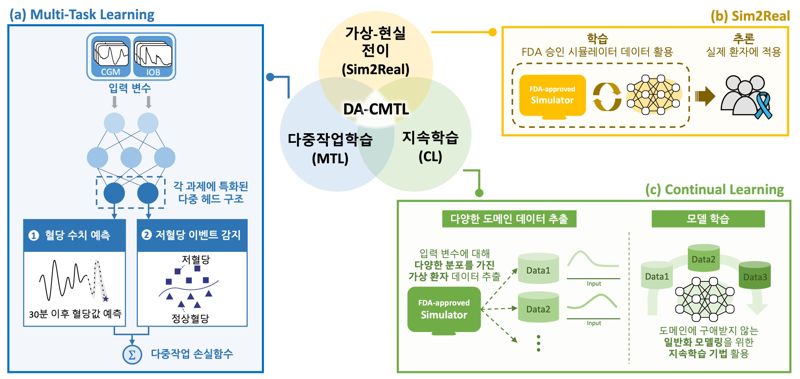
According to POSTECH on the 21st, a research team led by Professor Sungmin Park from the Departments of IT Convergence Engineering, Mechanical Engineering, Electrical and Electronic Engineering, and the Graduate School of Convergence, along with master's researcher Hwang Minju, developed an AI model called Domain-Agnostic Continual Multi-Task Learning (DA-CMTL). In simple terms, it is a 'universal blood glucose management AI.'
This model learns from blood glucose levels recorded every five minutes by a Continuous Glucose Monitor (CGM) attached to the patient's arm, as well as insulin injection data. Using this accumulated data, it predicts blood sugar changes and simultaneously calculates the likelihood of hypoglycemia.
Notably, the research team enhanced performance by integrating three technologies. First, 'Continual Learning' allows the model to maintain stable performance even when learning sequentially from different patients' data. Next, by applying 'Multi-Task Learning,' they implemented an integrated structure that enables simultaneous blood glucose prediction and hypoglycemia detection. Finally, the 'Sim2Real Transfer' technique was added so that knowledge gained in virtual environments is also effective with real patient data.
Experimental results showed that the model achieved a root mean square error (RMSE) of 14.01 mg/dL in blood glucose prediction accuracy, outperforming previous models by 5.12 mg/dL. Beyond preclinical trials, it also demonstrated significant improvements in real-time Artificial Pancreas System (APS) applications, confirming its potential for use in medical settings.
The most significant achievement of this study is its applicability to a broad range of patient groups, not just specific individuals. Professor Sungmin Park of POSTECH stated, “This research lays the foundation for next-generation artificial pancreas technology. We hope it will dramatically improve treatment methods and the quality of life for diabetes patients.”
[email protected] Yeon Ji-an Reporter