Ruling Party Proposes Increasing Supreme Court Justices from 14 to 26... Jung Chung-rae to Push for Constitutional Complaint Legislation
- Input
- 2025-10-20 15:29:15
- Updated
- 2025-10-20 15:29:15
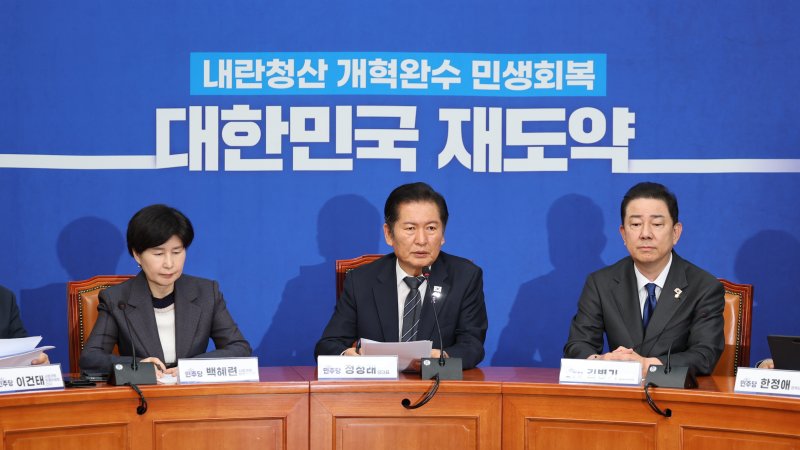
[Financial News] The Special Committee on Judicial Reform of the Democratic Party of Korea (DPK) unveiled its judicial reform plan on the 20th. The DPK’s proposal includes increasing the number of Justices of the Supreme Court of Korea, diversifying the composition of the Supreme Court Justice Candidate Recommendation Committee, reforming the personnel system through improvements to the Judicial Performance Evaluation System, and expanding the disclosure of lower court judgments. Although the introduction of a 'Constitutional Complaint Against Final Court Judgments,' which would allow the Constitutional Court of Korea to review court decisions, was not included in the reform plan, Jung Chung-rae, leader of the DPK, announced that the party leadership would submit legislation for this system. This constitutional complaint would allow constitutional review of cases already finalized by the Supreme Court, which the legal community views as effectively introducing a fourth instance trial system.
On this day, the Special Committee on Judicial Reform of the DPK held a press conference at the National Assembly of the Republic of Korea to present the key points of the judicial reform plan. Jung Chung-rae stated, "The Judiciary, which must maintain political neutrality and uphold due process under any circumstances, has been found to have engaged in hasty trials and interfered in the presidential election." He continued, "Chief Justice Cho Hee-dae refused to take the witness oath and answer questions at the National Assembly audit, while the head of the judiciary contradicted himself and gave evasive answers. It is a serious hypocrisy and contradiction for those who do not abide by the law themselves to judge others for legal violations."
The judicial reform plan announced by the DPK’s Special Committee on Judicial Reform consists of five main points: increasing the number of Justices of the Supreme Court of Korea, diversifying the composition of the Supreme Court Justice Candidate Recommendation Committee, introducing a Judicial Performance Evaluation System, expanding the disclosure of lower court judgments, and adopting a Pre-Issuance Hearing System for Search and Seizure Warrants.
First, the DPK plans to increase the number of Justices of the Supreme Court of Korea, including the Chief Justice, from the current 14 to a total of 26. Baek Hye-ryeon, a member of the Special Committee on Judicial Reform, explained, "This bill will take effect one year after promulgation. Thereafter, four justices will be added each year for three years, totaling 12 additional justices. As a result, the Supreme Court will operate with 26 justices after three years." She added, "Some have expressed concern that increasing the number of justices could allow a particular administration to dominate the judiciary. However, calculations show that 22 justices will be appointed during President Lee Jae Myung’s term, and the next president will also appoint 22 justices. In other words, the system is designed so that both the current and next administrations appoint an equal number of justices."
Additionally, the Supreme Court Justice Candidate Recommendation Committee will be expanded from 10 to 12 members. The number of judges recommended by the National Judges’ Representative Conference will increase from one to two, with at least one being a woman. One lawyer recommended by a majority of Local Bar Association presidents will be added. The head of the judiciary will be removed from the committee, and the Secretary-General of the Constitutional Court of Korea will be included instead. The chair of the committee, currently designated by the Chief Justice, will now be elected from among the committee members.
Judicial performance evaluations will now include assessments by each Local Bar Association as recommended by the Korean Bar Association (KBA). The composition of the Judicial Personnel Committee will also be revised to reduce the influence of the Chief Justice. Furthermore, the system will be reformed to allow full access and copying of lower court judgments, thereby strengthening disclosure. The Pre-Issuance Hearing System for Search and Seizure Warrants will also be introduced, requiring investigative agencies to justify the necessity of warrants before the court issues them.
Jung Chung-rae also announced plans to discuss the introduction of a Constitutional Complaint Against Final Court Judgments, which would allow the Constitutional Court of Korea to review cases where fundamental rights have been infringed by court rulings. He stated, "The constitutional complaint system is necessary to uphold the logic of the Constitution, protect citizens’ constitutional rights, and provide remedies for the public. As the party leadership will submit this legislation, we will do our utmost to ensure its passage in the plenary session through party consensus."
[email protected] Choi Jong-geun Reporter