[ADEX Report] President Lee Refines Strategy for Becoming a Top 4 Defense Power
- Input
- 2025-10-20 15:42:11
- Updated
- 2025-10-20 15:42:11

[Financial News]"The great dream—to make Korea one of the world’s top four defense industry powers—cannot be achieved by our efforts alone. Beyond simply exporting outstanding products, we must present a new brand value as a security cooperation partner."This was President Lee Jae Myung’s solution for advancing to a top-four defense power, as stated in his congratulatory address at the opening ceremony of Seoul International Aerospace & Defense Exhibition 2025 (Seoul ADEX 2025) at KINTEX, Ilsanseo-gu, Goyang-si, Gyeonggi-do, on the 20th. President Lee emphasized that solidarity and cooperation with the world are not optional but essential for securing the competitiveness of Korea’s defense industry in the global market.
To this end, the government plans to make unprecedented investments in defense R&D and aerospace R&D by 2030, aiming to secure core technologies and weapon systems for future defense and to build capabilities for independent space development.
President Lee stated, "We will invest boldly, especially focusing on developing proprietary technologies, components, and materials such as special semiconductors for defense, to establish technological sovereignty." He added, "We will expand opportunities for the private sector to propose technologies and equipment to the military and introduce a fast-track system for the defense industry to ensure rapid adoption."
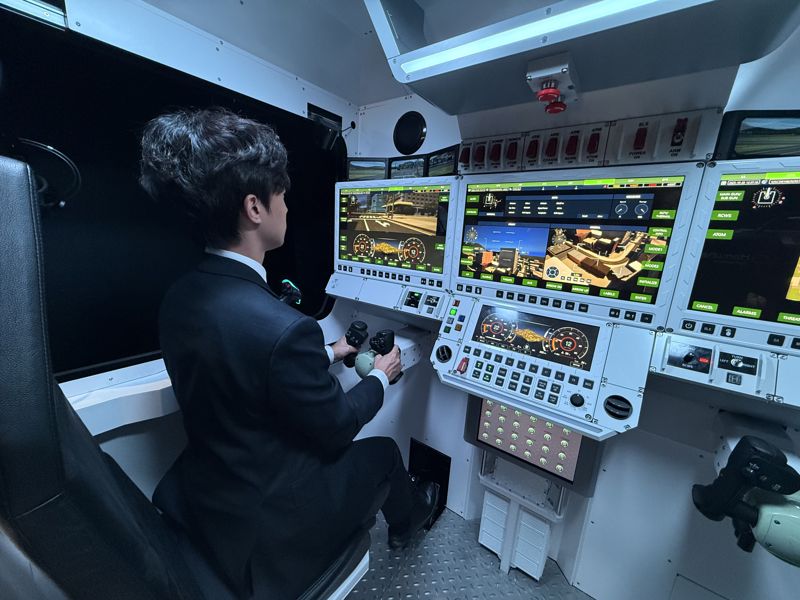
At the Hanwha Aerospace GVA Simulator showcased that day, visitors could glimpse a future battlefield where mission constraints between operators and gunners are eliminated. By leveraging Artificial Intelligence (AI) to collect data and make initial decisions, soldiers only need to execute, significantly speeding up judgment and action.
Choi Geon, Senior Researcher of the Elemental Technology Team 4 at Hanwha Aerospace, explained, "Previously, soldiers had to make decisions with dedicated equipment for each role, which took 8 to 9 seconds. Now, a computer can provide a decision in just one second." He added, "Even drone operations requiring manual control can be managed within the integrated system."
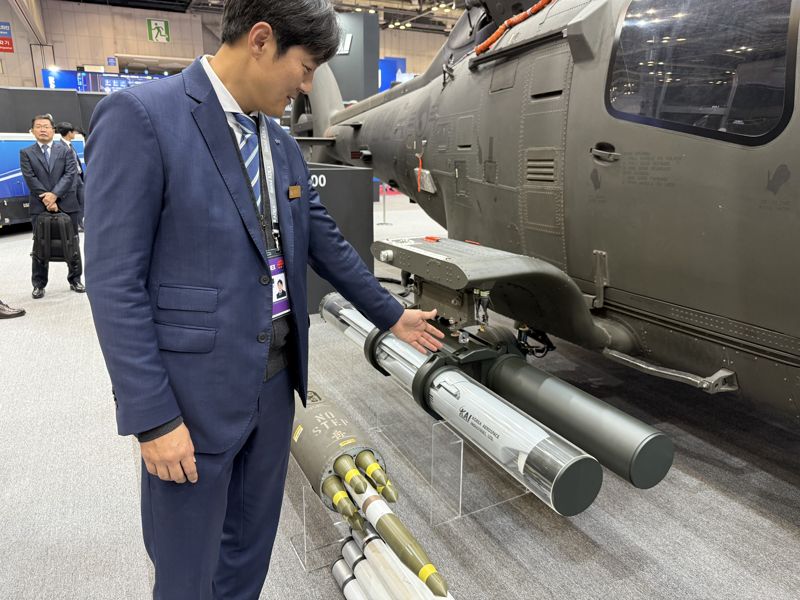
The Air Launched Effects (ALE) unmanned system from Korea Aerospace Industries (KAI) is no exception. It can be launched from a helicopter in flight to perform reconnaissance, deception, or self-destruct missions. While conventional 2.75-inch rockets (14 rounds, 7 per side) handle armament tasks, ALE is equipped with wings upon launch, allowing it to acquire aerial target information and relay it to the pilot.
Lee Jae-hyung, Head of the Rotary Wing Business Team 2 at KAI, noted, "The system moves according to the pilot’s line of sight through the pilot’s HMD. The reconnaissance development project known as LH mun-T is scheduled to begin next year. While ALE is launched from the air, this system will be ground-launched and then transferred for control."
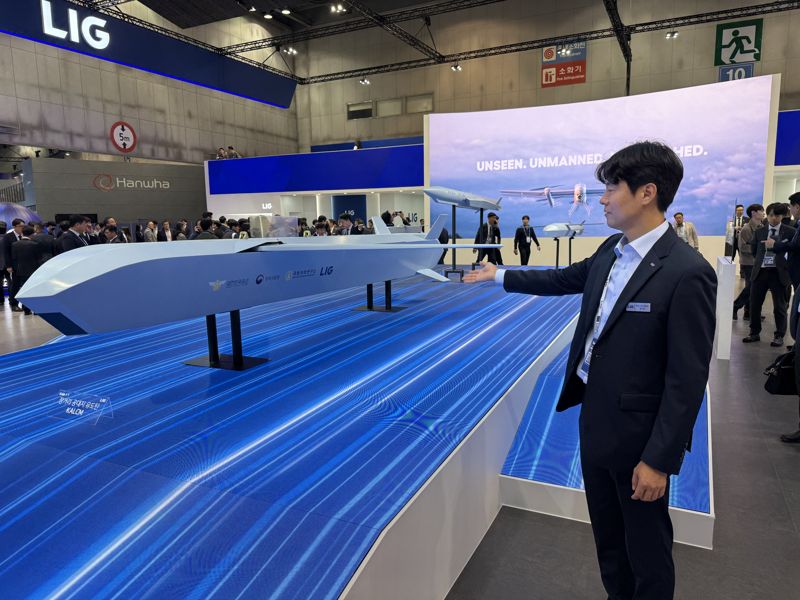
Kim Go-gyun, Senior Manager of Missile Systems Division 1 at LIG Nex1, explained about the short-range air-to-air missile, "It can be mounted on the KAI T-50 Golden Eagle and KAI KF-21 Boramae, and after launch within the pilot’s line of sight, it can turn 360 degrees, enabling dogfights." He added, "The Imaging Infrared Seeker (IIR seeker) at the front of the missile transmits infrared images to the pilot. The long-range air-to-surface guided missile can detect and track targets beyond visual range."
Choi Se-hoon, Senior Manager of the Missile Systems Division at LIG Nex1, emphasized regarding the long-range air-to-surface guided missile, "It is a weapon system to be mounted on the KAI KF-21 Boramae fighter. It can fly up to 500 km and strike within a 3-meter radius, targeting key ground facilities."
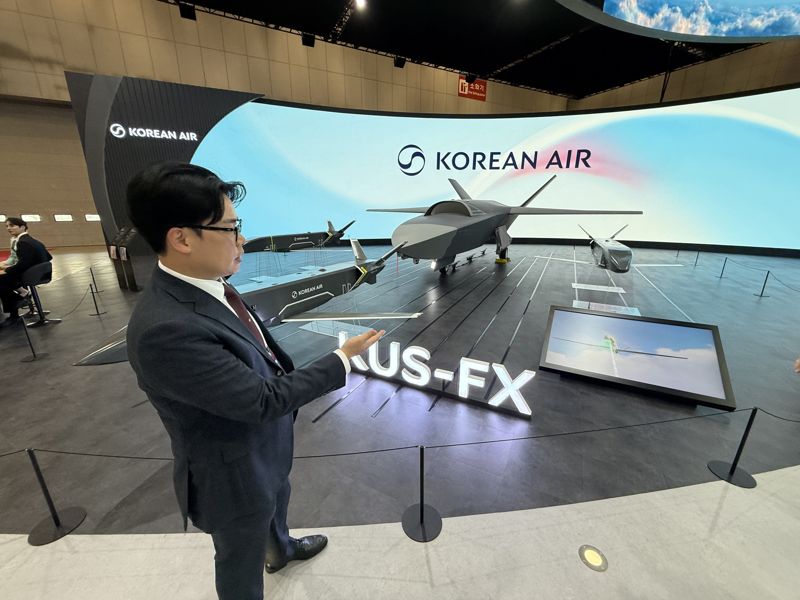
Korean Air unveiled its Low-Observable Unmanned Aerial Vehicle Squadron for the first time. This system operates in formations consisting of both manned fighters and multiple unmanned aerial vehicles.
Kim Dong-joo, Head of the Unmanned Systems Division at Korean Air, said, "We have been developing this system with the Agency for Defense Development (ADD) since 2023, aiming for a maiden flight next year. Some units are launched from vehicles on the ground using rocket propulsion, rather than ground taxi takeoff. The system allows manned aircraft to control unmanned vehicles and is more cost-competitive than missiles."
Hyundai Rotem presented both a liquid-fueled hypersonic engine and a solid-fueled Ducted Ramjet Engine. According to Lee Si-woo, a researcher at Hyundai Rotem’s Aerospace Development Team, the hypersonic engine, though liquid-fueled, achieves speeds of Mach 5 to 6 and offers advantages in control.
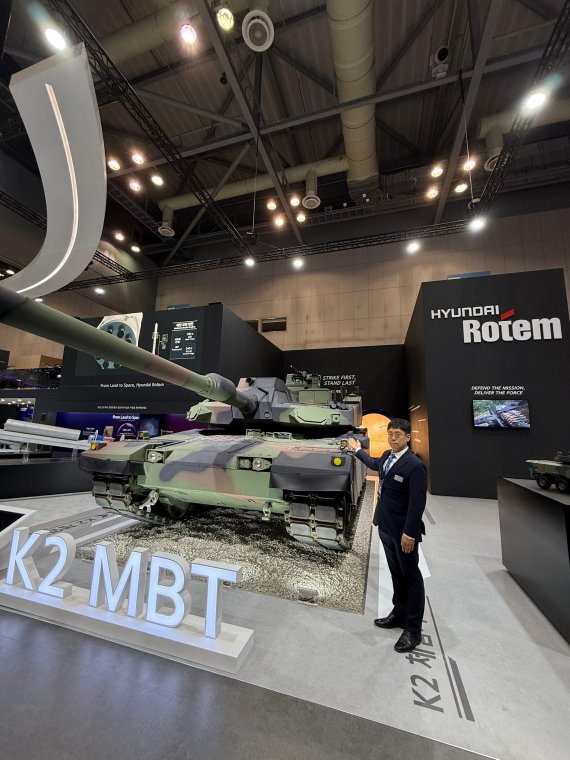
The K2PL main battle tank was also on display. Oh Hoon-tae, Senior Researcher of the Global Tank Systems Team 2 at Hyundai Rotem, stated, "Based on the K2 tank, we have upgraded from soft-kill to hard-kill systems. The crew can fire from inside the vehicle, and a Drone Jammer has been installed to counter drone threats."
[email protected] Kang Gu-gwi, Seo Young-jun Reporter