"Reviewing the Rationalization of Property Taxes... Comprehensive Tax System Redesign Based on Ability-to-Pay Principle," says Deputy Prime Minister Koo Yun-cheol
- Input
- 2025-10-19 12:29:53
- Updated
- 2025-10-19 12:29:53
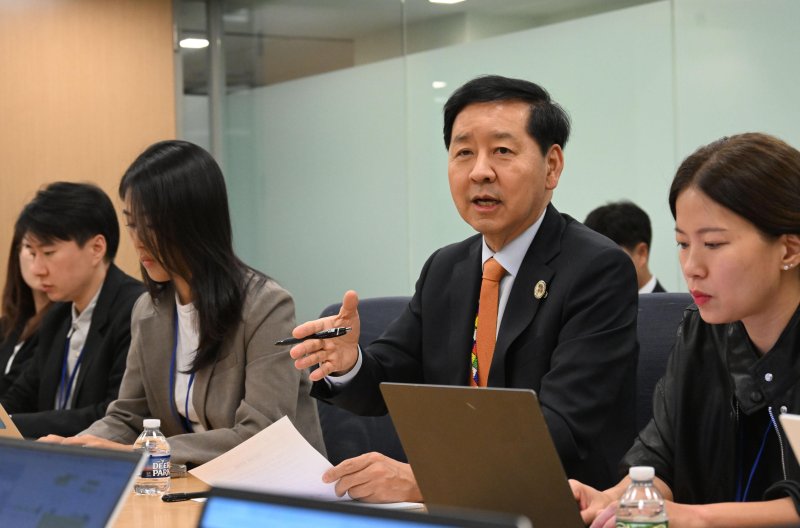
Koo Yun-cheol indicated the possibility of adjusting property holding taxes in line with the 'ability-to-pay' principle, which reflects taxpayers' capacity to bear the burden. The intention is to normalize transactions by improving the current structure, where holding taxes are low but capital gains taxes are excessively high.
During a press briefing after attending the G20 Finance Ministers and Central Bank Governors Meeting in Washington, D.C. on the 16th (local time), Koo stated, "In Korea's real estate market, the burden of holding property is low while capital gains taxes are high, resulting in a severe 'lock-in effect.'" He added, "Property holding taxes can be considered both a real estate policy and a reflection of the ability-to-pay principle."
He explained, "Because the cost of selling a home (capital gains tax) is high, people tend to hold onto their properties rather than sell them. If the holding tax burden on high-priced homes increases, properties will naturally come onto the market, boosting liquidity." He continued, "For example, if property tax is set at an average of 1% as in the United States, a home worth 5 billion won would incur an annual tax of 50 million won. As the burden during the holding stage increases, transactions could become more active."
Regarding the possibility of strengthening taxation on multiple homeowners, Koo noted, "This is not just an issue for those with multiple properties. We must also consider fairness between someone who owns three homes worth 500 million won each and someone who owns a single home worth 5 billion won." He emphasized, "Even if a person owns only one home, if it is a high-value property, the tax system should be designed in accordance with the ability-to-pay principle."
He further stated, "It is important to create a tax structure that is consistent across acquisition, holding, and transfer stages. We are considering a coherent tax system that the public can accept, rather than simply raising or lowering tax rates." To this end, the government plans to commission research on the overall real estate tax system and gather expert opinions before determining the timing of policy implementation.
Koo also remarked, "Ultimately, the structure of real estate taxation is linked to the capital market and productive finance. Through tax reform, we aim to alleviate the 'Korea discount' and reduce the phenomenon of capital being concentrated solely in real estate."
Regarding recent discussions on government organizational restructuring, he expressed regret over the separation of the Ministry of Planning and Budget and the Ministry of Finance and Economy, stating, "There is a significant difference in formulating economic policy depending on whether or not the budget is available as a tool."
He also commented on the failed transfer of domestic financial policy functions from the Financial Services Commission (FSC), saying, "It is unfortunate, but I will encourage the staff and continue to work hard."
junjun@fnnews.com Choi Yong-jun Reporter