"Antarctic Geographical Features to Be Named by the Public"... Nationwide Korean Language Naming Contest Announced
- Input
- 2025-10-19 11:00:00
- Updated
- 2025-10-19 11:00:00
The National Geographic Information Institute (NGII) under the Ministry of Land, Infrastructure and Transport (MOLIT) announced on the 19th that it will hold the 'Antarctic Place Name Korean Language Contest,' allowing the public to propose new Korean names for geographical features in Antarctic scientific research areas, including around Jang Bogo Station and the K-Route, starting from the 20th.
As a national agency specializing in spatial information, NGII is expanding the scope of Antarctic spatial data construction from the main scientific stations such as King Sejong Station and Jang Bogo Station to include candidate inland stations and new research areas like the K-Route.
Accordingly, NGII is working to assign Korean names to the geographical features around Jang Bogo Station and the K-Route, and to register these names in the Gazetteer of Antarctic Place Names.
This nationwide contest is open to everyone and will be conducted online. The aim is to gather valuable public input on Korean names for Antarctic geographical features.
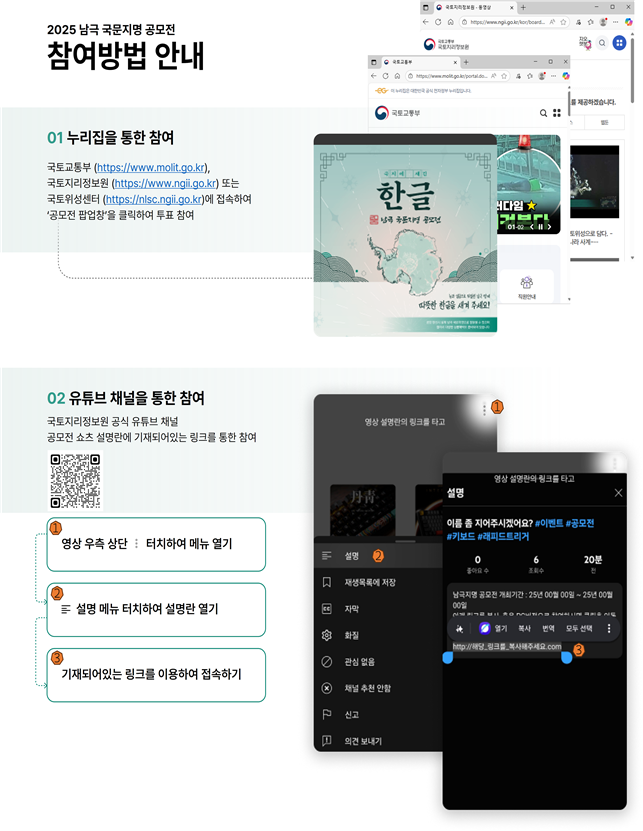
Voting can be done via the institute's official website and links in promotional videos. Participants can conveniently view the target areas in Antarctica using a 3D interactive map. Detailed information on each region's geographical characteristics and the origin of proposed names will also be provided.
NGII plans to finalize a total of 16 candidate names through a process that includes public input from this contest, expert consultations, reviews by related organizations, and public hearings.
Winners of the contest will receive awards such as the NGII Director's Prize. The grand prize entry will be confirmed as an official place name after review by the Korea Committee on Geographical Names (KCGN), and a place name certificate will also be awarded.
Cho Woo-seok, Director of NGII, stated, "This is a meaningful opportunity for the beauty of the Korean language to be inscribed on the Antarctic continent and recorded at polar research sites worldwide." He added, "By establishing unique Korean place names for our research areas, we will contribute to ongoing scientific cooperation and the foundation for peaceful research activities within the Antarctic Treaty System (ATS)."
act@fnnews.com Choi Ah-young Reporter