[fn Editorial] Lee: “Bureaucratic Regulations Are Shackles on Economic Recovery”—Absolutely Right
- Input
- 2025-10-16 18:47:00
- Updated
- 2025-10-16 18:47:00
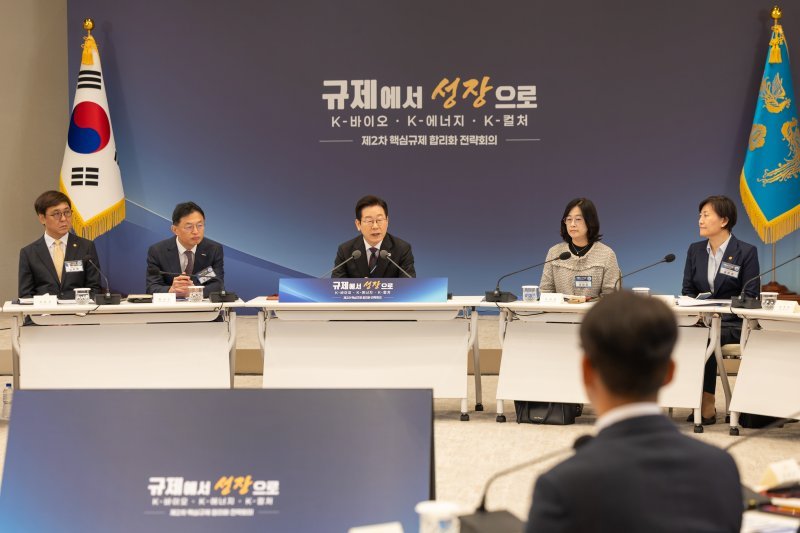
On this day, President Lee placed particular emphasis on regulatory reform in the biotechnology industry, Energy, and Culture sectors. He stated that to foster private sector creativity, the paradigm must shift from regulation to growth. In the biotechnology industry, he called for reforms to accelerate demonstration, clinical trials, and treatment. For the Culture sector, he urged the relaxation of regulations affecting creative activities and overseas expansion. In the renewable Energy sector, he identified the removal of complex regulations related to permits and site selection as a top priority.
In reality, Korean industries, once regarded as new growth engines, are losing their edge in the global marketplace as companies are hampered by various regulations. The game industry, which accounts for 70% of K-content exports, has been shackled by the Shutdown Law and Web Board Game Regulation, as the prevailing perception is that it is a target for regulation rather than promotion. As a result, game exports in 2023 fell by more than 6% compared to the previous year. Although Korea is one of the few countries in the world to systematically accumulate health checkup data, overlapping regulations such as the Personal Information Protection Act and the Bioethics and Safety Act prevent the use of this data, causing Korea to lag behind in the race for new drug development.
For regulatory reform to be more than just a slogan, a thorough diagnosis of reality is required. Every administration has advocated 'regulatory innovation,' but without concrete analysis and alternatives, reforms have repeatedly been blocked by ministries defending their vested interests. As a result, bureaucratic inertia—where officials are more concerned with avoiding problems than fostering industry—has become entrenched.
To achieve tangible results from the current administration’s regulatory rationalization, the focus of ministries must shift from 'supervision and control' to 'promotion and development.' Regulators should also be responsible for fostering the industries they oversee, becoming 'promotion-oriented supervisors.' To this end, regulatory reform must not be a one-off meeting but institutionalized to quickly reflect the needs of businesses, and the incentive structure should be revised to encourage bureaucrats to actively pursue regulatory reform.
South Korea now faces limits to growth due to low birth rates, declining labor productivity, weakening competitiveness in key industries, and sluggish productivity among small and medium-sized enterprises. Seventeen unicorn companies, each valued at over $1 billion, have stated they cannot operate in Korea because of regulations. Global consulting firm McKinsey & Company has compared Korea’s situation to a 'frog in a pot.' Without sweeping regulatory reforms to change the economic paradigm, it will be difficult to pull Korea out of the boiling pot.