'Many Needs, Not Enough Money': National Fiscal Deficit Nears 90 Trillion Won, Second Largest on Record
- Input
- 2025-10-16 10:03:56
- Updated
- 2025-10-16 10:03:56
[Financial News] This year, the government’s fiscal deficit is approaching 90 trillion won. This is the second largest figure on record, following the massive issuance of deficit bonds during the COVID-19 pandemic in 2020. The continued expansionary fiscal policy, including two rounds of supplementary budgets such as the 13 trillion won consumption coupon program, has led to increased deficit bond issuance. National debt (central government debt) has also climbed to 1,260 trillion won. With mandatory expenditures rising due to low birth rates, an aging population, and economic stagnation, concerns are growing over the government’s fiscal management and the soundness of public finances.
On the 16th, the Ministry of Economy and Finance announced that the Managed Fiscal Balance, which reflects the government’s actual fiscal condition, posted a deficit of 88.3 trillion won as of the end of August. This is an increase of 4.1 trillion won compared to the same period last year, when the deficit stood at 84.2 trillion won.
The Integrated Fiscal Balance, which subtracts total expenditures from total revenues, recorded a deficit of 53.7 trillion won. The Managed Fiscal Balance is calculated by excluding 34.6 trillion won in social security funds, such as the National Pension Service (NPS), from this figure.
Heejung Hwang, Director of Fiscal Soundness at the Ministry of Economy and Finance, stated, “With the second supplementary budget in full swing, the fiscal deficit has become the second largest after the 96 trillion won deficit in 2020, when four supplementary budgets were implemented due to COVID-19.” The government projects the Managed Fiscal Balance, reflecting the second supplementary budget, to reach a deficit of 111.6 trillion won this year, or -4.2% of Gross Domestic Product (GDP).
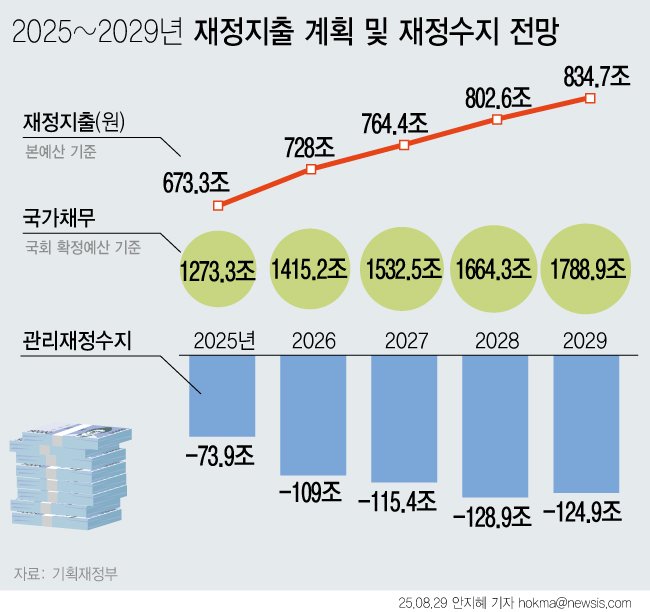
According to the Ministry of Economy and Finance’s estimates, the Managed Fiscal Balance deficit will continue to rise, reaching 109 trillion won next year, 115.4 trillion won in 2027, and 128.9 trillion won in 2028.
Government expenditures continue to outpace revenues. As of the end of August, total revenue increased by 35 trillion won year-on-year to 431.7 trillion won. Of this, national tax revenue was 260.8 trillion won, up 28.6 trillion won from the previous year. Improved performance by major companies, including in the semiconductor sector, led to a 17.8 trillion won increase in corporate tax, the largest gain. The number of wage earners, expanded bonus payments, and strong overseas stock performance also contributed to a 9.6 trillion won rise in income tax revenue.
From January to August, corporate tax revenue rose 39.1% (17.8 trillion won) year-on-year to 63.4 trillion won, while income tax revenue increased by 9.6 trillion won (12.5%) to 86.7 trillion won.
At the end of last month, the Ministry of Economy and Finance revised its national tax revenue forecast for this year to 369.9 trillion won. In contrast, Value-added tax (VAT) revenue fell by 1.2 trillion won.
The government expects a modest increase in national tax revenue this year, driven by improved corporate performance. However, significant uncertainties remain due to prolonged sluggish exports and weak domestic demand. The government forecasts total fiscal revenue for this year at 642.4 trillion won.
Total government expenditures, which reflect the government’s net fiscal scale, increased by 38.4 trillion won to 485.4 trillion won. The government plans to continue its expansionary fiscal policy, raising expenditures from 728 trillion won next year to 834.7 trillion won in 2029, an average annual increase of 5.5%—one of the highest rates among previous administrations.
As spending rises on welfare such as pensions and healthcare, as well as on Treasury bond interest payments, national debt (central government debt) will continue to grow. As of the end of August, national debt stood at 1,260.9 trillion won. To cover the fiscal shortfall, Treasury Bond issuance is also increasing. From January to September, 188.5 trillion won in Treasury Bonds (including those for individual investors) were issued. In September alone, 21.5 trillion won in Treasury Bonds were issued, with foreigners net purchasing 6.9 trillion won. To finance the second supplementary budget, the government plans to issue a total of 231.1 trillion won in Treasury Bonds this year.
The Treasury bond yield for 10-year bonds rose slightly to 2.95% amid rising uncertainties such as the US-Korea tariff agreement. As yields rise, the interest burden on government bonds also increases.
[email protected] Jung Sang-geun Reporter