[fn Editorial] Korea-U.S.-Japan Business Dialogue Should Serve as an Exit from Trade Conflicts
- Input
- 2025-10-15 18:44:41
- Updated
- 2025-10-15 18:44:41
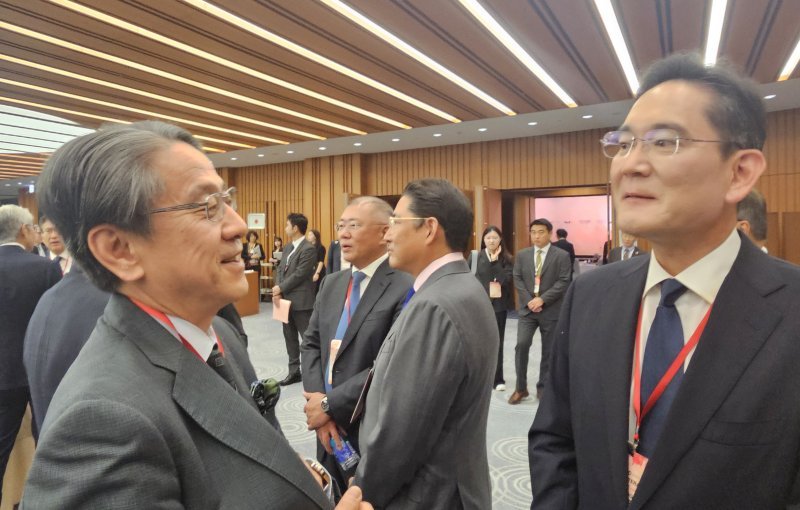
This event took place amid heightened uncertainty in corporate management, driven by escalating U.S.-China tensions and closer military ties among North Korea, China, and Russia. Rather than limiting themselves to general discussions on global cooperation, business leaders from each country engaged in detailed talks on risks and ways to expand mutual benefits across a wide range of sectors, including IT, telecommunications, and energy.
Currently, Korean companies are suffering from global political and diplomatic variables. As a result of the U.S.-China trade war, China imposed sanctions on Hanwha Ocean, a symbol of Korea-U.S. cooperation in shipbuilding. Previously, China’s restrictions on the export of rare earths, key raw materials for high-tech industries, negatively affected domestic companies such as Samsung Electronics and SK hynix. If the United States enforces a 25% tariff, it is feared that Hyundai Motor Group and other domestic firms will suffer significant losses.
In this context, the recent gathering of business leaders from Korea, the U.S., and Japan is highly significant as it aims to minimize risks and seek technological cooperation. Hyundai Motor Group and Toyota Group, which are already collaborating in hydrogen and robotics, reportedly discussed expanding their partnership to motorsports and automotive parts. Samsung Electronics is also expected to strengthen cooperation with American and Japanese industries in artificial intelligence (AI) and semiconductors. In today’s environment, where it is increasingly difficult for individual companies to secure proprietary technologies in every field, alliances among companies from countries with shared values are no longer optional but essential.
The challenges posed by rising global protectionism are spreading beyond individual companies to the broader economic structure. The government should treat the trilateral economic dialogue not as a one-off event but as the starting point for structural cooperation. Institutionalizing Korea-U.S.-Japan technological cooperation and providing tangible support measures that companies can truly benefit from are necessary. In particular, there is a need for roadmaps that deliver real outcomes, such as establishing joint R&D funds or expanding personnel exchanges in strategic sectors like semiconductors, batteries, and AI.
As the new Cold War intensifies, supply chain disruptions and technological bloc formation are accelerating, which could lead to a vicious cycle that stifles economic vitality. Ahead of the Asia-Pacific Economic Cooperation (APEC) summit in Gyeongju, the government should thoroughly analyze the economic dialogue and devise exit strategies to overcome the new Cold War framework. Korea must strengthen alliances within the liberal democratic bloc while maintaining flexibility to avoid disadvantages due to ideology. Such strategic flexibility will reduce corporate uncertainty and establish a new diplomatic paradigm that underpins sustainable economic growth.