Is Grabbing 'KPop Demon Hunters' a Guaranteed Hit?... Companies Rush to Collaborate
- Input
- 2025-10-13 17:23:54
- Updated
- 2025-10-13 17:23:54
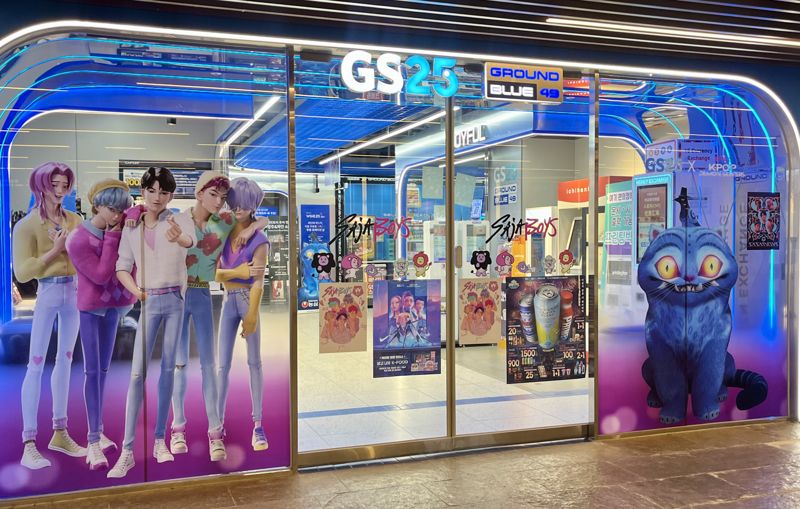
[Financial News] As the global popularity of the Netflix film KPop Demon Hunters continues unabated, the so-called 'KPop Demon Hunters effect' is spreading throughout the retail industry. Intellectual property (IP) content that combines a uniquely Korean worldview with K-pop and K-food has firmly established itself as a 'killer content,' driving sales in related sectors beyond simple video consumption.
According to Netflix Tudum, as of the 13th, KPop Demon Hunters has accumulated 325.1 million views. Even four months after its Netflix release, it remains the most-watched Netflix film ever, continuing its global box office streak.
Notably, scenes featuring characters eating K-food such as gimbap and cup noodles, along with traditional Korean patterns and props like the gat, have fueled a global craze. Collaborative products with retailers are seeing explosive sales. GS25, in partnership with Netflix, launched five KPop Demon Hunters ready-to-eat meals last month, surpassing 1 million units sold in just over a month. By including random stickers with the meals and using character-themed store wraps and standees, the brand fully leveraged the 'KPop Demon Hunters effect.' At four specialized stores with high foreign visitor traffic, such as Incheon Airport T1 and T2, ready-to-eat meal sales jumped 63.7% in the first two weeks after launch. During the Chuseok holiday, sales of collaborative products at Busan General Terminal and Daejeon Complex Terminal increased by 29% and 9%, respectively, compared to the first three days after launch.
CU also saw a sharp rise in sales among foreign customers following the KPop Demon Hunters boom. In July and August, when the film’s global popularity surged, the number of overseas payment transactions increased by 185% year-on-year. During the same period, gimbap sales rose by 231%, ramen by 99%, ambient ready meals by 143%, and snacks by 53%. Additionally, a scene where the main character eats an entire roll of gimbap became a meme, prompting CU to launch the 'K-Tong Bulgogi Gimbap.'
Riding the wave of K-food’s popularity, 7-Eleven reported that from July to August 12, foreign customer gimbap sales at airport stores increased by 120% compared to the previous year.
The success of KPop Demon Hunters has also led to increased demand for Korean cultural experiences overall. Since the film’s release, the National Museum of Korea saw a 77% year-on-year increase in cumulative visitors in August, and sales at the goods brand MU:DS rose by 73%. The Magpie Tiger Badge sold out after word spread that it resembled the characters Derpy and Seo from the film.
Collaboration with KPop Demon Hunters has become an essential strategy not only in retail but also across the food, fashion, and leisure sectors. In the food industry, Nongshim and Paris Baguette have released collaborative products, while companies like 8seconds and Everland are also engaging in extensive partnerships. The retail industry notes that K-content is evolving from 'viewing content' to 'experiential content' that people eat, wear, and enjoy. An industry insider commented, “The KPop Demon Hunters craze is boosting sales not only of official collaboration products but also of items inspired by related elements. This is expected to lead to sustained interest in K-Culture as a whole.”
[email protected] Kim Hyun-ji Reporter