KOSPI Falls Below 3,600 Amid U.S.-China Tensions; Individual Investors Limit Losses [fn Morning Market Report]
- Input
- 2025-10-13 10:05:57
- Updated
- 2025-10-13 10:05:57
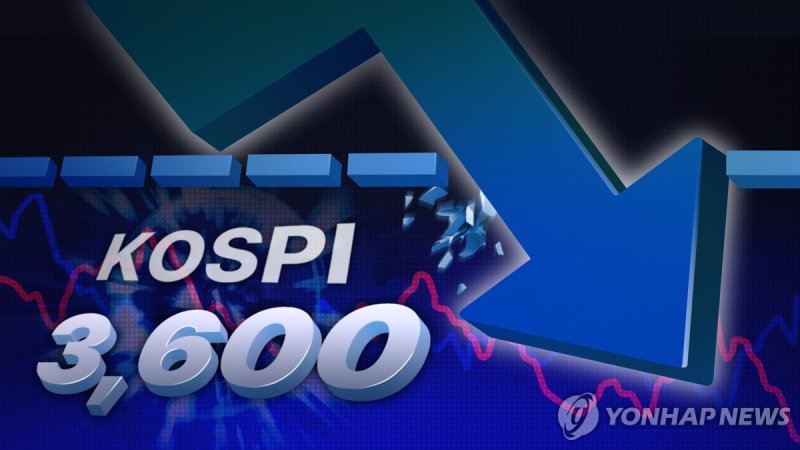
In early trading on the 13th, the Korea Composite Stock Price Index (KOSPI) dropped below the 3,600 mark, plunging over 2%. However, individual investors' bargain buying helped reduce losses to just over 1%. After surpassing 3,600 for the first time ever on the 10th, KOSPI fell to the mid-3,500s over the weekend as the U.S.-China trade conflict reignited. The index has since rebounded slightly as both countries signaled a willingness to ease tensions.
As of 10 a.m., KOSPI was down 36.20 points (1.00%) from the previous trading day, standing at 3,574.40. The index opened at 3,550.08, a 1.68% drop, and plunged more than 2% to 3,522.54, but has partially recovered thanks to individual investors’ bargain hunting.
In the main stock market, foreign investors and institutions are net sellers of 371.8 billion won and 87.5 billion won, respectively. Individual investors are net buyers of 435.8 billion won.
Top market cap stocks such as Samsung Electronics Co., Ltd. and SK hynix also gave up all their previous gains. Samsung Electronics Co., Ltd. is trading at 92,600 won, down 1.91%, while SK hynix is down 3.50% at 413,000 won.
At the same time, the KOSDAQ Index was at 857.81, down 1.68 points (0.20%) from the previous session. KOSDAQ also opened at 845.76, down 1.60%, and after dropping over 2%, has narrowed its losses.
The decline in the domestic stock market follows a sharp drop on the New York Stock Exchange (NYSE) over the weekend. On the 10th (local time), the Dow Jones Industrial Average (DJIA) fell 1.90%, while the S&P 500 Index (S&P 500) and NASDAQ Composite Index (NASDAQ Composite) plunged 2.71% and 3.56%, respectively. The Philadelphia Semiconductor Index (SOX) also tumbled 6.32%, signaling a likely decline in major domestic semiconductor stocks.
Earlier, President Donald Trump criticized China’s moves to restrict exports of rare earth elements (REE) and announced a 100% additional tariff on Chinese goods starting next month. However, both the U.S. and China ruled out the possibility of a direct confrontation early this morning (Korean time), easing some market concerns.
[email protected] Kim Mi-hee Reporter