'Three-Hour Waits' Were the Norm... Korea Pavilion at Expo 2025 Osaka, Kansai, Japan Welcomes 3.15 Million Visitors
- Input
- 2025-10-13 11:00:00
- Updated
- 2025-10-13 11:00:00
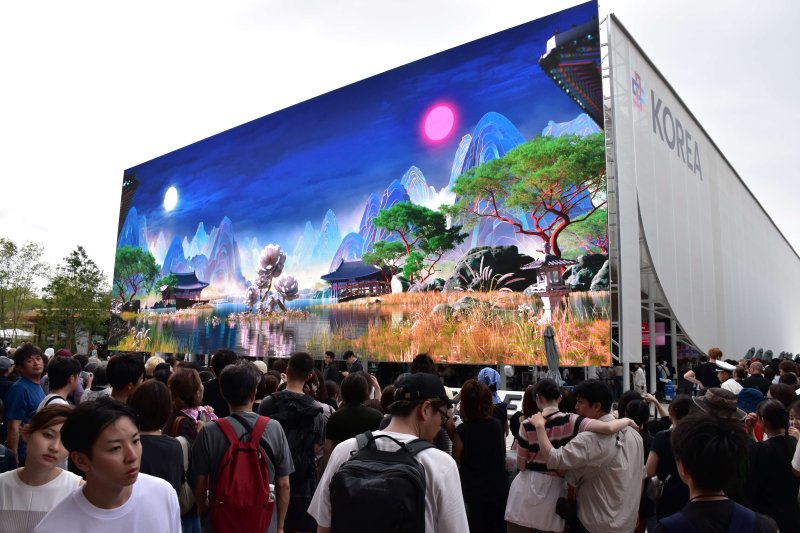
[Financial News] Drawing 3.15 million visitors over six months and generating daily lines of up to three hours, the Korea Pavilion at Expo 2025 Osaka, Kansai, Japan concluded its 184-day journey with great success. Featuring innovative experiential content that combined Artificial Intelligence (AI), K-pop, and other elements of Korean technology and culture, the pavilion was praised by international outlets such as The New York Times (NYT) as a 'must-see national pavilion,' further elevating the status of the K-brand.
The Ministry of Trade, Industry and Energy (MOTIE) and the Korea Trade-Investment Promotion Agency (KOTRA) announced that the Korea Pavilion at Expo 2025 Osaka, Kansai, Japan closed on the 13th after a successful run. Out of approximately 25.5 million total expo visitors, more than 12%—a total of 3.15 million people, including online participants—visited the Korea Pavilion.
With the theme 'With Hearts,' the Korea Pavilion attracted an average of 17,000 visitors per day, and entrance wait times reached two to three hours. Interactive exhibitions, such as an experience where AI transformed visitors’ voices into music, a demonstration of hydrogen fuel cell principles using soap bubbles, and immersive content combining K-pop and storytelling, received enthusiastic responses from all generations.
Thanks to this popularity, the Korea Pavilion was featured as a 'must-see national pavilion' in 1,824 media reports from both domestic and international outlets, including The New York Times (NYT) and Japan Broadcasting Corporation (NHK). Over 6,000 international dignitaries, including the Deputy Prime Minister of Belgium, the Crown Princess of Sweden, and the Secretary General of the Bureau International des Expositions (BIE), also visited the pavilion.
The Korea Pavilion was also recognized for its value by winning a bronze award in the Special Category at the 'Olympics of World Expositions.'
In addition to showcasing future technologies and culture through exhibits on AI, renewable energy, and mobility, the Korea Pavilion hosted a variety of industrial and cultural events, highlighting Korea’s competitiveness to the world. During Korea Day and Korea Week, 14 programs—including the Joseon Tongsinsa parade, Korea Premium Goods Exhibition, and K-culture events—were concentrated to maximize national brand promotion.
Survey results showed that 90% of Korea Pavilion visitors expressed increased interest in visiting Korea, and the number of tourists to Korea rose by 17% compared to the same period last year. Beyond tourism, events such as the Korea Premium Goods Exhibition, investment promotion delegations, and business-to-business (B2B) forums on AI and climate response contributed to establishing a new framework for Korea-Japan economic and industrial cooperation.
Many visitors are seen waiting to enter the Korea Pavilion at Expo 2025 Osaka, Kansai, Japan. Provided by Korea Trade-Investment Promotion Agency (KOTRA).
[Financial News] Drawing 3.15 million visitors over six months and generating daily lines of up to three hours, the Korea Pavilion at Expo 2025 Osaka, Kansai, Japan concluded its 184-day journey with great success. Featuring innovative experiential content that combined Artificial Intelligence (AI), K-pop, and other elements of Korean technology and culture, the pavilion was praised by international outlets such as The New York Times (NYT) as a 'must-see national pavilion,' further elevating the status of the K-brand.
The Ministry of Trade, Industry and Energy (MOTIE) and the Korea Trade-Investment Promotion Agency (KOTRA) announced that the Korea Pavilion at Expo 2025 Osaka, Kansai, Japan closed on the 13th after a successful run. Out of approximately 25.5 million total expo visitors, more than 12%—a total of 3.15 million people, including online participants—visited the Korea Pavilion.
With the theme 'With Hearts,' the Korea Pavilion attracted an average of 17,000 visitors per day, and entrance wait times reached two to three hours. Interactive exhibitions, such as an experience where AI transformed visitors’ voices into music, a demonstration of hydrogen fuel cell principles using soap bubbles, and immersive content combining K-pop and storytelling, received enthusiastic responses from all generations.
Thanks to this popularity, the Korea Pavilion was featured as a 'must-see national pavilion' in 1,824 media reports from both domestic and international outlets, including The New York Times (NYT) and Japan Broadcasting Corporation (NHK). Over 6,000 international dignitaries, including the Deputy Prime Minister of Belgium, the Crown Princess of Sweden, and the Secretary General of the Bureau International des Expositions (BIE), also visited the pavilion.
The Korea Pavilion was also recognized for its value by winning a bronze award in the Special Category at the 'Olympics of World Expositions.'
In addition to showcasing future technologies and culture through exhibits on AI, renewable energy, and mobility, the Korea Pavilion hosted a variety of industrial and cultural events, highlighting Korea’s competitiveness to the world. During Korea Day and Korea Week, 14 programs—including the Joseon Tongsinsa parade, Korea Premium Goods Exhibition, and K-culture events—were concentrated to maximize national brand promotion.
Survey results showed that 90% of Korea Pavilion visitors expressed increased interest in visiting Korea, and the number of tourists to Korea rose by 17% compared to the same period last year. Beyond tourism, events such as the Korea Premium Goods Exhibition, investment promotion delegations, business-to-business (B2B) forums, and specialized events on AI and climate response contributed to establishing a new framework for Korea-Japan economic and industrial cooperation.
Kang Kyung-sung, President of KOTRA, emphasized, "The Korea Pavilion at Expo 2025 Osaka, Kansai, Japan served as a platform to showcase the strength of our industry and culture to the world and to share our vision for the future. We will do our utmost to ensure that the impact of the expo expands into trade, investment, industry, culture, and tourism exchanges, laying the foundation for Korea’s continued growth."
[email protected] Park Kyung-ho Reporter