Industry Voices Concern: 'Unrealistic 2035 Greenhouse Gas Reduction Targets Threaten Corporate Survival'
- Input
- 2025-10-13 14:00:00
- Updated
- 2025-10-13 14:00:00
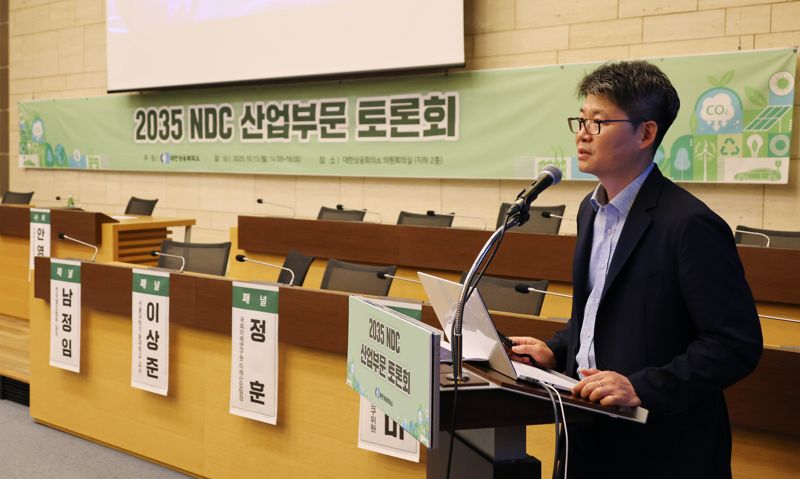
The NDC, under the Paris Agreement, is a greenhouse gas reduction target set by each country. The government plans to submit the 2035 NDC to the United Nations Framework Convention on Climate Change (UNFCCC) this November.
Regarding the 2035 NDC, the government has proposed four scenarios to reduce emissions by between 48% and up to 65% compared to 2018 levels. The four options are: 48% (reflecting industry demands), 53% (average linear trajectory from 2018 to 2050), 61% (recommended by the international community), and 65% (recommended by civil society).
At the forum, Oh Il-Young, Director of Climate and Energy Policy at the Ministry of Climate, Energy and Environment, stated, “Decarbonizing industry will be a challenge that opens new markets while protecting our industrial competitiveness. The government will provide bold support and improve regulations to back the industry, and we hope companies will respond with innovation and technology development.”
However, most industry representatives expressed concern that setting overly ambitious targets threatens corporate survival. Nam Jung-im, Director at the Korea Iron & Steel Association (KOSA), noted, “Hydrogen reduction steelmaking, a key technology for achieving carbon neutrality by 2050, is included in the draft 2035 NDC at a minimum scale of 1.5 million tons. However, the industry expects commercial facilities to be introduced only by 2037. The government must take into account the commercialization timeline for core carbon-neutral technologies such as hydrogen reduction steelmaking when setting the 2035 NDC.”
Eunmi Jung, Senior Research Fellow at the Korea Institute for Industrial Economics & Trade (KIET), pointed out, “Among the scenarios developed by the 'Technical Working Group'—composed of experts from the Greenhouse Gas Inventory and Research Center (GIR)—the most proactive and innovative option is the 48% reduction. The government should not be driven solely by ambition but should carefully set targets that are realistically achievable.”
Sangjun Lee, a professor at Seoul National University of Science and Technology (SeoulTech), who participated in the panel discussion, remarked, “Korea’s NDC target is directly linked to the level of emissions trading regulations, so a scientific and thorough review is required. The government should comprehensively consider the pace of technological advancement in the industrial sector and on-site conditions, clearly distinguishing between reduction measures that can be implemented before 2035 and those that are realistically unfeasible.”
Meanwhile, civil society groups such as Plan 1.5 and the Korean Federation for Environmental Movement (KFEM) also attended the forum. They argued that Korea should set its 2035 NDC target at 61% or higher. Changmin Choi, Policy Activist at Plan 1.5, asserted, “It is the state's duty to protect citizens’ fundamental rights from the climate crisis. The reduction target for the industrial sector, set at a significantly lower level (21–30%) compared to countries with similar industrial structures such as Japan and Germany, should be critically re-examined.”
[email protected] Kwon Jun-ho Reporter