'Real Underwater Sensation'—Recreating Eardrum Pressure with VR
- Input
- 2025-10-13 08:57:31
- Updated
- 2025-10-13 08:57:31
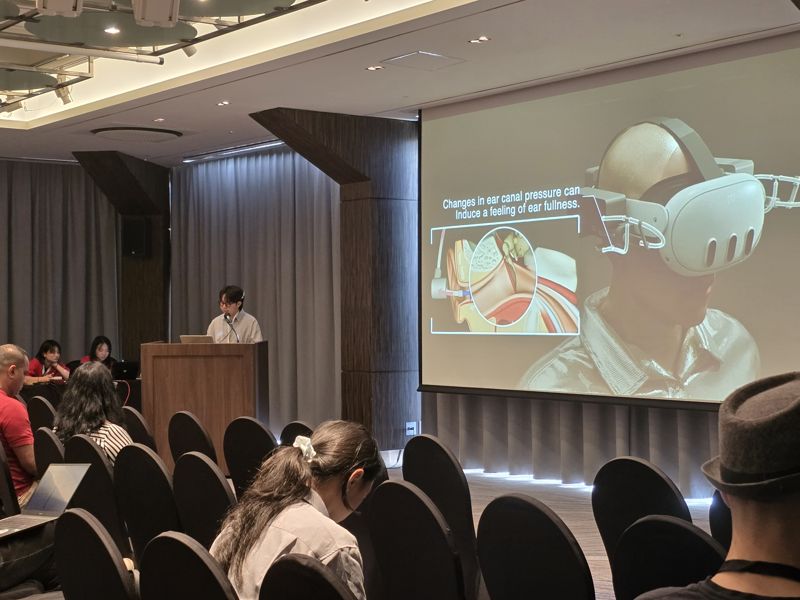
[Financial News] A Korean research team has developed an innovative haptic system that precisely controls inner ear pressure, allowing users to realistically experience changes in atmospheric pressure in virtual reality (VR). This is the first time that a VR experience has included the sensation of pressure that makes ears feel clogged.
The Gwangju Institute of Science and Technology (GIST) announced on the 13th that Professor Kim Seung-jun and his research team from the Department of AI Convergence have developed a new technology called EarPressure VR. By attaching it to a VR headset, the device finely adjusts inner ear pressure, recreating realistic sensations of environmental pressure such as ear fullness caused by changes in atmospheric or water pressure.
This technology enables users to safely experience the feeling of ear fullness in VR environments, similar to what occurs when altitude changes or when underwater. It presents a new sensory interface that elevates traditional VR experiences, which have focused mainly on visual and auditory stimuli.
EarPressure VR continuously monitors the inner ear with a pressure sensor and uses a built-in motor and medical syringe to create pressure changes within a ±40 hectopascal (hPa) range in just 0.57 seconds. This speed closely matches the rate at which people feel pressure changes when descending underwater.
To determine whether users could clearly perceive changes in inner ear pressure, the research team conducted experiments separating the direction and intensity of pressure. The results showed that when a pressure difference of about 14.4 to 23.8 hPa or more was applied, users could distinguish whether the pressure was acting inward or outward. Differences in intensity of 14.6 to 34.9 hPa were also distinguishable. These findings align with previous medical research indicating that the eardrum is highly sensitive to pressure changes.
In experiments simulating changes in water depth or environmental movement, participants reported much higher realism and immersion when pressure feedback was provided, compared to when only sound effects were used. Participants who experienced the technology commented, 'It truly feels like being underwater,' and 'It was a completely new sensory experience.'
EarPressure VR features a lightweight, wearable design that can recreate pressure changes without bulky equipment. It holds potential for a wide range of applications, including remote surgery, disaster rescue, diving training, virtual high-altitude experiences in sports and health apps, and even delivering powerful bass sensations during music listening.
Professor Kim Seung-jun emphasized, 'This is an innovative technology that allows users to directly experience environmental pressure changes—previously difficult to achieve—by controlling inner ear pressure. It will fundamentally transform user experiences in future technologies such as VR, AR, remote operations, and training simulations.'
The results of this research were presented at the ACM Symposium on User Interface Software and Technology 2025 (UIST 2025), one of the world’s most prestigious conferences in user interface and interaction technology, held from September 28 to October 1 in Busan. The on-site demonstration booth for EarPressure VR attracted significant interest from visitors.
The research team plans to continue follow-up studies to integrate the technology with commercial VR devices and expand its applications to various fields.
[email protected] Yeon Ji-an Reporter