Visiting Sani Garden, a Promising Small-Scale Tourist Destination
- Input
- 2025-10-09 16:58:57
- Updated
- 2025-10-09 16:58:57
Haenam County, Jeollanam-do — The Ministry of Culture, Sports and Tourism and the Korea Tourism Organization selected Sani Garden in Haenam County, along with Hoengseong Lake Trail (Hoengseong, Gangwon), Otgol Village (Dong-gu, Daegu), Myeoncheon Eupseong Fortress (Dangjin, Chungnam), and Sunchang Fermentation Theme Park (Sunchang, Jeonbuk), as 'Promising Small-Scale Tourist Destinations for 2025.' While Sani Garden is still relatively unknown as a tourist spot, it is considered a 'hidden gem' with great potential for future growth. Opened in May last year after reclaiming the nearby sea and connecting small islands, Sani Garden covers a total developed area of 160,000 pyeong (about 530,000m2), but only about 50,000 pyeong are currently open to the public. In early October, as autumn set in, I visited Sani Garden in Haenam County.
From Sea to Garden: Sani Garden
The area around Guseong-ri, Sani-myeon, Haenam County, where Sani Garden is located, was originally part of the sea. The construction of a seawall changed the landscape, but the salty land remained barren. Building an arboretum here seemed a reckless challenge, reminiscent of the Chinese fable 'Yu Gong Moves the Mountain.' Eventually, the sea became land, and grass and trees turned it into a lush garden. Counting from the construction of the seawall in 1981, it has been nearly half a century. If measured from the start of Solaseado, Korea's first tourism and leisure city, it has been close to 20 years.
When the Sani Garden development project began in earnest in 2020, the first tree transplanted was the Camellia japonica, now the garden’s symbol. This tree, standing tall atop a gentle hill in Nori Garden at the entrance, is over 200 years old. The oldest tree in Sani Garden originally grew in a field on an island when the area was still sea. It bore many scars from being tied to cattle and struck by farming equipment. The field’s owner, unable to watch the tree suffer any longer, donated it to Sani Garden. After careful treatment and nurturing, the tree was successfully transplanted to its current location. Now, this solitary Camellia japonica standing against the sea breeze has become a must-visit photo spot for all visitors.
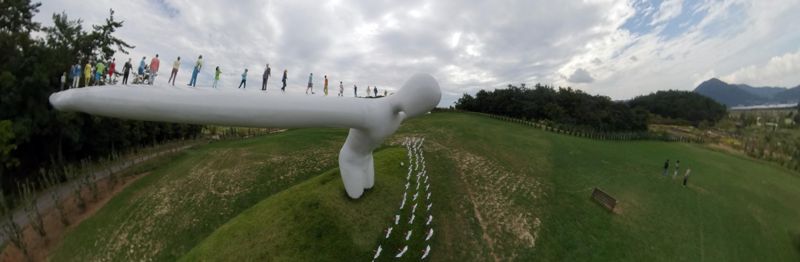
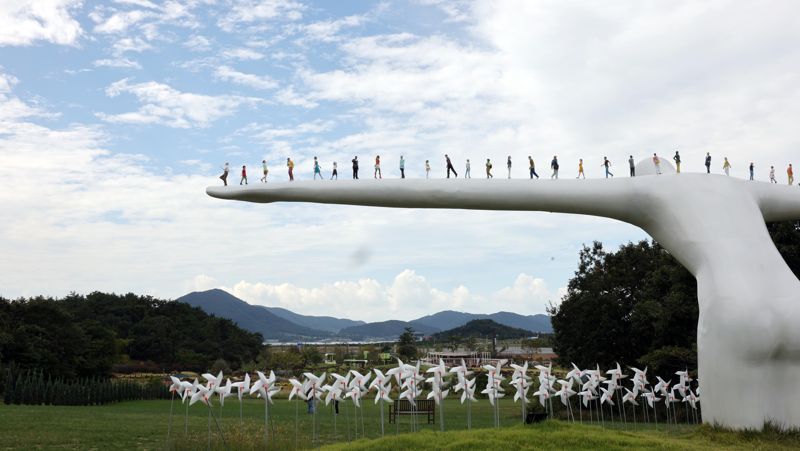
Another great place for photos in Sani Garden is Sky Maru, where the large sculpture 'Bridge of Human' stands with its arms outstretched. Created by renowned sculptor Yoo Young-ho, famous for the 'Greeting Man,' the work features 42 human figures sitting atop the giant’s arms, bent to form a bridge. The piece, which seems to soar toward the sky, symbolizes connection and communication between people and nature, reflecting Sani Garden’s philosophy as a 'future garden city.' The vast lawn of Sky Maru is especially beautiful at sunset, making it the perfect backdrop for memorable photos.
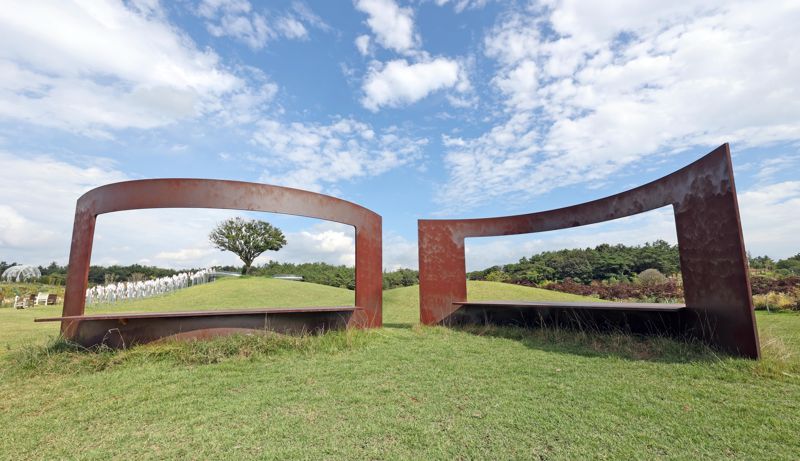
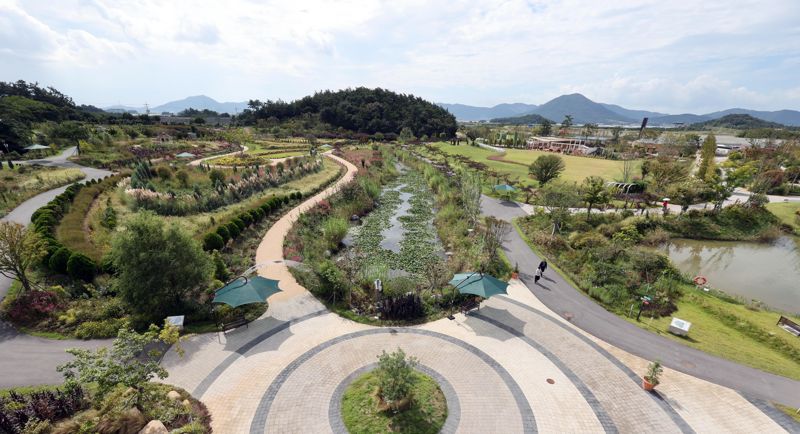
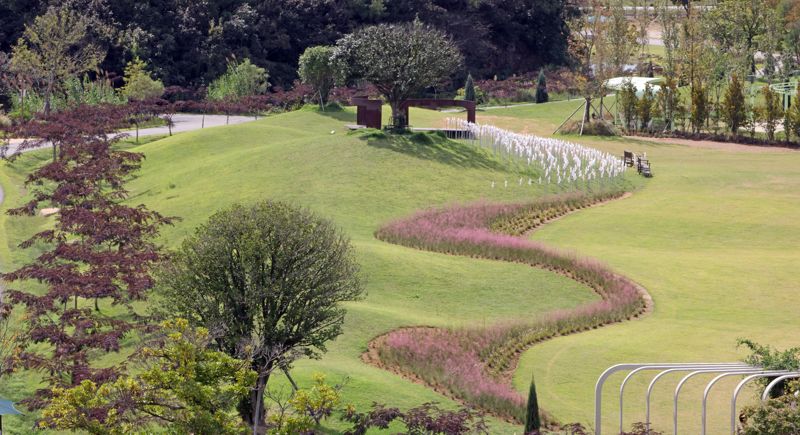
As a newly established garden, Sani Garden does not yet have towering trees or dense forests. Instead, visitors are greeted by the tranquility of the expansive grounds and the understated presence of trees and grasses, which bring a sense of peace. Walking the entire route—from the Welcome Garden, through Water Garden, Promised Land, and Sky Maru, to Butterfly Forest, Flow Garden, Sani Waterfall, Nori Garden, and 13 themed gardens—takes about two and a half hours. However, choosing the 'Memory Course,' which highlights the dreams and passion of those who turned sea into land, allows you to finish in under an hour. Still, it is recommended to stroll leisurely and explore every corner of the garden.
After Uldolmok, Head to Daeheungsa Temple and Ttangkkeut Village
If you visit Ttangkkeut Village in Haenam County, there are many other attractions to explore besides Sani Garden. These include the Woosooyoung National Tourist Site, the site of Admiral Yi Sun-sin’s legendary victory at the Battle of Myeongnyang with just 12 ships; Daeheungsa Temple, a thousand-year-old Buddhist temple renowned as a center of tea culture; and Ttangkkeut Tourist Site, marking both the end and the beginning of the Korean Peninsula.
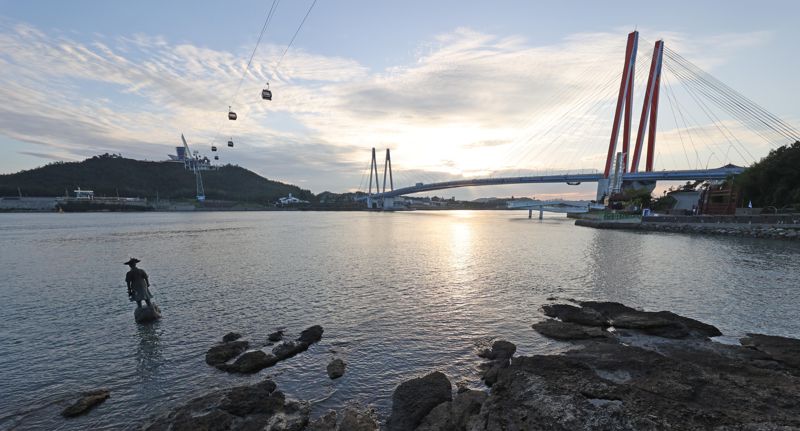
The first thing to do at Woosooyoung National Tourist Site is to ride the Myeongnyang Marine Cable Car. Operating since 2020, the cable car travels just over 1 km above the sea, from the former Jeolla Woosooyoung site in Haenam County to the summit of Manggeumsan in Jindo. From above, you can see Uldolmok, the site of Admiral Yi Sun-sin’s victory over the Japanese navy. If you time your visit right, you can witness the swirling, turbulent currents of Uldolmok from the cable car, creating a unique impression. The site also features a skywalk with a transparent glass floor, allowing visitors to experience the roaring waters of Uldolmok up close.
At Woosooyoung National Tourist Site, it is also interesting to find the small statue often called 'Contemplative Yi Sun-sin.' Unlike the usual heroic and imposing statues, this one depicts the admiral in a thoughtful and reflective pose, drawing much attention since its installation in 2008. The statue is surprisingly small, and at high tide, water can reach up to its ankles, making it difficult to spot. In contrast, the statue of Yi Sun-sin at Yi Sun-sin Victory Park across Uldolmok in Jindo stands tall with a long sword at his side, exuding a commanding presence.
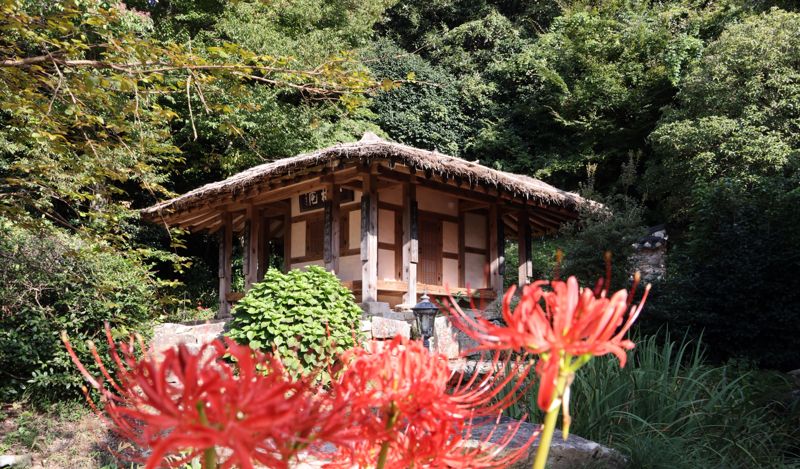
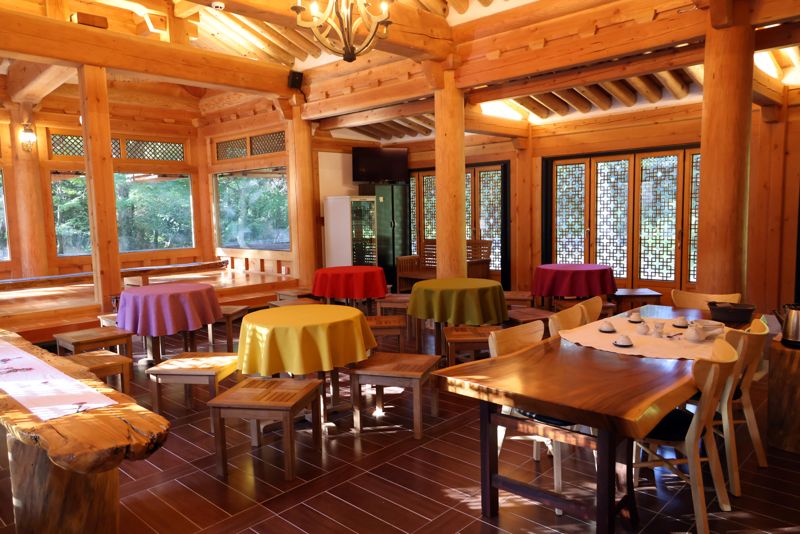
Daeheungsa Temple, surrounded by Duryunsan Mountain like a folding screen, is listed as one of Korea’s Mountain Monastic Heritage Sites by UNESCO and is famous for its stunning scenery. It is also renowned as a center of Korean tea culture, largely due to Iljiam Hermitage, where Monk Choui (1786–1866), known as the 'Saint of Tea,' spent his later years. Monk Choui not only cultivated new tea varieties here but also authored classic texts on tea, such as 'Dongdasong' and 'Dasinjeon.'
Continuing this tradition, Daeheungsa Temple operates Templestay programs focused on 'Daseon Ilmi,' which means 'tea and meditation as one.' These programs offer not only meditation and Zen practice but also hands-on tea making, tea conversations with monks, and moments of mindfulness. On the 25th and 26th, Daeheungsa Temple will host a tea gathering throughout the temple grounds, providing visitors with the chance to enjoy the autumn foliage while reflecting over a cup of tea.
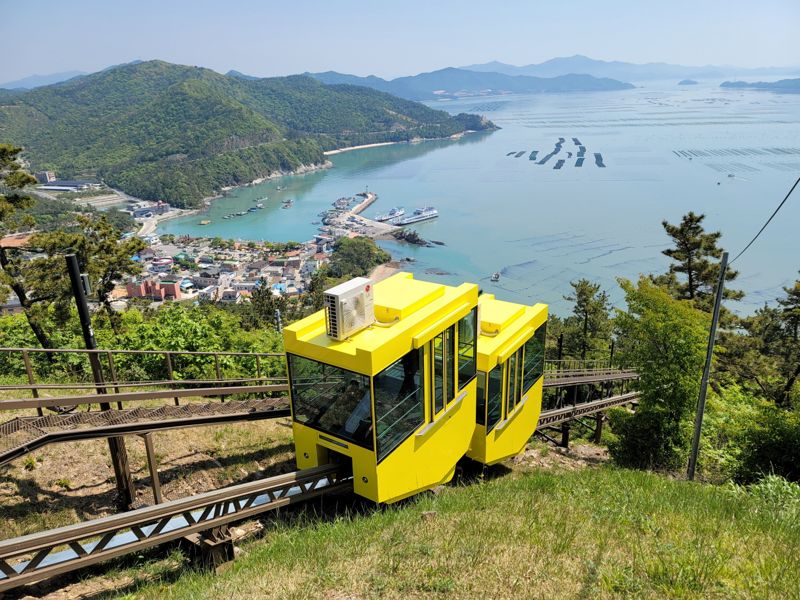
The final destination in Haenam County is Ttangkkeut Village, the southernmost tip and starting point of the Korean Peninsula. It takes about 40 to 50 minutes by car from Daeheungsa Temple to Ttangkkeut Village, which was once called Galdu or Tomal. From the Ttangkkeut Observatory atop Sajabong Peak on Galdu Mountain, you can see islands scattered across the sea. In front of the Ttangkkeut Tower, inscribed with 'Here is the Beginning of the Korean Peninsula,' you can take memorable photos. The most efficient route is to take the Ttangkkeut Monorail up and walk down, stopping by the Ttangkkeut Tower along the way.
jsm64@fnnews.com Jung Soon-min Reporter