"Commercial Act Risks to Intensify Next Year... Breach of Trust Should Be Swiftly Abolished During September's Regular Session of the National Assembly"
- Input
- 2025-09-30 16:33:54
- Updated
- 2025-09-30 16:33:54
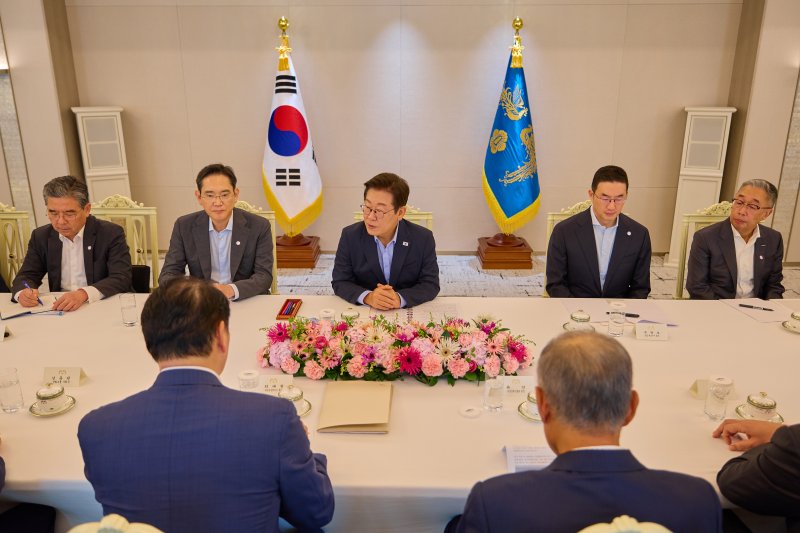
The Korea Chamber of Commerce and Industry (KCCI) evaluated the first government-ruling party plan for rationalizing economic criminal penalties, stating, "The abolition of aggravated punishment for breach of trust, which the business community has continuously requested, prioritizing administrative measures and using criminal penalties as a last resort, and shifting focus to economic penalties instead of criminal ones, all actively reflect the opinions from the business field." The Federation of Korean Industries (FKI), Korea Enterprises Federation (KEF), and Korea International Trade Association (KITA) also noted, "Efforts have been made to reflect the business community’s concerns about excessive economic criminal penalties that stifle corporate activity," adding, "This could lay the foundation for future regulatory improvements." In addition, there were calls to review the level of criminal penalties in labor-related laws. KEF stated, "The level of punishment for employers under labor laws, which has been strengthened, should be reviewed to ensure that business owners who actually create jobs at industrial sites are not unduly discouraged by excessive penalties."
Following President Lee Jae Myung’s directive on July 30 to "promptly devise measures to rationalize economic criminal penalties so that excessive penalties do not hinder corporate activity," the government and ruling party formed a Task Force (TF) and, after two months, announced a plan to rationalize economic criminal penalties. The plan aims to revise 30% of economic criminal penalty regulations, including breach of trust, within a year. The business community has expressed relief at these developments. Given that two amendments to the Commercial Act under the Lee Jae Myung administration have exposed vulnerabilities in the stability of major shareholders and corporate management, there is a consensus that swift discussions in the National Assembly are necessary.
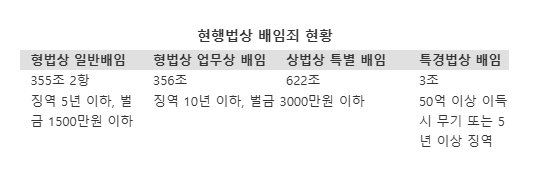
South Korea is the only country in the world with aggravated punishment provisions for breach of trust, leading to criticism of a so-called 'Galapagos penalty system.' If the gain from breach of trust exceeds 5 billion KRW, the aggravated provision allows for sentences equivalent to murder—at least five years in prison or even life imprisonment. Moreover, breach of trust is regulated under four separate provisions: special breach of trust under the Commercial Act, occupational and general breach of trust under the Criminal Act, and breach of trust under the Act on the Aggravated Punishment of Specific Economic Crimes. This has resulted in persistent issues such as ease of filing complaints, ambiguity, and outdated standards. There are 5,886 economic criminal penalties across 414 economic laws, including criminal penalties under the Monopoly Regulation and Fair Trade Act (MRFTA), the Same Person Designation System, administrative sanctions for violations of the working hours system, and criminal penalties for Restrictions on Subcontract of Construction Works. A business community representative stated, "We welcome the direction toward abolishing breach of trust," but added, "We hope that not only breach of trust, but also the nearly 6,000 economic criminal penalties, including those under the MRFTA, will be addressed with concrete improvement plans as soon as possible."
ehcho@fnnews.com Cho Eun-hyo Reporter