[fn Editorial] Backup Activation Delayed Due to Budget Shortage—Immediate Implementation of Redundancy Needed
- Input
- 2025-09-29 18:10:14
- Updated
- 2025-09-29 18:10:14
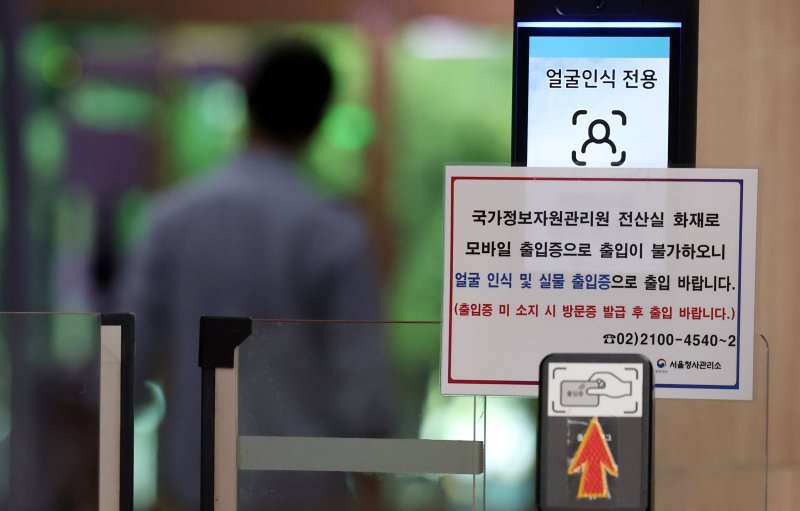
According to the Central Disaster and Safety Countermeasures Headquarters (CDSCHQ), as of the morning, only 62 out of 647 paralyzed government administrative information systems had been restored. However, it is expected to take a considerable amount of time before all services return to normal. Three years ago, during the KakaoTalk outage, the government boasted, 'We have a system in place that can be restored within three hours even in the event of a disaster.' Yet, not only the IT systems but also public trust in the government have now collapsed.
It is the government's duty to thoroughly investigate the cause of this disaster and establish robust measures to prevent recurrence. There have been numerous questionable actions since the fire broke out. Storing both the Uninterruptible Power Supply (UPS) batteries and servers together in a cramped data center was extremely hazardous. Since battery fires became a social issue in 2017, separating servers and batteries has become standard practice. Who could have imagined that a facility storing the nation’s core data would be left so vulnerable?
The controversy over the battery relocation process and the recommended usage period must also be addressed. The fire occurred during the battery relocation, and it is suspected that an overcurrent may have flowed in during the power shutdown and restoration. The decision to relocate the batteries was made as a precaution against fire risk. Ironically, while trying to prevent a fire, the operation itself caused one. It is incomprehensible how such a critical task was handled so carelessly.
It was also confirmed that the battery involved in the fire had exceeded its recommended lifespan of ten years and had been advised for replacement. The burned battery was installed just 60 centimeters from the server. Given that it was already past its recommended usage period, this level of administrative complacency is simply astounding.
Most concerning is the fact that a data redundancy system was not implemented due to budget constraints. Establishing a Disaster Recovery System (DRS) at a separate location to ensure backup in case of unforeseen disasters is a basic necessity. The government has been promoting the National Computing Resources Center No. 4, connecting Daejeon, Gwangju, and Daegu, as a dedicated disaster recovery data center in Gongju, South Chungcheong Province.
However, 18 years after construction began in 2008, the center has yet to open its doors. The original goal was to complete the center by 2012, but delays for various reasons pushed completion to 2023. Still, due to budget issues, the disaster recovery system has not been activated, and the center has not opened. Now, the nation is facing the consequences. It is truly disheartening. In the era of Artificial Intelligence (AI), data is the foundation of national operations. A government that cannot even uphold the basics is meaningless. Immediate action must be taken to establish a disaster recovery data system.