[fn Editorial] Korea-Japan Economic Community, Worth Considering as a Means to Overcome Difficulties
- Input
- 2025-09-22 18:27:55
- Updated
- 2025-09-22 18:27:55
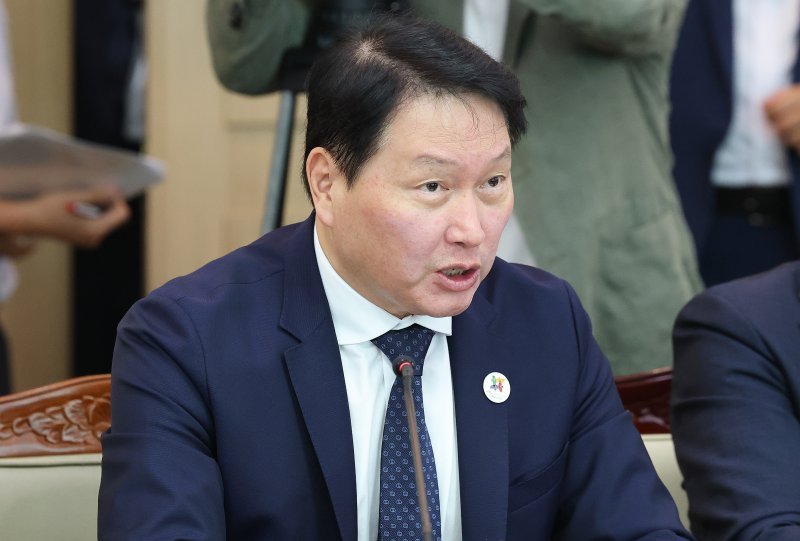
Choi SK Chairman Proposes EU-style Integration
Possibility to Rise as the World's 4th Largest Economic Bloc
Possibility to Rise as the World's 4th Largest Economic Bloc
The Korea-Japan Economic Community is persuasive from a pragmatic perspective. Although the South Korean government has announced its consideration of joining the CPTPP, the process is not simple. It requires unanimous consent from 11 member countries and must meet conditions of high-level liberalization in sensitive areas such as agricultural openness, labor regulations, and state-owned enterprise operations.
On the other hand, bilateral cooperation between Korea and Japan is easier to establish realistic trade standards. The two countries have already laid the foundation for basic economic relations through the Korea-Japan Basic Treaty and the Korea-Japan Economic Cooperation Agreement. Bilateral cooperation can create a much deeper and more substantial relationship than multilateral frameworks. Geographically, being adjacent also provides the undeniable advantage of significantly saving on logistics costs and time.
Moreover, both countries face the common challenge of the US-China conflict, aligning their interests. With both countries highly dependent on China, maximizing industrial synergy effects between them can elevate them as key players in a new supply chain. Furthermore, the recent protectionist policies of the Donald Trump US administration also pose a common crisis for both countries. Both countries are in a serious dilemma due to excessive tariff pressures from the US. To build economic independence amid the US-China rivalry, a solid economic community between the two countries can be an alternative.
The effects of a Korea-Japan Economic Community are also expected to exceed expectations. Chairman Choi forecasts that the Korea-Japan Economic Community could become the 'world's 4th largest economic bloc' upon its launch. This is not merely an idealistic theory. Beyond the simple effect of combining the economic scales of the two countries, the integration of their technological and capital strengths could transform them into a giant economic bloc. In fact, the two countries possess world-class technological prowess and market dominance in advanced technology fields such as semiconductors, batteries, and robotics.
Of course, establishing a Korea-Japan Economic Community is not as easy as it sounds. It could remain merely an idealistic notion. The first hurdle is coordinating the issue of industrial overlap. The biggest obstacle is the public sentiment entangled with historical issues. However, these limitations can be resolved gradually. The two countries can start by strengthening cooperation centered on advanced technologies where they have strengths, thereby activating economic exchanges. As trust in the synergy effects of bilateral cooperation builds, the idea of an economic community can be concretized.
In the current global economic order fraught with uncertainty, it is difficult to become a sustainable nation with outdated economic concepts of the past. The Korea-Japan Economic Community should not be dismissed as merely a fanciful proposal but considered as a means to leap forward from a stagnant economy.