[fn Editorial] Starting Legislation for 4.5-Day Workweek Despite Lack of Work and Low Productivity
- Input
- 2025-09-18 18:45:40
- Updated
- 2025-09-18 18:45:40
Lack of work leads to a sharp drop in working hours for SMEs
Labor productivity ranks 54th, caution against speeding
Labor productivity ranks 54th, caution against speeding
Working hours in our country have decreased by 210 hours over the past 10 years, marking the largest drop among OECD countries. While it might be welcome news that working hours have decreased in a country classified as a long-working-hours nation, the reason behind this is not positive. The decrease in working hours is due to a lack of work caused by a prolonged economic recession.
In this situation, news has emerged that the government will legislate a 4.5-day workweek within this year. The Ministry of Employment and Labor announced that the Legislative Office will submit the 'Support Act for Reducing Actual Working Hours' to the National Assembly within the year to support the legislation of the 4.5-day workweek.
Even if we have to follow global trends, decisions should be made after considering the current situation, but it seems too hasty.
According to the 'Report on the Status of Working Hours Reduction for SMEs' released by the Small and Medium Business Research Institute on the 18th, the annual average working hours in Korea decreased from 2075 hours in 2014 to 1865 hours in 2024, a reduction of 210 hours. Over the same 10-year period, the reduction in the United States was 34 hours, and the OECD average was 52 hours. Even Japan, a similar long-working-hours country, only reduced by 112 hours.
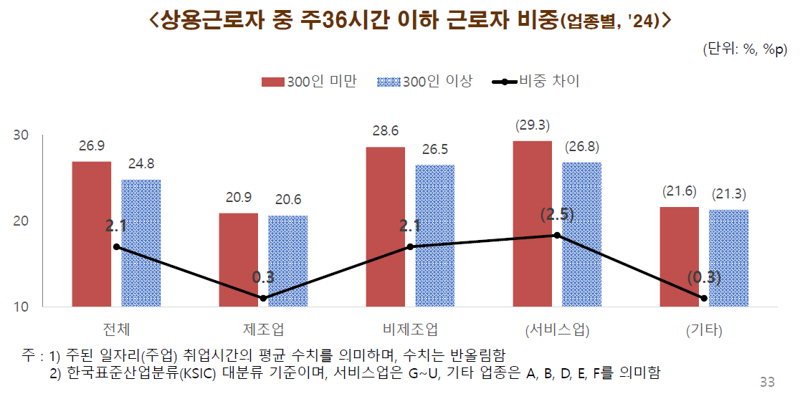
The reduction in working hours in Korea is related to the quality of work. The proportion of regular workers in SMEs working 36 hours or less per week increased by 17.6 percentage points from 9.3% to 26.9% over 10 years. In large corporations, the proportion increased by 15.9 percentage points to 24.8% over the same period. The reduction in working hours is due to the disappearance of quality jobs and the increase in short-time workers due to the economic recession.
The government should focus more on creating systems and conditions that can improve the quality of work. There have been countless criticisms that rigid work systems prevent research and development personnel in advanced industries from fully utilizing their skills. They are forced to leave work under the 52-hour regulation, which is not seen in any competing country. Flexible work is essential for venture startups. The scope of flexible work should be expanded to match the nature of the work, but this seems like a story from another country. Is it right for outdated work systems to hinder venture and advanced companies?
Low productivity cannot continue as it is. According to OECD statistics, Korea's hourly labor productivity is $44.4, which is 79% of the OECD average of $56.5 and 57% of the United States' $77.9. In last year's evaluation by the International Institute for Management Development in Switzerland, Korea's labor productivity ranked 54th. If we recklessly reduce working hours at workplaces, national competitiveness will inevitably decline further.
The Legislative Office's proposal includes provisions for tax credits and labor cost support for companies that adopt the 4.5-day workweek and hire new employees. The Ministry of Employment and Labor is also set to finalize the schedule for reducing working hours within the year and actively pursue legal amendments. If employees work less and receive the same pay, working conditions will naturally improve. However, this is not the case for companies.
No company wants to pay the same wages for less work. We must consider the reality that while our working hours are not few, our productivity ranks at the bottom.