'Impersonating Institutions Voice Phishing' Half of the Victims are in Their 20s and 30s... High Amount Damages Also Doubled
- Input
- 2025-09-18 12:00:00
- Updated
- 2025-09-18 12:00:00
Impersonating Institutions Voice Phishing, 76% of the Total
Deceiving as if Involved in Crime and Self-Confined
Targeting Youth Familiar with Non-Face-to-Face Finance... Be Cautious of the Method
Deceiving as if Involved in Crime and Self-Confined
Targeting Youth Familiar with Non-Face-to-Face Finance... Be Cautious of the Method
[Financial News] Prosecutors, Financial Supervisory Service, etc. impersonating 'institution impersonation' phone financial fraud (voice phishing) crimes are rapidly increasing. In particular, the number of crimes deceiving young people familiar with the non-face-to-face financial environment to embezzle large amounts of over 1 billion won is increasing, so caution is needed.
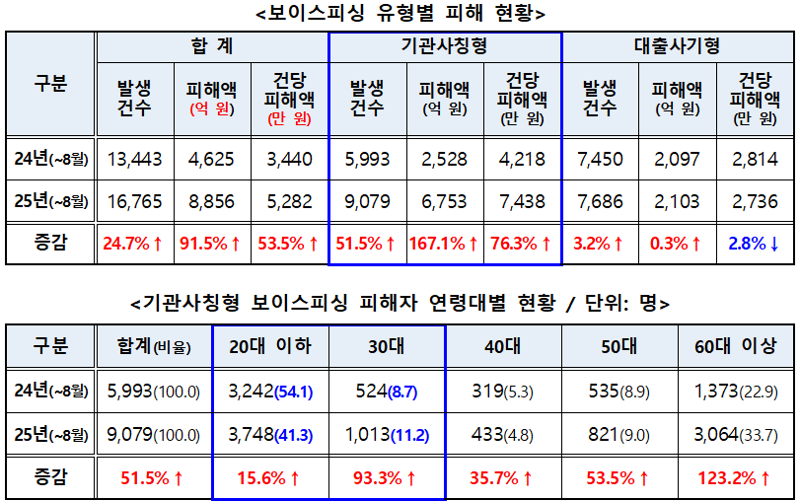
The National Investigation Headquarters of the Gyeongchalcheong announced on the 18th that the damage amount of institution impersonation voice phishing from January to last month this year was 675.3 billion won, a 167.1% increase compared to the same period last year (252.8 billion won).
It accounts for 76.2% of the total voice phishing damage amount (885.6 billion won). A total of 9,079 cases occurred, an increase of 51.5%.
The damage per case was 74.38 million won, a 76.3% increase compared to the previous year (42.18 million won), and high amount damages are also increasing.
In particular, the damage among young people in their 20s and 30s has significantly increased. The number of victims in their 30s increased from 524 last year to 1,013 this year, nearly doubling. In their 20s, it increased by 15.6% from 3,242 to 3,748. More than half of the victims of institution impersonation voice phishing are in their 20s and 30s.
The high amount damages among young people are also increasing. From July to December last year, the proportion of victims over 1 billion won in their 20s and 30s was 17%, but it jumped to 26% from January to April and 34% from May to July this year, doubling in half a year.
Voice phishing criminals are targeting young people familiar with using non-face-to-face finance based on sophisticated scenarios, according to the police.
They approach victims by pretending to deliver online registered mail, make them enter personal information on a website, and automatically generate fake documents such as 'arrest warrants' to deceive them into thinking they are involved in a crime. They then force them to use secure messengers like Signal, Telegram, or purchase old mobile phones with weak security.
Recently, instead of detaining the victims, they have evolved into a form where they make them 'self-confine' in lodging establishments by offering 'temporary probation'.
Customized methods reflecting the victim's occupation have also emerged. For self-employed individuals, they impersonate the National Tax Service to question tax evasion charges, or for overseas residents and students, they approach them like embassy staff and deceive them into thinking they are involved in overseas drug cases.
The police are distributing 50,000 promotional posters to lodging establishments nationwide to prevent 'self-confinement' damage, and are expanding the promotion range focusing on major crime locations such as gold shops, and conducting on-site education for financial company employees, telecom agency owners, etc.
It is important to note that investigative agencies do not instruct individuals to view crime information or investigation documents on websites. They also do not instruct to contact only through specific messengers or to open a separate mobile phone. Requests for financial information for personal asset inspection, loan execution, or virtual asset delivery requests are also 100% voice phishing. If contacted by various institutions, share the situation with those around you and directly verify with the institution.
Park Seong-ju, head of the National Investigation Headquarters, urged, "Recent institution impersonation crimes cause large-scale damage in the process of psychologically dominating the victim to realize the damage late," and asked to "always pay attention to crime methods and countermeasures."
[email protected] Kang Myeong-yeon Reporter