Offshore Wind Power as 'Energy Security'... Need to Build Market through Public-Private Cooperation
- Input
- 2025-09-18 14:44:35
- Updated
- 2025-09-18 14:44:35
Shin Dong-gyu, Executive Vice President of Doosan Enerbility Power Service BG Wind Design
Localization rate of 10MW wind turbines over 70%..Creating an ecosystem for SMEs
Overcoming with low wind speed technology..Achieving utilization rate over 30%
Localization rate of 10MW wind turbines over 70%..Creating an ecosystem for SMEs
Overcoming with low wind speed technology..Achieving utilization rate over 30%
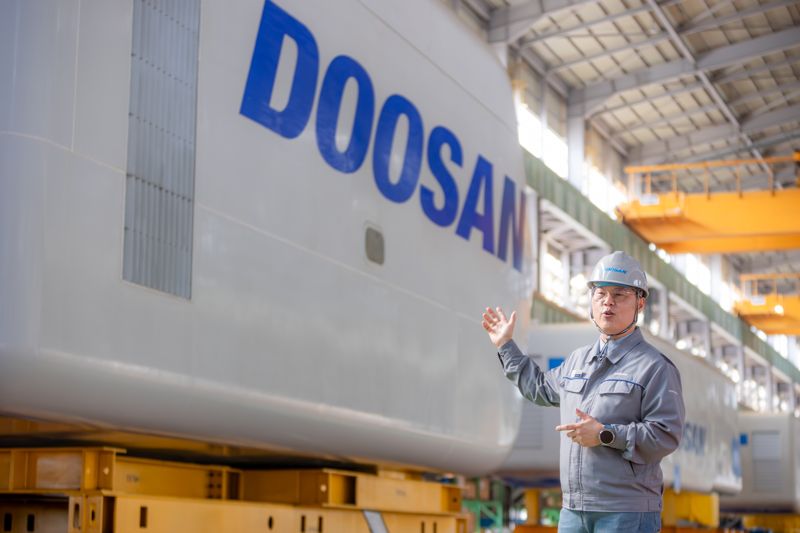
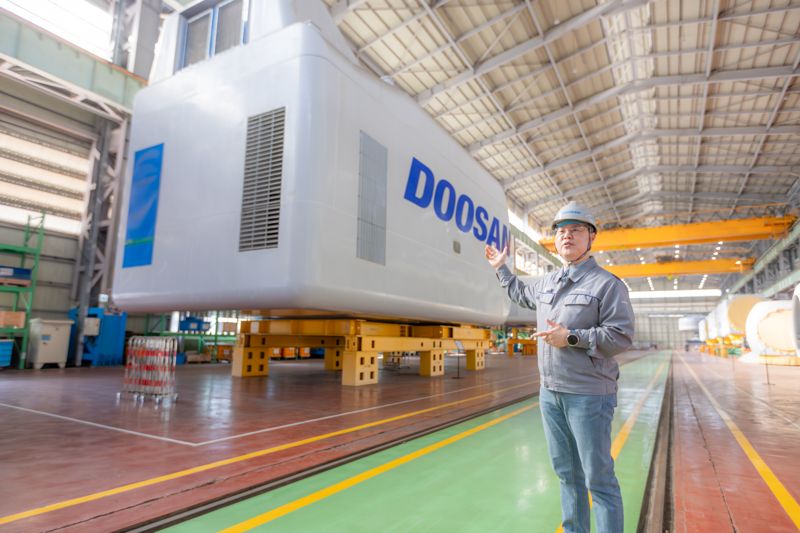
【Changwon (Gyeongnam)=Kang Gu-gwi Reporter】"The wind power business in Korea should prioritize energy security, and the localization of major components and the establishment of a domestic supply chain should be key."
Shin Dong-gyu, Executive Vice President of Power Service BG at Doosan Enerbility, who is in charge of wind design, met with Financial News at the Changwon headquarters of Doosan Enerbility on the 18th and expressed caution about China's entry into the domestic offshore wind power market. He believes that there are aspects that need to be thoroughly verified in terms of energy security and domestic industry contribution. Doosan's wind turbines are equipped with 300 sensors to optimize maintenance, maximize operation rates, and gain insights for the development of next-generation models.
■"Ecosystem virtuous cycle through component localization"
In response to Chinese companies, Doosan Enerbility has raised the localization rate of components for 10MW-class offshore wind turbines to over 70% by incorporating as many domestically producible components as possible. It is no exaggeration to say that almost all components, except for those requiring high reliability such as forged frame parts, have been localized.
Through this, they aim to induce a virtuous cycle in the domestic offshore wind power industry ecosystem by expanding the supply of 10MW wind turbines in the future, fostering the domestic component industry, and creating new jobs. They are also considering the development of ultra-large 20MW-class wind turbines. However, turbine installability, marshaling port (back port), and system infrastructure are key issues.
Executive Vice President Shin said, "While carrying out national projects, we have built a track record through reliability tests of localized components and large-scale demonstration operations. By verifying reliability, we have also strengthened the commercial competitiveness of suppliers," and "We are considering the domestic development and production of additional components such as permanent magnet synchronous generators, which will further improve the localization rate of components."
Doosan Enerbility, which started the offshore wind power business in 2005, has gradually increased its scale by completing the development of 3MW-class offshore wind turbines in 2010 and 5.5MW-class offshore wind turbines in 2019. In 2022, they completed the demonstration of 8MW-class offshore wind turbines and secured international type certification for 10MW-class this year.
In the early stages of the business, the localization rate of components was only about 30%. Doosan Enerbility found a solution in creating an ecosystem for small and medium-sized enterprises. Including first-tier component suppliers, about 150 domestic SMEs are already participating. Doosan Enerbility plans to gradually expand this even further.
In the domestic market, the offshore area of the southwest coast, where large-scale wind farms are being established, is mostly a low wind speed area with an average annual wind speed of 6.5 to 7 m/s. Offshore wind power generally needs a utilization rate of over 30% to achieve economic viability, but the low wind speed of the domestic southwest coast makes it difficult for overseas wind turbines to achieve a 30% utilization rate. He found a solution in maximizing rotor diameter. It is designed to achieve a utilization rate of over 30% even in low wind speed offshore environments. By reducing the cost of power generation, it is expected to become an economically viable wind farm.
■"If public bidding continues for 3 more years, self-sustaining competitiveness will be secured"
The domestic wind power market is still in its infancy, and the visible achievements of the domestic wind power industry are still insufficient. The industry points out that public bidding should be maintained for the time being to establish a self-sustaining ecosystem.
Executive Vice President Shin said, "In the first half of this year, a public-led market was established in the fixed-price competitive bidding system, and additional incentives are being provided for public institution equity participation and government R&D demonstration to contribute to the supply chain and security," and emphasized, "In the future, the use of the public track should continue to ensure that the results of domestic R&D lead to commercialization, thereby revitalizing and strengthening the competitiveness of the domestic wind power industry ecosystem." He added, "Support and encouragement are needed to actively utilize the domestic wind power generation system to develop and participate in offshore wind farms centered on domestic power generation companies."
Doosan Enerbility recently won a 689MW offshore wind power project through public bidding. This is an innovative event in the domestic wind power supply chain.
He said, "If public bidding continues for just 3 more years, component suppliers will become competitive and will be able to survive without government incentives," and "The domestic wind power market still lacks global competitiveness in all areas, including policy, system, infrastructure, and supply chain, so government support for industrial development is needed in addition to corporate efforts."
Executive Vice President Shin has been overseeing the development of wind turbines since 2022 and is the key figure in completing the 10MW-class Korean offshore wind turbine. In July, he succeeded in obtaining international type certification. International type certification is a procedure that checks the design and manufacture of wind turbines and confirms their performance and load suitability in prototypes. Completion of type certification means that it is at a level that can be supplied as a commercial product. [email protected] Kang Gu-gwi Reporter