[fn Editorial] Failure to Curb Concentration in the Capital Region, Success Must Be Achieved Through Hub Universities
- Input
- 2025-09-17 19:01:47
- Updated
- 2025-09-17 19:01:47
Over 20 years, tens of thousands of young people have moved annually
Reviving local education is the top priority
Reviving local education is the top priority
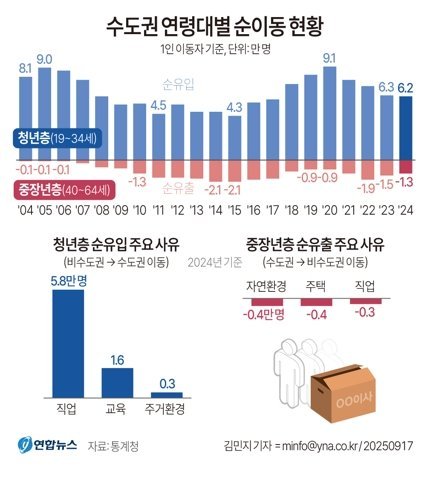
Over the past 20 years, it has been found that young people (aged 19-34) have flocked to the capital region every year. The Statistics Korea announced on the 17th that there are specific figures in the 'Recent 20 Years of Population Movement in the Capital Region' statistics. Last year, the net influx of young people into the capital region was about 60,000. Over the past 20 years, the net influx population has increased by at least 30,000 and up to 100,000 each year. In the capital region, the influx of young people into Gyeonggi and Incheon was prominent, and even in Seoul, where housing costs are high, the net influx trend has not been broken in the past 10 years. The middle-aged group (aged 40-64) has consistently moved out of the capital region since 2007. They left in search of less expensive real estate and a nature-friendly environment.
The reason young people flocked to the capital region is because of jobs and education. More than 90% is due to jobs. Young people would have barely become office workers after passing through the high competition to enter university and the needle-hole-like hiring process. However, when they become middle-aged, the trend over the past 20 years has been to move out of the capital region, leaving behind soaring house prices.
The concentration of young people in the capital region and the resulting collapse of local areas is not a story of yesterday or today. If left unattended, it can lead to national misfortune. We must be vigilant. The overall population of the capital region also saw a significant net outflow from 2011 to 2017, when the relocation of public institutions to local areas was concentrated, but since then, the net influx has been evident. According to the future population projections by Statistics Korea by region, the proportion of the capital region's population will rise from 50.5% in 2022 to 53.4% in 2052. If no action is taken, it could worsen.
The harms of concentration in the capital region lead to overheated entrance exams, employment difficulties, rising house prices, and low birth rates. To increase the worst birth rate, the concentration in the capital region must be alleviated. Regions where young people have left see a decrease in labor supply and find it more challenging to attract businesses. It is urgent to create a virtuous cycle where people are born and raised in local areas, obtain quality jobs, settle down, and have children. To this end, the education issue in local hub cities must be resolved first. The Ministry of Education's six major national tasks and 25 implementation tasks announced today include policies with this in mind.
The Ministry of Education says it will ease the hierarchy of universities centered on the capital region by promoting the creation of '10 Seoul National Universities'. It seems unnecessary to attach the title '10 Seoul National Universities' while trying to revive local universities, but the key is to properly enhance the competitiveness of local areas. The government says it will nurture hub national universities as education and research hubs driving regional technology-led growth. It intends to support local universities to play a role in nurturing talent and research and development (R&D) linked to regional strategic industries. To this end, it announced the establishment of a national chair professor system, recognizing exceptions to the retirement age limit of 65 and providing the highest level of support.
To prevent it from becoming a superficially glossy plan, detailed action items must be devised and implemented, even if it takes time. For hub universities to function as technology hubs, regional strategic industries must be developed, and vitality must be provided to companies. Currently, 80% of domestic large companies and 60% of small and medium-sized enterprises are concentrated in the capital region. It is hoped that support measures such as providing exceptional tax benefits to companies relocating to local areas will be considered.
For over 20 years, national balanced development has been advocated, but the reality is that concentration in the capital region has worsened. The causes of this must be examined, and measures that will have a practical effect must be presented. Regional pork-barrel policies are also a reason for the failure to curb concentration in the capital region. Through selection and concentration, urgent areas must be revived first.