Will Korea-US Tariff Negotiations Become a Long-Term Battle? ... "Need a Korean Solution, Not a Japanese Repetition"
- Input
- 2025-09-15 15:57:05
- Updated
- 2025-09-15 15:57:05
The Korea-US tariff negotiations are likely to enter a long-term battle due to disagreements over the operation method of a $350 billion investment fund in the US. The government is continuing high-level diplomatic efforts to find a solution, but both sides are at a stalemate, unable to find a breakthrough. Experts point out that the Japanese-style agreement model does not fit the Korean reality, and that a strategic response unique to Korea, including currency swaps, is necessary even if it takes time.
Yeo Han-gu Heads to the US Again... "Negotiations in Line with National Interest"
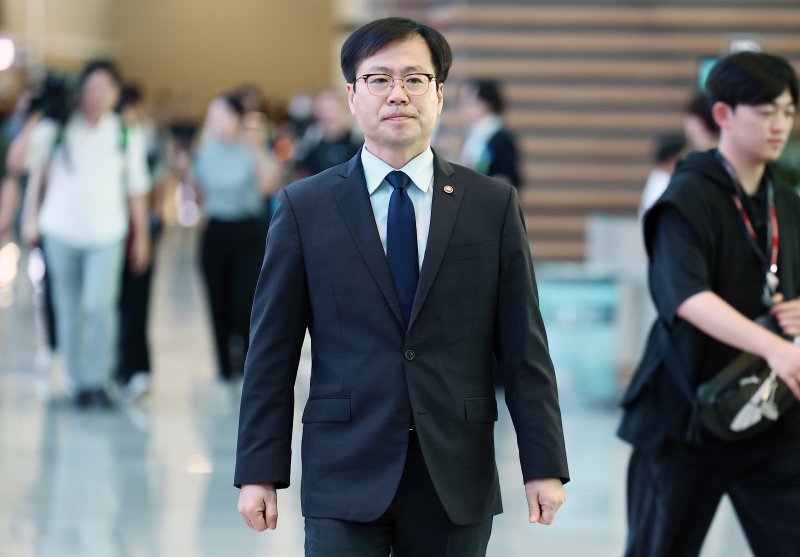
On the 15th, Yeo Han-gu, head of the Trade Negotiation Headquarters of the Ministry of Trade, Industry and Energy, departed for Washington DC, USA. Following Minister Kim Jung-gwan's visit on the 11th, another high-level official headed to the US in just four days. Yeo will meet with Howard Lutnick, US Secretary of Commerce, and Jamieson Greer, representative of the US Trade Representative (USTR), to continue follow-up negotiations.
Upon departure, he stated, "We are doing our best to create a reasonable negotiation result that aligns with the national interest." He added, "Rather than the situation being urgent, please understand it as the government doing its utmost in all directions," attempting to alleviate concerns about the possibility of prolonged negotiations.
The Presidential Office also reaffirmed the negotiation stance on the same day.
Kang Yu-jeong, spokesperson for the Presidential Office, stated in a briefing, "The tariff negotiations are still ongoing with the primary principle of preserving national interest," and "The negotiations are open in the direction of prioritizing the interests of the Republic of Korea."
Regarding concerns about prolonged negotiations, she explained, "It is difficult to see the negotiations that have been ongoing for 100 days since the launch as prolonged," and "The final agreement point will be decided when it aligns with national interests such as foreign exchange reserves or corporate protection."
The two countries previously agreed on the $150 billion 'MASGA Project', but they have not found a meeting point in the operation method of the remaining $350 billion investment fund in the US. While the US demands cash-based short-term execution and job creation within the US, Korea is reluctant due to excessive foreign exchange and corporate burdens. The abolition of tariffs on key items such as automobiles and steel also remains uncertain.
Some even suggest that "it might be better to pay high tariffs" in response to the US's excessive demands. The incident where 475 people, including 317 Korean employees, were arrested and detained at the Hyundai Motor and LG Energy Solution joint battery plant in Georgia, USA, further fueled public opinion.
President Trump adjusted his message seemingly conscious of the critical public opinion immediately after the incident.
On the 14th, he stated on the social media platform 'Truth Social', "We welcome foreign investment. We also welcome their employees." He added, "We hope foreign companies will bring their skilled workers to teach American workers," effectively setting a condition of 'training American workers' for allowing foreign investment.
"Create a Compromise Unique to Korea"
Experts emphasize that the Japanese-style agreement should not be repeated. Japan documented the reduction of automobile tariffs and quickly accepted the US-style demands, but Korea finds it difficult to follow the same path due to economic conditions. Following the Japanese-style agreement would place a significant burden on Korea's economy.
Professor Kim Tae-hwang of Myongji University's Department of International Trade said, "Japan holds $1.3 trillion in foreign exchange, but Korea has only $410 billion," and analyzed, "If $80 billion is procured annually during Trump's term and $350 billion is invested in cash, it would mean using 20% of foreign exchange reserves each year." He continued, "The government's request for a currency swap was a good decision. It should be used as a mechanism to minimize market instability and create a compromise unique to Korea in the negotiations."
Ultimately, it seems unlikely that the Korea-US negotiations will be concluded in the short term.
Professor Kim suggested, "The government should not rashly break the negotiations but should negotiate with patience and determination," and "Short-term damage to the automobile industry should be compensated with subsidies, and in the long term, a different negotiation approach from Japan should be sought."
[email protected] Park Ji-young Reporter