[fn Editorial] Thoroughly Investigate Human Rights Violations of U.S. Detainees and Negotiate Resolutely
- Input
- 2025-09-14 18:08:25
- Updated
- 2025-09-14 18:08:25
Chained and Shackled in 72-Person Cells
Pressured to Invest $350 Billion on Return Day
Pressured to Invest $350 Billion on Return Day
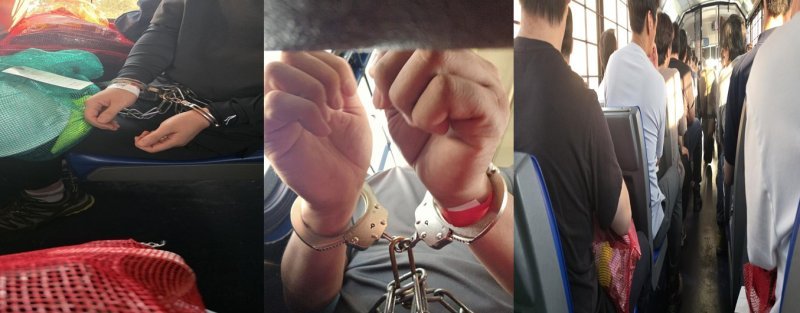
The detention facilities were extremely poor. The workers, who were taken without knowing the reason, initially stayed in a temporary facility with 72 people. There were only five or six toilets, all open, and they lived with handcuffs and shackles. Later, they were moved to a 2-person room, but even there they had to use open toilets. There was only a cloth barely covering the lower body. They were forced to fill out documents without any explanation or Miranda rights being read, and there were many testimonies of a consistently high-pressure atmosphere. The fear and anxiety the detainees must have felt until they boarded the plane back home is indescribable.
It is infuriating that the U.S. authorities treated Korean companies and workers, who flew to the U.S. to build an advanced factory, so mercilessly. Although there is some responsibility on our side for not properly addressing the visa system issues in advance, such treatment of allied country workers is unacceptable. The detained workers were essential personnel for the local factory construction work. The construction could not proceed without them, as it was a process that could not be resolved by hiring locals. Knowing this, the U.S.'s rudeness and arrogance, crossing the line for various political reasons, must be questioned by our government, and the truth about human rights violations during the detention process must be uncovered.
The aftermath of the detention incident will not be easy to handle. There are already predictions that the construction of the battery factory in Georgia, where all key personnel have left the U.S., will be delayed by at least three months. The reactions of domestic companies, which have promised large-scale investments and entered the U.S. market, are also not favorable. It is natural to be cautious about investing in the U.S., which is full of uncertainties. The revival of U.S. manufacturing, aimed at by the Trump administration, is also inevitably facing setbacks.
As national anger boils over the U.S.'s actions, the U.S. government has instead started tariff pressure. On the 11th, when the detainees were released and boarded a flight to Korea, U.S. Secretary of Commerce Howard Rutnick said, "Korea must accept the agreement or pay tariffs," taking a hardline stance. Korea and the U.S. have not found a meeting point regarding the operation method of a $350 billion U.S. investment fund. Our government intends to support most of the fund with loans and guarantees, while the U.S. side demands direct investment. This is the method accepted by Japan. When President Trump decides on an investment destination, Japan agreed to provide funds within 45 days. The U.S. will take 90% of the investment profits, and they are demanding the same from us. However, our situation cannot be the same as Japan, the world's fourth-largest economy and a quasi-reserve currency country. Korea's foreign exchange reserves are about $410 billion. We cannot accept the Trump administration's 'investment blank check' as it is.
If negotiations continue to stall, mutual tariffs will rise again to 25%, and the automotive tariff, which was lowered to 15%, will return to 25%. Both companies and the government will be extremely anxious. However, the more this happens, the more we must respond resolutely. The national interest must come first, both first and second. Although it is not easy, we must navigate the crisis with a long-term perspective, demonstrating flexibility and perseverance.