US-Korea Tariff Negotiations 'Investment in the US Issue' Stalemate
- Input
- 2025-09-14 13:03:30
- Updated
- 2025-09-14 13:03:30
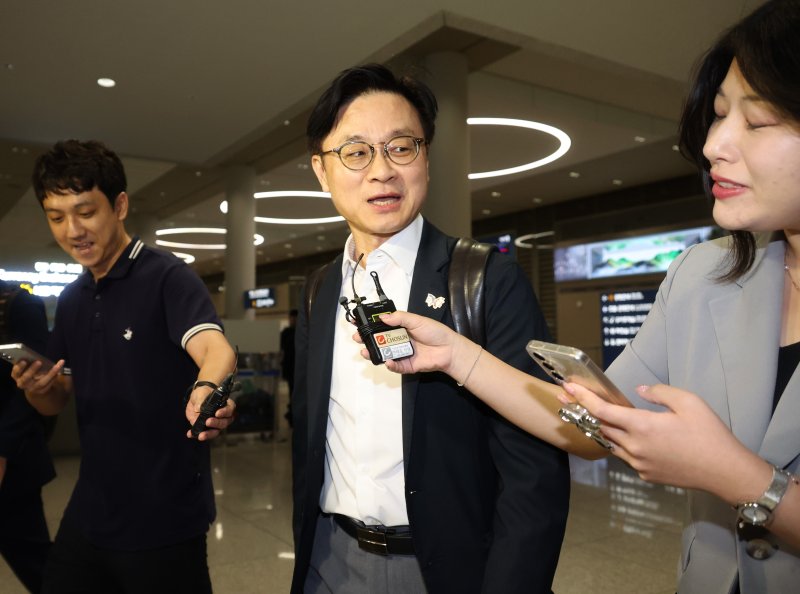
[Financial News] Kim Jeong-gwan, Minister of Trade, Industry and Energy, who visited the United States for follow-up consultations on US-Korea tariff negotiations, has returned. Minister Kim met with Howard Rutnick, US Secretary of Commerce, to coordinate details related to Korea's investment in the US, but did not disclose whether there was any progress in the consultations.
Arriving at Incheon Airport on the morning of the 14th, Minister Kim avoided specific answers to reporters' questions about the results of the negotiations as he exited the arrival hall. Previously, on the 12th (local time), Minister Kim met with Secretary Rutnick at a location in New York to attempt to reach an agreement on the structure, method, and profit distribution of Korea's promised investment in the US.
In the tariff negotiations last July, the US and Korea agreed to reduce the reciprocal tariff of 25% imposed by the US on Korea to 15%, in exchange for Korea pursuing a total investment of $350 billion (approximately 486 trillion won) in the US. Although this was confirmed in a broad framework at the US-Korea summit held at the White House last month, specific consultations have not yet been completed.
In this regard, a working-level consultation was held on the 8th in Washington DC between the joint working-level delegation of the Ministry of Trade, Industry and Energy and the Ministry of Strategy and Finance and the US Trade Representative (USTR), but it is known that they failed to narrow differences on the issue of investment in the US.
As a result, Minister Kim directly went to the US on the 11th to continue ministerial-level consultations with Secretary Rutnick. Regarding investment in the US, Korea is trying to minimize the proportion of direct investment and fill it with guarantees to reduce the burden, but the US is strongly demanding an expansion of direct investment. In the selection of investment targets, the US emphasizes its leadership, while Korea insists on a method where Korean companies make decisions after business feasibility reviews.
In the issue of profit distribution from investments, the US is pressuring Korea based on the example of negotiations with Japan. The US proposed a method where profits are split equally before the recovery of investment funds, but 90% of profits go to the US after recovery, which Korea finds unreasonable and difficult to accept. Additionally, the US is demanding the removal of non-tariff barriers in fields such as agriculture and digital, while Korea is trying to secure favorable conditions by presenting plans for industrial cooperation in areas like shipbuilding.
Meanwhile, Minister Kim is known to have reiterated concerns regarding the arrest and detention of 330 Korean workers at the Hyundai Motor Group-LG Energy Solution joint battery plant construction site in Georgia, USA. He emphasized that improving the visa system is necessary for Korean companies to invest stably in the US.
[email protected] Choi Yong-jun Reporter