Large Corporations: '6 out of 10 Companies Have No New Hires This Year'
- Input
- 2025-09-11 08:59:35
- Updated
- 2025-09-11 08:59:35
Recruitment Market for Large Corporations Shrinks Compared to Last Year
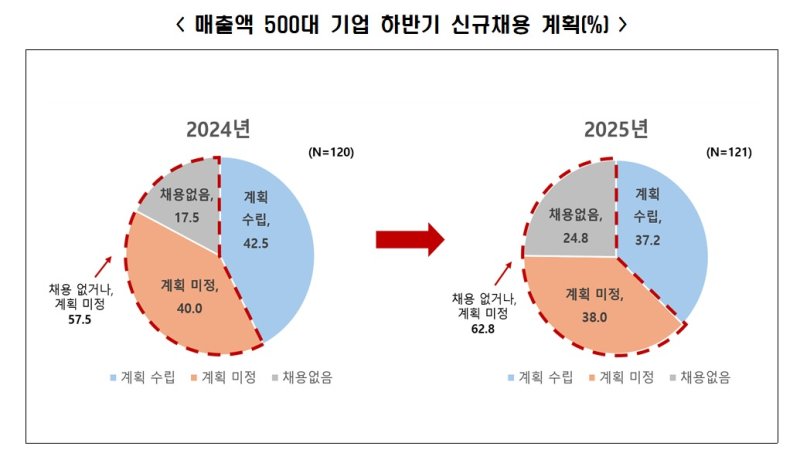
The Korea Economic Association (Hankyung-hyeop) commissioned Research & Research to survey the top 500 companies by sales (121 responding companies), and it was found that 62.8% have no plans for new hires in the second half of this year or are undecided. This is an increase of 5.3 percentage points compared to the second half of last year (57.5%). 'Undecided' decreased by 2.0 percentage points to 38.0%, and 'None' increased by 7.3 percentage points to 24.8%.
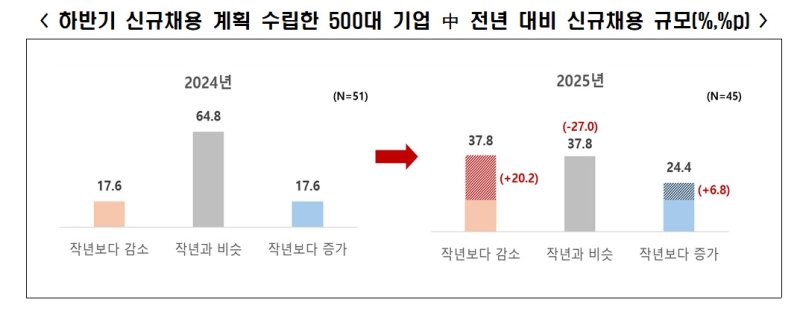
Among the companies that have established recruitment plans, 37.8% plan to reduce the scale compared to last year, and 24.4% plan to increase it. 37.8% plan to maintain a similar level. Companies reducing recruitment increased by 20.2 percentage points compared to the second half of last year, and those expanding increased by 6.8 percentage points.
Hankyung-hyeop analyzed, "The proportion of companies without recruitment plans in the second half of this year has increased significantly compared to last year, and the proportion of companies planning to reduce the scale among those with recruitment plans has also more than doubled compared to last year, raising concerns that the recruitment market will shrink compared to last year."
By industry, the proportion of undecided or no recruitment plans was high in construction and civil engineering (83.3%), food products (70.0%), steel and metal (69.2%), and petrochemicals and products (68.7%). These are mainly industries experiencing restructuring, economic downturns, and cost pressures.
The most cited reason for not hiring new employees or not increasing recruitment scale was 'management austerity to respond to increased internal and external uncertainties and deteriorating corporate profitability' (56.2%). This was followed by 'increased cost burden due to rising raw material prices and labor costs' (12.5%), and 'economic downturn due to prolonged global recession and high exchange rates' (9.4%).
Companies that responded they would increase new hires cited 'securing future talent regardless of economic conditions' (45.4%), 'increased demand for manpower in new industries or new job categories' (36.4%), and 'replacement due to existing workforce attrition' (18.2%) as reasons.
Challenges in new recruitment included 'difficulty finding talent that meets the required level' (29.4%), 'early resignation of recruits' (24.0%), 'attrition during the recruitment process' (19.3%), and 'many false applicants' (14.7%). 'Lack of talent in science and technology fields such as new industries and new technologies' was 2.9%. The job categories experiencing difficulties in securing manpower were research and development (35.9%), professional and technical positions (22.3%), and production and field positions (15.9%).
Policy tasks for promoting new graduate recruitment included 'inducing corporate investment and employment expansion through regulatory relaxation' (38.9%), 'expanding incentives for companies that increase employment' (22.3%), 'strengthening support for companies in new industry growth areas' (10.7%), and 'resolving mismatches between job seeker capabilities and employer needs' (10.7%).
Lee Sang-ho, head of the Economic and Industrial Headquarters of Hankyung-hyeop, emphasized, "Traditional core industries are losing vitality, and companies in new industry fields have not yet gained enough competitiveness to expand employment. In a situation where the management environment has become more difficult due to amendments to the labor and commercial laws, the government and the National Assembly should support companies' employment capacity through various regulatory relaxations and investment support."
[email protected] Reporter Cho Eun-hyo